
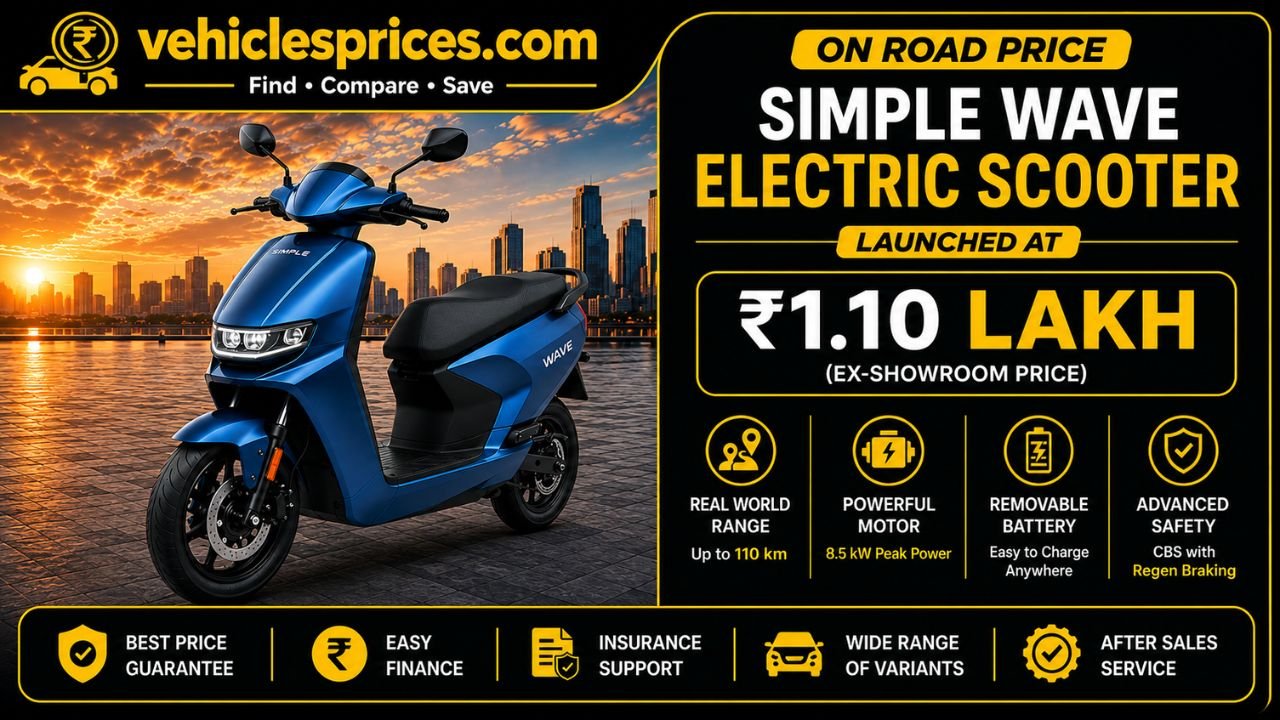
Simple Energy has officially launched the Simple Wave electric scooter in India, priced from ₹1,09,999 (ex-showroom) – arguably the most important launch on the Simple Energy scooter lineup’s 2026 calendar, and one that a large chunk of India’s family-commuter crowd has been waiting for since the sportier Simple One made its case for performance over practicality.
This isn’t a replacement for the Simple One. It sits alongside it, aimed at a completely different buyer. Same basic idea as any good family scooter – comfortable, spacious, easy to live with – but built around a dolphin-inspired design language, a 6-variant lineup across four battery capacities, and a seat long enough to be called India’s longest.
Simple Wave Launch and Delivery Date in India
Simple Energy officially launched the Simple Wave on September 2, 2026, confirming pricing and the full variant line-up. Customer deliveries are set to begin on September 25, 2026 – a fairly short gap between launch and delivery, and pre-launch walkaround videos had already been circulating ahead of the reveal, showing the scooter’s dolphin-themed design curves and its 70-litre storage layout in real life.
There’s a reason the company is moving quickly from reveal to delivery. Unlike several other EV launches in India that announce pricing months before a single unit reaches a customer, Simple Energy appears to want to convert launch-day interest straight into road-ready deliveries within weeks.
The dealership push backs that up too. Simple Energy is scaling up from its current 75 outlets to a footprint of 150-200 retail showrooms across India by the end of the fiscal year – a fairly reliable sign that the company is preparing its network to actually support deliveries at volume, not just take bookings.
Simple Wave Electric Scooter Specifications
| Quick Specifications of Simple Wave | Specifications Details & Reference Data |
| Ex-Showroom Price | ₹1,09,999 (Wave S 2.2 kWh, confirmed) to TBA (higher variants pricing not yet announced) |
| On-Road Price (Bengaluru Average) | ₹1,13,000 – ₹1,14,250 (Base Variant); higher variants’ on-road pricing not yet published |
| Variants & Battery Options | Wave S (Base): 2.2 kWh / 2.7 kWh — ₹1,09,999 onwards. Wave (Mid): 3.7 kWh — pricing TBA. Wave+ (Top): 5.0 kWh — pricing TBA |
| Powertrain Type | Fully Electric (no petrol/diesel/hybrid option) |
| Motor Output | 4.5 kW (Wave S 2.2 kWh) / 6.4 kW third-gen motor (all other variants) |
| Drivetrain | Mid-mounted motor driving the rear wheel via chain drive (not a hub motor — unlike most rivals) |
| Claimed IDC Range | Wave S 2.2 kWh: 110 km · Wave S 2.7 kWh: 132 km · Wave: 171 km · Wave+: 243 km |
| Top Speed | 75 km/h (Wave S variants) / 90 km/h (Wave & Wave+) |
| Suspension | Telescopic fork (front) + twin-shock, adjustable (rear) |
| Brakes | 220mm front disc + rear drum, CBS standard across all variants |
| Charging | 750W portable home charger included; Wave+ does 0–80% in ~2 hrs 15 mins on fast charging |
| Seating | Long single-piece flat seat designed for two adults (920mm) |
| Underseat Storage | 70 Litres, plus front apron compartments and accessory “Pill Storage” side pod |
| Safety Features | CBS (standard), GripSense traction control (higher variants only), hill-hold assist, fall alert, reverse mode, crawl mode |
| Colours | Pearl White, Coral Red, Twilight Black, Polar Blue, Dolphin Grey, Forest Green |
| Key Features | • 7-inch TFT (higher variants) / 7-inch LCD (base variants) console• Turn-by-turn navigation, smartphone connectivity• Geofencing, Timefencing, Theft Alert, Find My Scooter• Four ride modes on Wave/Wave+: Eco X, Eco, Ride, Sport (Wave S skips Sport)• Dolphin-inspired design with smile-shaped LED DRL |
simple wave scooter price in india
The Simple Wave lineup spans 6 models across 3 variants and 4 battery capacities, but only the introductory starting price has been officially announced so far: ₹1,09,999 (ex-showroom) for the entry-level Wave S with the 2.2 kWh battery. Simple Energy hasn’t revealed pricing for the higher variants yet.
| Variant | Battery | Claimed IDC Range | Top Speed | Ex-Showroom Price | Approx. On-Road Price (Bengaluru) |
| Wave S | 2.2 kWh | 110 km | 75 km/h | ₹1,09,999 (confirmed) | ₹1,13,000-₹1,14,250 |
| Wave S | 2.7 kWh | 132 km | 75 km/h | Not yet announced | Not yet announced |
| Wave | 3.7 kWh | 171 km | 90 km/h | Not yet announced | Not yet announced |
| Wave+ | 5.0 kWh | 243 km | 90 km/h | Not yet announced | Not yet announced |
That’s ex-showroom, not what you’ll actually pay to ride it home. For the confirmed base variant, adding insurance and registration charges pushes the on-road price to roughly ₹1,13,000-₹1,14,250 in Bengaluru – the exact gap depends heavily on which state you’re registering in and its EV subsidy structure. Once Simple Energy reveals pricing for the higher variants, their on-road figures will scale up accordingly, since insurance premiums rise with a vehicle’s declared value.
Why does this pricing matter? Because it’s really the whole point of the scooter. Most flagship electric scooters in India comfortably cross ₹1.3-1.5 lakh once you climb to their higher trims. So, keeping the Wave’s entry price under ₹1.1 lakh will satisfy the exact customer who felt priced out of the segment’s more premium offerings. A direct value comparison against rivals will only be fully possible once Simple Energy announces pricing for all six configurations.
Read Also: Maruti S Presso On Road Price – Petrol & CNG Compared
Simple Wave On-Road Price Structure
The Simple Wave On-Road Price price isn’t a random number your dealer picks. It’s built from two main parts on top of the ex-showroom figure, and understanding them helps you spot overcharging instantly.
Ex-showroom price: The factory-set base cost before any tax or fee – ₹1,09,999 for the confirmed base Wave S, as covered above.
Registration and road tax: Most states offer EV subsidies and road tax exemptions on electric two-wheelers, which is why the on-road premium over ex-showroom tends to be smaller than on a comparable petrol scooter.
First-year comprehensive insurance: Mandatory for every new two-wheeler – approximately ₹4,250 for the base variant, and expected to scale up for the higher-battery trims given their higher declared value once those prices are announced.
Because EV subsidy rules differ across states, the same Simple Wave variant can cost a few thousand rupees more or less depending purely on where you register it.
Simple Wave Scooter On-Road Price in Top Cities
City-wise on-road figures haven’t been published for the Wave yet. Based on the confirmed Bengaluru ex-showroom price of ₹1,09,999, the on-road price there is expected to land around ₹1,13,000 to ₹1,14,250 once insurance and registration are factored in. We’ll update this table with other cities and higher variants as official figures come in.
| City | Ex-Showroom Price | Approx. On-Road Price |
| Bengaluru | ₹1,09,999 | ₹1,13,000-₹1,14,250 |
| Other cities | Not yet published | Not yet published |
Why does this pricing matter? Because it’s really the whole point of the scooter. A sub-₹1.1 lakh starting price, combined with typically lower EV road-tax burden, keeps the Wave in reach of the exact family buyer who’s been priced out of bigger-battery electric scooters until now.
Simple Wave Scooter Features
Confirmed at launch, straight from the company:
| Feature | Availability |
| Console | 7-inch TFT (higher variants) / 7-inch LCD (lower variants) |
| Smartphone connectivity | Yes |
| SMS/Call alerts | Yes |
| Music Controls | Yes |
| Reverse Mode | Yes |
| Find My Scooter | Yes |
| Theft Alert | Yes |
| Geofencing and Timefencing | Yes |
| Hill Hold | Yes |
| Traction Control | Yes |
| Fall Alert | Yes |
| Crawl Mode | Yes |
Both console options offer turn-by-turn navigation, music controls, and call/SMS alerts alongside the connected features listed above. The Wave also gets four ride modes on most variants – Eco X, Eco, Ride, and Sport – though the base Wave S 2.2 kWh variant skips Sport mode and gets only Eco X, Eco, and Ride.
Read Also: Royal Enfield Himalayan 440 Launch Date, Price & Specifications
Simple Wave Battery and Performance
Pop the seat off and you’ll find one of four battery packs depending on which of the 6 variants you pick.
| Spec | Wave+ | Wave TFT/EBN | Wave S 2.7 kWh | Wave S 2.2 kWh |
| Battery Capacity | 5 kWh | 3.7 kWh | 2.7 kWh | 2.2 kWh |
| Motor Output | 6.4 kW | 6.4 kW | 6.4 kW | 4.5 kW |
| IDC Range | 243 km | 171 km | 132 km | 110 km |
| 0-40 km/h | 3.3 sec | – | – | – |
| Top Speed | 90 km/h | 90 km/h | 75 km/h | 75 km/h |
| Ride Modes | Eco X, Eco, Ride, Sport | Eco X, Eco, Ride, Sport | Eco X, Eco, Ride | Eco X, Eco, Ride |
The top-spec Wave+ has a claimed IDC range of up to 243 km, while the base Wave S 2.2 kWh offers a claimed range of 110 km. Both Wave S battery options (2.2 kWh and 2.7 kWh) top out at 75 km/h with three ride modes, while stepping up to the Wave or Wave+ unlocks a 90 km/h top speed and an additional Sport mode. Motor output also drops on the entry variant – the base Wave S 2.2 kWh runs a 4.5 kW motor, while every other variant in the range shares the same 6.4 kW motor regardless of battery size. These performance figures aren’t aimed at making the Wave a performance-oriented scooter, but they should be more than adequate for typical city riding and daily commuting.
Simple Wave Charging Time
Official range figures are IDC-rated, meaning real-world range will vary with load, speed, and riding style – the same caveat that applies to every electric two-wheeler’s claimed numbers. What Simple Energy has confirmed is the charging speed: the Wave+ goes from 0% to 80% in 70 minutes on fast charging. For home charging, every Wave ships with an included 750W portable charging unit, which comes with a built-in smart overnight protection mode designed to preserve long-term battery health.
Simple Wave Design and Styling: What the Walkaround Reveals
The Simple Wave’s pre-launch walkaround content paints a pretty complete picture at this point. Two influences are obvious: a deliberate break from the sporty, angular Simple One, and a fresh “dolphin-inspired” design brief.
Body panels. Smooth, curvy, fluid surfacing across the chassis, meant to resemble a dolphin silhouette rather than the sharp-edged look common across the segment. A wide front apron and a smile-shaped continuous LED DRL sit up front, with full LED lighting throughout.
Storage. This is where the Wave actually parts ways with most rivals – Simple Energy calls it the largest underseat storage in the segment. Total main storage is a 70-litre underseat boot, big enough to fit two full-size helmets. There’s also a quick-access “Pill Storage” compartment on the side panel for small essentials, though this is available as an accessory rather than standard fit, plus additional storage compartments built into the front apron.
Cockpit. Higher variants get a 7-inch TFT instrument console; lower variants get a 7-inch LCD console instead – both offering smartphone connectivity, turn-by-turn navigation, music controls, and call/SMS alerts.
The seat – genuinely the biggest talking point. At 920 mm, Simple Energy is calling this India’s longest scooter seat, engineered specifically for comfortable dual-rider family commutes rather than a solo-rider sporty perch.
Simple Wave Seat Height and Ergonomics
Seat height comes in at an accessible 775 mm – low enough to keep the Wave flat-footed-friendly for most Indian riders despite its unusually long 920 mm seat length. This is an important figure for the Indian market, where approachability is a strong factor in a family buyer’s decision-making, especially when the scooter is meant to be shared between riders of different heights.
Quick Ergonomics Snapshot
| Spec | Simple Wave |
| Seat Length | 920 mm (India’s longest, per the brand) |
| Seat Height | 775 mm |
| Ground Clearance | 175 mm |
| Water-Wading Capacity | 300 mm |
Simple Wave Suspension and Handling
Suspension duties are handled by a conventional telescopic front fork and a rear monoshock, mounted on a high-tensile tubular steel frame. Ground clearance comes in at 175 mm, and – notably for a country where monsoon flooding regularly strands two-wheelers – the Wave is rated for 300 mm of water-wading capacity, a figure aimed squarely at riders who need a scooter that survives a genuinely waterlogged street rather than just light rain.
The Wave rolls on 12-inch alloy wheels at both ends with 90-section tyres. Braking is handled by a 220 mm front disc paired with a rear drum, backed by Combined Braking System (CBS) and a traction control system to manage slip on wet roads – plus hill-hold assist and a Reverse mode for tight parking manoeuvres.
Simple Wave vs Simple One: What’s the Difference?
| Parameter | Simple Wave (Wave+ shown) | Simple One |
| Positioning | Family-focused, practicality-first | Sporty, performance-focused |
| Battery | Up to 5.0 kWh (4 pack options) | Not covered in this data |
| Claimed Range | Up to 243 km | Not covered in this data |
| Seat | 920 mm – India’s longest | Not covered in this data |
| Storage | 70L across 3 compartments | Not covered in this data |
| Starting Price | ₹1,09,999 | Not covered in this data |
We don’t have confirmed Simple One specifications in the data used for this article, so a full side-by-side isn’t possible yet – but the positioning gap is clear from Simple Energy’s own messaging: the One chases performance buyers, the Wave chases family and value buyers.
Bottom line: these aren’t competing for the same buyer. The Wave is for someone who wants space, range flexibility, and a low entry price without the sportier trade-offs of the One.
Simple Wave Scooter Rivals
The Simple Wave will rival the likes of the TVS iQube, Bajaj Chetak, Hero Vida VX2, and the newly launched Ather Konarc. Its combination of multiple variants, a claimed range of up to 243 km, and a long list of connected features makes it a strong proposition in the segment – positioned toward the more affordable, practicality-first end of the electric scooter market rather than the flagship, tech-forward end.
Why the Simple Wave Scooter Matters
Simple Energy built its early reputation on the Simple One – a scooter that leaned hard into performance numbers, chasing the same enthusiast crowd that flagship electric scooters from other manufacturers were courting. It was a fine strategy for generating headlines, but it left an entire segment of the market unaddressed: the buyer who doesn’t care about 0-40 times, and instead wants a scooter that can carry two people comfortably, swallow a week’s groceries, survive a flooded monsoon street, and not demand a second mortgage to buy.
The Wave reads like Simple Energy’s answer to that gap. A genuinely long seat instead of a sculpted sporty one. A 70-litre, three-way storage system instead of a single undersized boot. A starting price under ₹1.1 lakh instead of a flagship-chasing number. It isn’t trying to out-spec the One – it’s trying to be the practical, family-first electric scooter that a much larger share of India’s two-wheeler buyers have actually been asking for.
Frequently Asked Questions (FAQs)
Q1. When was the Simple Wave launched and when do deliveries begin?
The Simple Wave was launched in India on September 2, 2026, with customer deliveries scheduled to begin on September 25, 2026.
Q2. What is the starting price of the Simple Wave?
₹1,09,999 (ex-showroom) for the base Wave S 2.2 kWh variant – this is the only officially confirmed price so far; pricing for the other 5 configurations hasn’t been announced yet.
Q3. What is the on-road price of the base Simple Wave?
Approximately ₹1,13,000 to ₹1,14,250 in Bengaluru, including comprehensive insurance and registration; figures for other cities and higher variants aren’t published yet.
Q4. How many variants and battery options does the Simple Wave come with?
6 models across 3 variants and 4 battery capacities – Wave S (2.2 kWh and 2.7 kWh), Wave (3.7 kWh), and Wave+ (5 kWh).
Q5. What is the maximum range of the Simple Wave?
The flagship Wave+ with its 5 kWh battery pack offers a claimed IDC range of 243 km on a single charge.
Q6. How fast can the Simple Wave charge?
The Wave+ variant can go from 0% to 80% charge in 70 minutes using fast charging; a 750W portable home charger is also included.
Q7. What is the seat height and length of the Simple Wave?
Seat height is 775 mm, with a 920 mm seat length that Simple Energy calls the longest in the segment.
Q8. How much storage does the Simple Wave offer?
A 70-litre underseat boot – the largest in the segment – plus front apron storage compartments and an accessory “Pill Storage” side compartment.
Q9. What is the warranty on the Simple Wave?
A standard 3-year/30,000 km warranty covering the chassis, battery pack, and motor, extendable to 5 years/50,000 km.
Q10. How many colour options does the Simple Wave come in?
Six shades – Pearl White, Polar Blue, Forest Green, Coral Red, Twilight Black, and Dolphin Grey.
Q11. Where can I find a Simple Energy scooter showroom near me?
Check the official Simple Energy website for currently operational outlets – the network is expanding from 75 to 150-200 showrooms across India by the end of the fiscal year.
Q12. Is there a Simple Wave electric scooter review available yet?
Not yet. The Wave launched on September 2, 2026, but deliveries only begin September 25, 2026, so independent, ridden reviews haven’t been published – only launch-day and walkaround coverage is available so far.
Q13. Who are the Simple Wave’s main rivals?
The TVS iQube, Bajaj Chetak, Hero Vida VX2, and the newly launched Ather Konarc.
Source: Simple Energy





Leave a Reply