September 4 is circled on a lot of calendars right now. That’s the day Royal Enfield finally pulls the wraps off the Royal Enfield Himalayan 440 – arguably the most anticipated launch on the brand’s 2026 calendar, and one that a fairly vocal chunk of the Himalayan 411 crowd has been asking for since the 450 arrived.
Here’s the short version, if you’re in a hurry: it’s not a replacement for the Himalayan 450. It sits below it. Same basic idea as the old 411 – simple, air-cooled, easy to live with – but built on the newer Scram 440 platform, with a few changes to make it more off-road capable than its road-biased sibling.
Below, we’ve combined everything we know now-launch date, expected price, engine specs, details from the spy photos, seat height, mileage estimates, competitors, and a frequently asked questions list-and we’ll update it as more details emerge.
Royal Enfield Himalayan 440 Launch Date in India
Royal Enfield has confirmed the Himalayan 440 launches in India on September 4, 2026. It’s not a rumour or a “likely window” anymore – the date “04.09.2026” is sitting right there on the brand’s own Himalayan 440 microsite.
There’s a reason this particular date was picked. September 2026 marks ten years since the original Himalayan 411 went on sale back in 2016, and Royal Enfield seems to want the anniversary and the new launch to land together – probably not a coincidence.
The venue backs that up too. Reports point to the newly built Royal Enfield Himalayan Basecamp in Leh, Ladakh as the launch location. For a bike literally named after this mountain range, it’s hard to think of a more fitting backdrop.
In the last week or so, dealership sightings have started popping up across the country – a fairly reliable sign that stock is already moving ahead of the reveal, and that deliveries probably won’t take too long once pricing is announced.
Read Also: Maruti S Presso On Road Price – Petrol & CNG Compared
Royal Enfield Himalayan 440 Expected Price
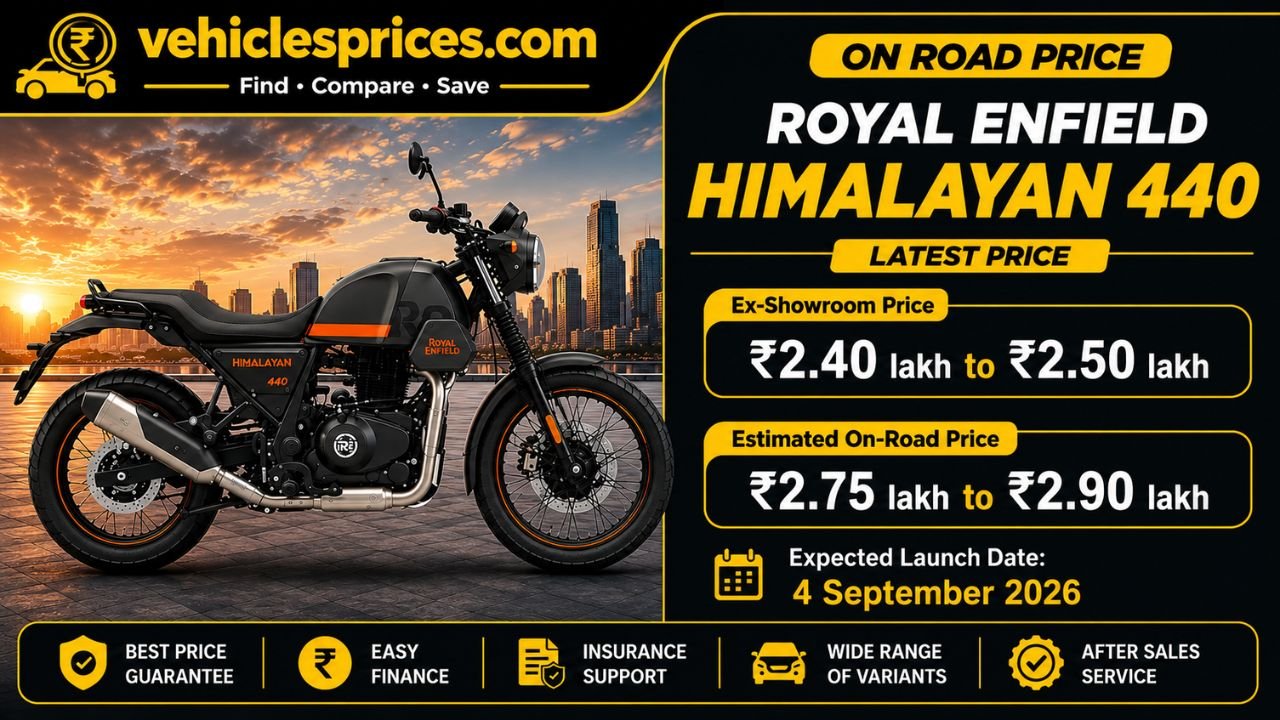
Though nobody outside Royal Enfield knows the final number, the consensus among dealer sources and auto publications is pretty much tight on where the Royal Enfield Himalayan 440 price in India is likely to open. Expect it to start at around ₹2.40 lakh and peak near ₹2.50 lakh (ex-showroom).
| City | Expected Starting Price (Ex-showroom) |
| Mumbai | ₹2,45,000 onwards |
| Delhi | ₹2,43,000 onwards |
| Bangalore | ₹2,40,000 onwards |
| Pune | ₹2,36,000 onwards |
| Hyderabad | ₹2,40,000 onwards |
| Chennai | ₹2,35,000 onwards |
| Kolkata | ₹2,40,000 onwards |
| Lucknow | ₹2,42,000 onwards |
That’s ex-showroom, not what you’ll actually pay to ride it home. Add RTO registration, insurance, and state road tax, and the Royal Enfield Himalayan 440 on road price typically lands somewhere ₹15,000–₹40,000 higher than the figures above – the exact gap depends heavily on which state you’re registering in.
Why does this pricing matter? Because it’s really the whole point of the bike. The Himalayan 450 is a great motorcycle however, but it is not cheap to buy and to maintain as compared to the old 411. So, keeping the 440’s price near 2.5 lakhs will satisfy the exact customer who might have felt that he is paying too much for the 450.
Royal Enfield Himalayan 440 On Road Price Structure
The on-road price isn’t a random number your dealer picks. It’s built from three clear parts, and understanding them helps you spot overcharging instantly.
- Ex-showroom price: The factory-set base cost before any tax or fee — the ₹2.40–2.50 lakh range covered above.
- RTO registration and road tax: A percentage of the ex-showroom price, and this percentage changes from state to state.
- First-year comprehensive insurance: Mandatory for every new two-wheeler, and the premium depends on your city, your age, and any add-on covers you choose.
Because RTO tax rules differ across states, the same Himalayan 440 variant can cost thousands of rupees more or less depending purely on where you register it. So the Royal Enfield Himalayan 440 on road price you see in one city may not match what a friend paid elsewhere, even for the identical trim.
Royal Enfield Himalayan 440 On Road Price in Top Cities
Here’s how the base variant (expected ex-showroom ₹2.40 lakh) roughly compares on-road across a few major cities, once RTO and insurance are factored in:
| City | Ex-Showroom Price (Expected) | Approx. On-Road Price |
| Delhi | ₹2,40,000 | ₹2,58,000 onwards |
| Mumbai | ₹2,40,000 | ₹2,65,000 onwards |
| Bangalore | ₹2,40,000 | ₹2,70,000 onwards |
| Pune | ₹2,40,000 | ₹2,66,000 onwards |
| Chennai | ₹2,40,000 | ₹2,68,000 onwards |
| Hyderabad | ₹2,40,000 | ₹2,62,000 onwards |
| Kolkata | ₹2,40,000 | ₹2,60,000 onwards |
| Lucknow | ₹2,40,000 | ₹2,63,000 onwards |
Why does this pricing matter? Because it’s really the whole point of the bike. The Himalayan 450 is a genuinely impressive motorcycle, but it’s also expensive to buy and expensive to maintain relative to the old 411. Pricing the 440 close to ₹2.5 lakh keeps it in reach of the exact buyer who felt priced out when the 450 arrived.
Read Also: Mahindra Thar Roxx Price 2026: Ex-Showroom & On-Road Price
Royal Enfield Himalayan 440 Features
What we’re fairly confident about, based on spy shots and reporting so far:
- Analogue speedometer with digital LCD inset
- Tripper navigation pod (possibly optional, not standard)
- Switchable dual-channel ABS
- Six-speed gearbox
- 21-inch front / 17-inch spoked wheels, tubed tyres
- Telescopic front forks, linked rear monoshock
- Tall windscreen
- LED tail-light, minimalist indicators
- Round rear-view mirrors
No TFT screen, no ride-by-wire, no riding modes – and that’s the point. This is a “keep it simple” bike by design, not by budget constraint.
Royal Enfield Himalayan 440 Engine and Performance
Pop the tank off (hypothetically) and you’ll find the same 443cc, air-oil-cooled, single-cylinder LS440 engine that does duty in the Scram 440. It’s a bored-out evolution of the old LS410 unit from the 411 and Scram 411 – 3mm extra bore, translating into a modest but real bump in output.
On the Scram, this engine puts out 24.5–25.4bhp at 6,250rpm and 34–34.5Nm at 4,000rpm. Royal Enfield may retune it slightly for the Himalayan’s more off-road-oriented character, but don’t expect a big swing either way. Compared to the old Himalayan 411’s 24.5bhp/32Nm, it’s an incremental gain rather than a leap – though the real story isn’t the peak numbers anyway.
It’s the gearbox. The Himalayan 440 gets a six-speed unit, up from the 411’s five-speed – and this is the change actual owners will feel every day. Highway cruising was the 411’s weak spot; buzzy, breathless, and tiring past 90kmph. An extra ratio should ease that considerably on long stretches.
One more thing worth clearing up: despite “440” sounding like it belongs next to the liquid-cooled Sherpa engine in the 450, it doesn’t. This is still an air-oil-cooled motor. That’s deliberate – simpler to service, cheaper to own, and more in line with what long-time Himalayan 411 owners actually wanted back.
Royal Enfield Himalayan 440 Mileage
Official ARAI figures aren’t out yet – those only get certified closer to or at launch – but the Scram 440, running the same engine, typically returns somewhere in the 30–35 kmpl range in real-world use. Expect the Himalayan 440 to land in roughly the same zone, with the caveat that different gearing, bigger front wheel, and off-road-biased weight distribution could nudge the number either way slightly.
The sixth gear should help highway efficiency too, since the engine can sit at lower RPM for a given cruising speed than the old five-speed 411 ever managed. We’ll swap in confirmed ARAI numbers here the moment Royal Enfield releases them.
Royal Enfield Himalayan 440 Design and Styling: What the Spy Shots Reveal
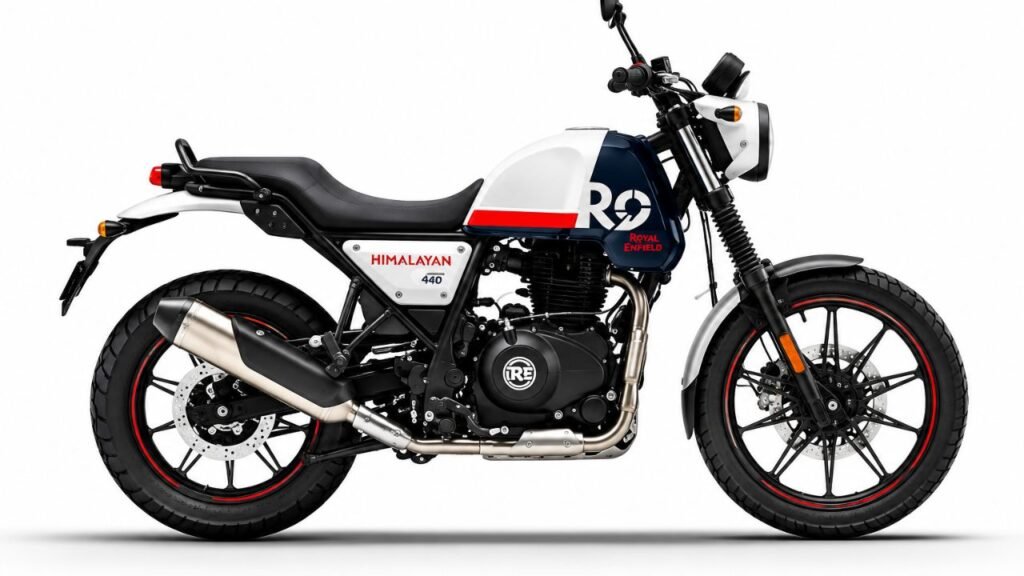
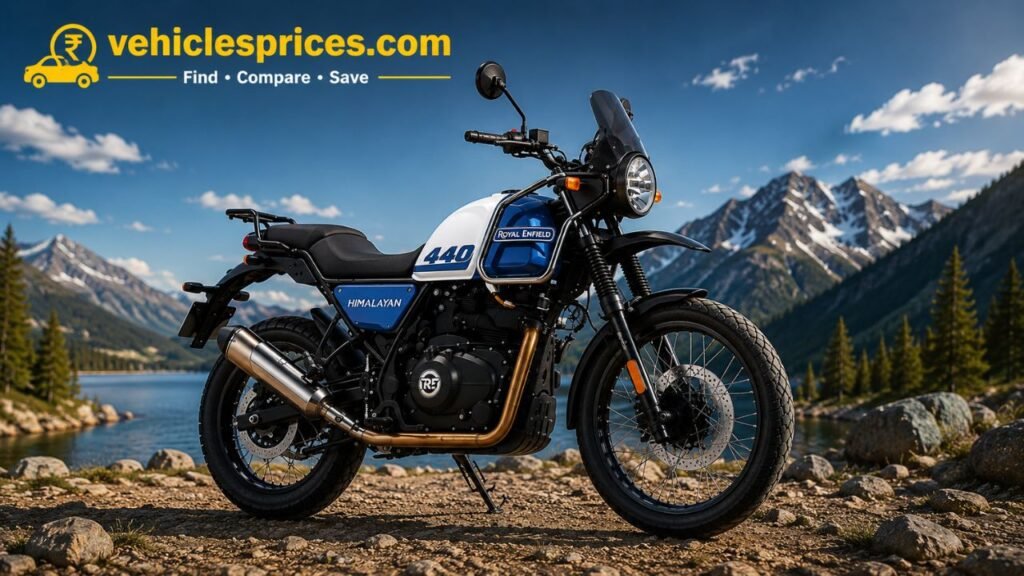
The Royal Enfield Himalayan 440 spy shots doing the rounds – including a batch shot at a dealership ahead of launch – paint a pretty complete picture at this point. Two influences are obvious: the old 411’s silhouette, and the current Scram 440’s hardware.
Rear end. Almost a carbon copy of the 411/Scram 440 – a simple rear fender, small indicators, a plain tail-light, and an exhaust that looks built to survive a few rock strikes rather than to look pretty.
Wheels and tyres. This is where the Himalayan 440 actually parts ways with the Scram. Expect a classic 21-inch front, 17-inch rear spoked setup on tubed Ceat Grip XL dual-purpose tyres – 90-section front, 120-section rear. The Scram runs a smaller 19-inch front, which is fine for tarmac but less confidence-inspiring over rocks and ruts. The bigger front wheel on the Himalayan rolls over obstacles more calmly, which is really the whole reason this variant exists.
Cockpit. A high, single-piece handlebar, silver-finished clutch and brake levers, round mirrors lifted straight off the Scram 440, and a tall windscreen for wind protection at speed.
The console – genuinely the biggest talking point. Instead of carrying over the 411’s much-loved multi-dial cluster, the 440 borrows the Scram 440’s layout wholesale: a mostly analogue speedometer with a small digital LCD inset for odometer, trip meter, fuel level, and gear position. It’s cleaner, more modern, arguably more useful day-to-day – but if you’re someone who thought the old 411’s dashboard was part of its charm, this might feel like a downgrade. A Tripper navigation pod sits to the right of the speedo, though several reports suggest it could be an optional accessory rather than standard fit. There’s a small RE badge underneath it.
Royal Enfield Himalayan 440 Seat Height and Ergonomics
While there are no official specs yet, it should come as no surprise that the seat height will be right around the approachable 411’s 800mm range, with the Scram 440 being slightly lower at 795mm. This is an incredibly important figure for the Indian market where the average height is lower than in the European or American market, making approachability a strong factor in buyer’s decision-making.
That is not to say that the Himalayan 450’s 825mm+ height isn’t approachable, because it isn’t. In fact, many buyers were put off by the Himalayan’s height when it launched, even if it provided excellent agility on the go. On the other hand, the 800mm will be perfectly flat-footed for most Indian buyers and even be a first-time adventure bike for many.
Read Also: Swift Dzire On Road Price 2026: City-Wise List & CNG Cost
Quick Ergonomics Comparison
| Model | Seat Height | Approx. Kerb Weight |
| Himalayan 411 (Old) | 800mm | ~199kg |
| Scram 440 | 795mm | ~190kg |
| Himalayan 450 | 825mm (standard) | ~196kg |
| Himalayan 440 (Expected) | ~800mm | TBA |
Royal Enfield Himalayan 440 Suspension and Handling
Expect telescopic front forks paired with a linked rear monoshock – the same basic architecture the 411 pioneered for Royal Enfield back in 2016. The travel figures and adjustability might shift slightly to balance road comfort against off-road ability, but don’t expect a radical rethink here.
Braking should be discs front and rear with dual-channel ABS, switchable at the rear – meaning you can turn rear ABS off for proper off-road braking control, same as on the Scram 440 and Himalayan 450.
Royal Enfield Himalayan 440 vs Himalayan 450: What’s the Difference?
| Parameter | Himalayan 440 (Expected) | Himalayan 450 |
| Engine | 443cc, air-oil-cooled, single-cylinder | 452cc, liquid-cooled, DOHC Sherpa engine |
| Power | ~25bhp | ~40bhp |
| Torque | ~34Nm | ~40Nm |
| Gearbox | 6-speed | 6-speed |
| Front Suspension | Telescopic forks | USD forks (43mm) |
| Instrument Cluster | Analogue-digital | Full TFT display |
| Seat Height | ~800mm | 825–845mm |
| Expected Price | ~₹2.40–2.50 lakh | Meaningfully higher |
| Positioning | Simple, accessible ADV | Premium, tech-loaded ADV |
Bottom line: these aren’t competing for the same buyer. The 440 is for someone who wants the badge, the look, and the go-anywhere reputation without the running costs or complexity of the 450.
Royal Enfield Himalayan 440 Rivals
| Rival | Approx. Price (Ex-showroom) | Engine |
| Yezdi Adventure | ₹2.10–2.55 lakh | 334cc, liquid-cooled |
| KTM 390 Adventure | ₹3.60 lakh+ | 399cc, liquid-cooled |
| Suzuki V-Strom SX | ₹2.10–2.30 lakh | 249cc, liquid-cooled |
| BSA Thunderbolt (launching Dec 2026) | TBA | TBA |
| Himalayan 440 (Expected) | ₹2.40–2.50 lakh | 443cc, air-oil-cooled |
Royal Enfield’s real advantage here isn’t spec-sheet numbers – the KTM and Yezdi both out-power it on paper. It’s the brand’s service network, resale value, and the sheer pull of the Himalayan name among Indian adventure riders. That counts for a lot when you’re planning a Ladakh trip and want to know parts and mechanics won’t be a problem three states away from home.
Why the Royal Enfield Himalayan 440 Matters
When the Himalayan 450 replaced the 411, it brought a genuinely impressive set of upgrades – liquid cooling, USD forks, a DOHC head, ride-by-wire, a full TFT dash. Reviewers loved it. But a meaningful chunk of the old 411’s fanbase didn’t feel the same way. It got heavier, pricier, and – for some – a bit too sophisticated for a bike that was originally supposed to be simple and cheap to fix on the side of a mountain road.
The 440 reads like Royal Enfield’s answer to that complaint. Simpler engine, familiar looks, a price that doesn’t require a second thought. It’s not trying to out-spec the 450 – it’s trying to be the 411’s actual successor in spirit, even if the 450 technically wears that title on paper.
Frequently Asked Questions (FAQs)
1. What is the launch date of the Royal Enfield Himalayan 440?
September 4, 2026, at the Royal Enfield Himalayan Basecamp in Leh, Ladakh.
2. What will be the price of the Royal Enfield Himalayan 440 in India?
Expected to be in the ₹2.40–2.50 lakh (ex-showroom) range, though official pricing is confirmed only at launch.
3. What engine does the Royal Enfield Himalayan 440 use?
A 443cc, air-oil-cooled, single-cylinder LS440 engine – shared with the Scram 440 – producing around 25bhp and 34Nm, paired with a six-speed gearbox.
4. What is the expected mileage of the Royal Enfield Himalayan 440?
Likely in the 30–35 kmpl range, similar to the Scram 440, though official ARAI figures aren’t out yet.
5. How is the Himalayan 440 different from the Himalayan 450?
Simpler air-oil-cooled engine, lower price, more basic analogue-digital cluster – versus the 450’s liquid-cooled engine, TFT display, and higher price.
6. What is the expected seat height of the Royal Enfield Himalayan 440?
Around 800mm, close to the old Himalayan 411’s figure, and noticeably lower than the 450’s 825mm+.
7. Does the Royal Enfield Himalayan 440 get Tripper navigation?
Spy shots show the Tripper pod on the console, but it may end up as an optional accessory rather than standard fit.
8. What are the rivals of the Royal Enfield Himalayan 440?
Yezdi Adventure, KTM 390 Adventure, Suzuki V-Strom SX, and the upcoming BSA Thunderbolt.





Leave a Reply