Few motorcycles in India’s crowded modern-classic segment pull off heritage styling and daily usability without compromise – the Jawa 42 does. Classic Legends didn’t just revive a name; they built the 42 into the brand’s front door, a roadster that steals the round headlamp, teardrop tank, and upright stance straight from old-school Jawas and bolts on genuinely modern hardware underneath. The “All Stars” line is the sharpest visual statement this bike has ever made, and All Stars Black is the shade everyone reaches for first.
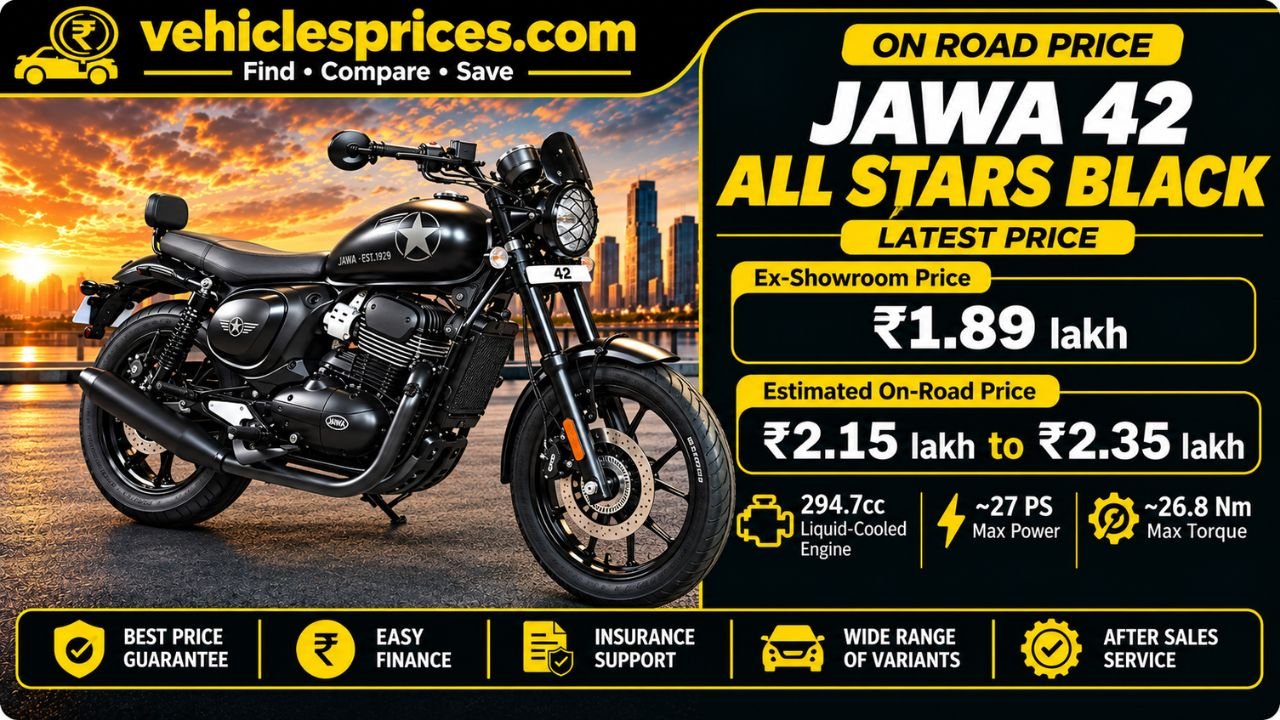
The Jawa 42 All Stars Black costs Rs 1,89,942 ex-showroom – the priciest of the five All Stars colourways on the standard 42. Mechanically it’s identical to every other shade: a 294.7cc liquid-cooled single making roughly 27 PS and 26.8 Nm, a six-speed gearbox, dual-channel ABS, tubeless tyres, and a circular LCD console with USB charging. The only thing that changes is the finish – a fully blacked-out treatment that strips chrome and drenches the tank and alloys in dark paint, making it the most cohesive-looking bike in the range. It goes head-to-head with the Royal Enfield Classic 350 and Meteor 350 on price and positioning.
Full Specification Sheet
| Parameter | Specification |
| Engine | 294.7cc, single-cylinder, liquid-cooled, DOHC |
| Max Power | ~27 PS @ 7,950 rpm |
| Max Torque | ~26.3–26.8 Nm @ 6,000 rpm |
| Gearbox | 6-speed, constant mesh |
| Frame | Double cradle |
| Front Suspension | Telescopic fork, Ø35mm |
| Rear Suspension | Twin shock absorbers, gas-filled, adjustable preload |
| Brakes | 280mm front disc / 240mm rear disc, dual-channel ABS |
| Tyres | 90/90-18 front / 120/80-17 rear, tubeless (spoke tube-type also offered) |
| Kerb Weight | 182–184 kg |
| Fuel Tank | 13.2 litres |
| Wheelbase | 1,369mm |
| Seat Height | 788mm (approx.) |
| Mileage | 32–33 kmpl (user-reported) |
Minor variances exist across sources due to rounding; treat the above as the most reliable current picture.
The double-cradle frame doesn’t chase agility – it chases stability, and it gets it. Kerb weight runs 182-184 kg on most trims, lighter still on some – that puts it below the vast majority of comparable cruiser-style bikes in the segment, and it shows the moment you’re threading through parking-lot traffic. At highway speed, that same weight stops being a liability and starts working for you – planted through crosswinds, unbothered by rough patches. A 1,369mm wheelbase keeps the turning circle tight enough to make dense city traffic feel manageable rather than exhausting – which, let’s be honest, is where most 42 owners actually spend their time.
Why Jawa Refreshed the 42: The All Stars Story
Classic Legends didn’t just slap a new coat of paint on the 42 and walk away. All Stars is a design philosophy shift that now runs across the whole Jawa-Yezdi portfolio – the 42, the 42 FJ, and the 42 Bobber all wear it. The idea started as a sharper, sportier read on the neo-classic Jawa, then hardened into full factory-custom character on the bikes that followed.
Five new shades land on the standard 42: All Stars Ivory, Nebula Blue, Moss Grey, Battle Green, and Black – the original black-and-ivory dual-tone sticks around as the entry option. That’s a real shift in intent. Instead of one “black bike,” buyers now pick a mood – understated Moss Grey on one end, uncompromising All Stars Black on the other. And this isn’t a one-off paint job: the 42 FJ picked up six colours, the 42 Bobber five. All Stars is Jawa’s language now, not a limited-run gimmick.
All Stars Black: First Impressions
Among the colourways, All Stars Black sits at Rs 1,89,942 – the most expensive on the standard 42, ahead of Nebula Blue, Moss Grey, and Battle Green, and a clean Rs 10,000 above the entry dual-tone.
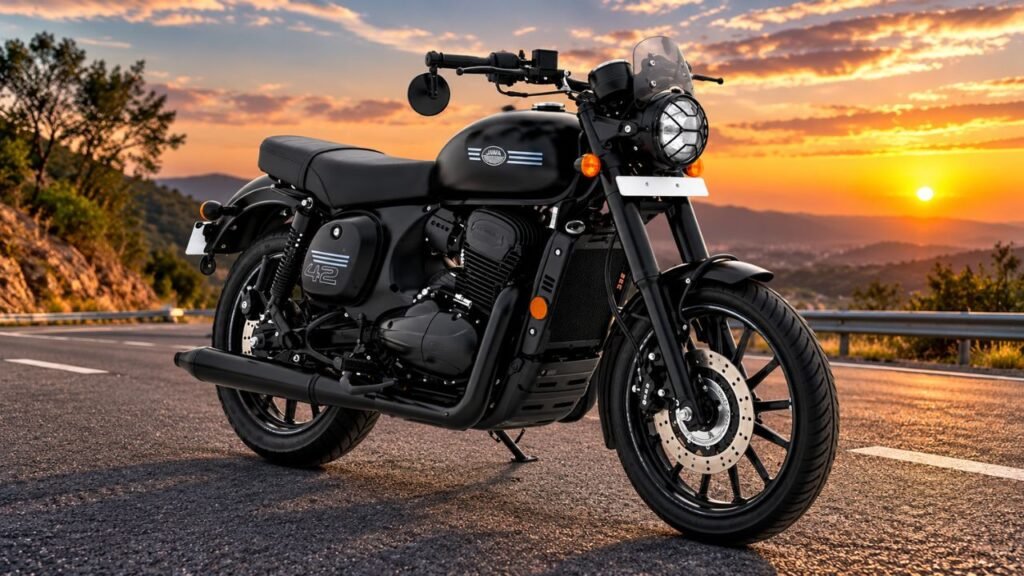
The premium isn’t paint depth alone – it’s the whole hardware package that gets darkened to match. The entry dual-tone keeps brightwork and contrasting panels; All Stars Black kills all of that. Dark engine casings, black alloys, chrome stripped down to almost nothing – the silhouette tightens up and reads as deliberate rather than decorative. The teardrop tank, round LED headlight, and single-piece bench seat all carry over untouched, but on the Black variant they’re drenched in a deep matte or gloss finish, broken up only by contrasting graphics and All Stars branding on the side panels.
Design and Styling
- Tank and bodywork: The teardrop tank – Jawa’s most recognisable design cue – carries a deep black base with pinstripe detailing that pays homage to 1970s-era Jawas. Its rounded, slightly bulbous profile has been preserved faithfully across the All Stars refresh, and on the Black variant it typically wears All Stars badges that catch the light without overwhelming the overall design.
- Lighting and instrumentation: A circular LCD console displays speed, revs, fuel level and trip data, along with a USB charging port built into the handlebar area. This keeps the classic aesthetic intact while housing genuinely useful modern data – useful for anyone relying on phone-based navigation on longer rides.
- Seat and ergonomics: The single-piece bench seat comfortably fits rider and pillion, with enough fore-aft room for taller riders to stretch out on the highway or shift forward through corners. Seat height stays accessible enough that most riders, even shorter ones, can plant both feet firmly at a standstill.
- Wheels and brakes: The front wheel uses a 90/90-18 tubeless tyre and the rear a 120/80-17 tubeless tyre, both on alloy rims. Disc brakes at both ends come with dual-channel ABS as standard, giving confidence-inspiring stopping power on wet or uneven roads – a genuine safety edge over rivals that still treat ABS as an optional extra.
Engine and Performance
Underneath the fresh paint, nothing’s changed – and Jawa didn’t need to change it. Power comes from a 294.7cc, single-cylinder, liquid-cooled DOHC engine punching out roughly 27 PS at 7,950 rpm and 26.3–26.8 Nm at 6,000 rpm, paired with a six-speed gearbox and fuel injection at 11:1 compression. Jawa’s own numbers put it at 27.3 PS and 26.8 Nm; a launch-day report reads it slightly lower at 26.9bhp – but every source agrees on one thing: the All Stars edition runs the exact same engine as the regular 42, nothing softened, nothing dialled back for the paint job.
User-reported mileage lands around 32-33 kmpl. Pair that with the 13.2-litre tank and you’re looking at 350km-plus on a single fill – this isn’t a bike built to sit pretty in a showroom, it’s built to be ridden hard on a weekend run and not bleed you dry doing it.
Exhaust note matters disproportionately to retro buyers, and Jawa knows it – the twin-upswept exhaust delivers a burble that’s become part of the brand’s identity. The engine itself, sometimes nicknamed “J-Panther” by enthusiasts, doesn’t chase top-end drama. Peak torque lands at a moderate 6,000 rpm, so the bike never needs to be thrashed to feel alive – short-shift through traffic or hold a gear on the highway, it stays responsive either way.
Features and Technology
- Digi-analogue instrument cluster – mixes an analogue dial face with a digital LCD insert for speed, revs, fuel, and trip data.
- USB charging – handlebar-mounted port for phones and GPS units.
- Dual-channel ABS – standard across the range, a genuine edge over rivals that restrict it to higher trims.
- Slip-and-assist clutch – featured on the larger-displacement 42 FJ and 42 Bobber (334cc), though not always advertised as prominently on the standard 294.7cc 42.
- LED lighting – round LED headlamp paired with LED tail-lamp treatment.
- Twin-pod switchgear and grab rail – small ergonomic details that round out the package.
Colours and Pricing
| Colourway | Ex-Showroom Price (Delhi) | Notes |
| Black and Ivory (dual-tone) | Rs 1,79,942 | Entry option |
| All Stars Ivory | Rs 1,84,942 | Classic light shade |
| All Stars Nebula Blue | Rs 1,86,942 | Mid-tier |
| All Stars Moss Grey | Rs 1,86,942 | Mid-tier |
| All Stars Battle Green | Rs 1,86,942 | Mid-tier |
| All Stars Black | Rs 1,89,942 | Flagship, blacked-out hardware |
These are ex-showroom Delhi figures – and on-road pricing swings hard by city. One comparable black-trim estimate ran Rs 2.21 lakh in Mumbai and Rs 2.52 lakh in Bangalore. State taxation alone can add tens of thousands to the number you actually pay.
Beyond the standard 42, the All Stars treatment doesn’t stop:
- 42 FJ All Stars (334cc Alpha2 engine): six colours – Chrome, Matte Black with Red/Black Clad, Nebula Blue, Aurora Green, Red Silver – from roughly Rs 2.01–2.08 lakh.
- 42 Bobber All Stars (334cc engine): five colours – Black Mirror, Shadow Black, Silver Knight, Jasper Red, Mystic Copper – from roughly Rs 2.08–2.20 lakh.
If you want black-on-black without spending big, the standard 42’s All Stars Black is the cheapest way in. The Bobber’s Shadow Black pushes further into single-seat menace; the FJ’s Matte Black variants go street-tracker on the bigger 334cc motor.
How the Three Black Options Compare
Since Jawa now offers several “black” variants across its 42 sub-family, it’s worth understanding how they differ beyond paint depth:
- Standard 42 All Stars Black: smaller 294.7cc engine, upright roadster posture, lowest price of the three black-themed options, dual-seat layout suited to daily commuting.
- 42 Bobber Shadow Black: dark chassis, engine, and seat combined with a contrasting dark grey tank, built around a single-seat bobber silhouette rather than the 42’s conventional dual-seat stance.
- 42 FJ Matte Black variants: street-tracker aesthetic with red or black cladding on top of the larger 334cc Alpha2 engine, positioned between the standard 42 and the Bobber on both price and performance.
For most buyers, the standard 42 All Stars Black wins outright – it’s the cheapest way in, the most practical for daily riding thanks to neutral ergonomics, and it still delivers the blacked-out menace that made you click on this article in the first place.
Ride Quality and Everyday Usability
The engine’s low-and-mid-range torque bias forgives everything traffic throws at it – no constant gear-hunting, no stalling out at a light. The suspension eats potholes and expansion joints without complaint, and the riding position – relaxed, slightly forward-leaning, not upright like a pure commuter and nowhere near as aggressive as a café racer – works whether you’re doing a five-kilometre office run or chasing a sunset up to a hill station.
Nothing underneath has changed with the All Stars refresh – engine, transmission, suspension, brakes, dimensions, all carried over untouched. That means the ride quality reputation the 42 already earned transfers straight through to every new colourway, Black included. Buyers worried that a “cosmetic refresh” means compromised fundamentals can stop worrying.
Competition: Where It Sits in the Market
The Jawa 42 has carved its own lane in the retro-modern segment, going up against the Royal Enfield Classic 350 and Honda H’ness CB350. One launch-day report throws the Meteor 350 into the mix too, naming both Royal Enfields as direct competition.
| Model | Engine | Power | Approx. Ex-Showroom Price | Positioning |
| Jawa 42 All Stars Black | 294.7cc, liquid-cooled | ~27 PS | Rs 1,89,942 | Design-forward neo-retro roadster |
| Royal Enfield Classic 350 | 349cc, air-cooled | ~20.2 PS | ~Rs 1,87,000+ | Segment benchmark, chrome-heavy classic |
| Royal Enfield Meteor 350 | 349cc, air-cooled | ~20.2 PS | ~Rs 2,05,000+ | Relaxed cruiser stance |
| Honda H’ness CB350 | 348cc, air-cooled | ~21 PS | ~Rs 2,10,000+ | Refined build, wider service network |
Prices above are indicative and vary by city – confirm current on-road pricing with local dealers.
Against the Classic 350, the 42 wins on engine character – liquid-cooling revs freer than Royal Enfield’s air-cooled thump, and Black’s monochrome treatment stands apart from RE’s chrome-and-paint playbook. Against the Meteor, it’s an ergonomics fight – the Meteor’s forward pegs and cruiser stance buy highway comfort at the cost of manoeuvrability, while the 42 stays nimbler in traffic. Against the Honda CB350, Honda wins on build quality and dealer reach, but Jawa hits back with sharper styling and a lighter kerb weight. Inside the Jawa-Yezdi family, the Yezdi Roadster and Scrambler share the same bones under different bodywork – worth a look too.
Ownership Costs and Practical Considerations
- Service intervals: First service after roughly 500–1,000 km or one month, then every 3,000–5,000 km or three to six months.
- Warranty: Jawa’s listing for the 42 FJ confirms a standard 4-year/50,000km warranty, extendable to 6 years, with 1 year of complimentary roadside assistance. This structure is typically applied consistently across the 42 family – confirm exact terms with your dealer.
- Fuel costs: With 32–33 kmpl mileage and a 13.2-litre tank, running costs stay reasonable for a 300cc motorcycle.
- Insurance and on-road costs: As the priciest standard-42 colourway, expect insurance premiums to track slightly higher than the entry dual-tone variant.
- Resale value: Jawa has had a mixed resale reputation compared to Royal Enfield, though the All Stars push may help improve residuals over time.
- Accessories and customisation: Jawa offers official accessories – touring seats, crash guards, panniers, and cosmetic add-ons – through its dealer network, letting All Stars Black owners personalise further without straying from the factory-supported ecosystem.
Who Should Buy the All Stars Black?
- Riders who want a distinctive, blacked-out roadster look without stepping up to the pricier 42 FJ or 42 Bobber
- Those who split riding fairly evenly between commuting and occasional touring, and want one bike that handles both without compromise
- Buyers who prefer a torquey, liquid-cooled engine over the thumpier, more traditional character of air-cooled rivals
- Anyone who values USB charging, dual-channel ABS, and tubeless tyres without wanting a fully digital, tech-heavy dashboard
- Buyers shopping in the roughly Rs 1.85–2.25 lakh on-road bracket who want the most premium-looking colour in the standard 42 lineup
- Riders who want to keep servicing and running costs modest – a 300cc engine with 32-33 kmpl mileage is comfortably lighter on the wallet than 350cc-plus rivals
Want a single-seat bobber silhouette or the extra shove of the 334cc Alpha2 engine? Go look at the 42 Bobber or 42 FJ instead – both throw their own black variants into the ring.
Read Also: Royal Enfield Himalayan 440 Launch | Upcoming Car Launches in September
Frequently Asked Questions
Is the All Stars Black mechanically different from the other four colours?
No – same engine, chassis, suspension, and brakes across all five shades.
Why is Black the most expensive colourway?
Darker paint plus blacked-out hardware (engine covers, alloys) costs more, adding roughly Rs 10,000 over the entry dual-tone.
How does this differ from the older “All Star Black Matte” trim?
Jawa has sold both “All Star Black Matte” and newer “All Stars Black” naming – matte has a non-reflective finish and a different price point. Confirm with your dealer which is in stock.
Does Black get any extra features?
No – LCD console, USB charging, dual-channel ABS, and tubeless tyres are standard across all colours. The difference is purely cosmetic.
Is the standard 42’s engine same as the 42 FJ or 42 Bobber?
No. Standard 42 runs the smaller 294.7cc unit (~27 PS); FJ and Bobber use the larger 334cc Alpha2 engine (~29 PS) at a higher price.
What’s the real-world fuel range?
Roughly 350–400 km per tank, based on a 13.2-litre tank and 32–33 kmpl mileage.
Can I get spoke wheels instead of alloys?
Yes – a spoke-wheel, tube-type variant is offered in the same tyre sizes alongside the standard tubeless alloys.
Does colour choice affect insurance much?
Not much – insurance on Black tracks only marginally higher than the entry dual-tone variant.
Source: Jawa MotorCycles





Leave a Reply