
Maruti Suzuki Baleno facelift 2026 is set to launch in India on September 5, 2026. It’s a mid-life update for the premium hatchback rather than a full generation change – Maruti Suzuki Baleno price in India 2026 is expected to range from around ₹6.00 lakh to ₹9.50 lakh (ex-showroom), with a reworked front end, a features update headlined by ventilated seats and a bigger touchscreen, and, for the first time on any Maruti Suzuki car, a CNG variant paired with an automatic gearbox.
Maruti Baleno Facelift India Launch: Date and Positioning
The Maruti Suzuki Baleno facelift 2026 launches in India on September 5, 2026, a little over four years after the current-generation model went on sale in 2022. Rather than a ground-up redesign, Maruti Suzuki is treating this as a mid-cycle refresh – the kind of update meant to keep the car’s styling and equipment current without touching its core mechanical package.
The variant lineup is expected to carry over Maruti’s familiar structure, with a possible new variant added above the current top-spec trim to headline the more premium additions like ADAS and ventilated seats. The expected variants are:
| Variant | Positioning |
| Sigma | Entry-level |
| Delta | Value-focused |
| Zeta | Feature-rich |
| Alpha | Range-topping |
A new top-tier variant sitting above Alpha is also being reported, though Maruti Suzuki hasn’t confirmed its name or exact positioning ahead of launch.
Maruti Baleno Facelift Specifications
Here’s what’s expected on the spec sheet, based on pre-launch reports. Maruti Suzuki will confirm final figures at the official unveiling.
| Specification | Details |
| Body type | Premium hatchback |
| Engine options | 1.2L petrol (possibly the Z12E 3-cylinder unit) / CNG bi-fuel |
| Petrol power/torque (expected) | ~80 PS / 117 Nm |
| Transmission | 5-speed MT / 5-speed AMT |
| CNG transmission | Manual, and AMT for the first time |
| Drivetrain | Front-wheel drive |
| Wheels | 16-inch alloy (higher variants), new design |
| Touchscreen | 10.1-inch (up from 9-inch) |
| Instrument cluster | Analogue-digital |
| Safety | Up to 6 airbags, ABS with EBD, ESP, ISOFIX, traction control, 360-degree camera, ADAS (top variant, expected) |
Exact power, torque, mileage and dimension figures will only be confirmed once Maruti Suzuki releases the official brochure at launch.
Maruti Suzuki Baleno Price in India 2026
The Maruti Suzuki Baleno facelift price in India is expected to start at around ₹6.00 lakh for the base Sigma variant and go up to roughly ₹9.50 lakh for the top-spec Alpha, ex-showroom. That keeps it close to the outgoing Baleno’s starting price of about ₹5.99 lakh, suggesting Maruti Suzuki is likely to keep the hike modest despite the added features and new CNG-AMT option.
Maruti Baleno Facelift: Variant-wise Price List (Expected, Ex-Showroom)
| Variant | Expected Price |
| Sigma | ₹6.00 – 6.10 lakh |
| Delta | ₹7.00 – 7.90 lakh |
| Zeta | ₹7.90 – 9.20 lakh |
| Alpha | ₹8.85 – 9.50 lakh |
These are pre-launch estimates based on dealership-level reports and the outgoing model’s price structure. Final variant-wise pricing, along with fuel-transmission combinations available on each trim, will be confirmed at launch.
Maruti Suzuki Baleno Price On Road
The figures above are ex-showroom prices, so they exclude RTO registration, road tax, insurance and any accessories. Maruti Suzuki Baleno on-road price varies by city depending on state-specific road tax structures. For reference, on-road prices for the outgoing Baleno in major cities currently look roughly like this, and the facelift’s on-road figures should track close to these once official pricing lands:
| City | Approximate On-Road Price (current Baleno, base variant) |
| Delhi | ₹6.9 – 7.0 lakh |
| Mumbai | ₹7.2 – 7.3 lakh |
| Bangalore | ₹7.4 – 7.5 lakh |
| Chennai | ₹7.4 – 7.5 lakh |
| Pune | ₹7.2 – 7.3 lakh |
| Hyderabad | ₹7.1 – 7.2 lakh |
| Kolkata | ₹7.0 – 7.1 lakh |
| Ahmedabad | ₹6.9 – 7.0 lakh |
These are reference figures for the base trim only; on-road prices for higher variants and the CNG-AMT combination will be higher and are best confirmed with your nearest Maruti Suzuki Nexa dealership once the official price list is out.
Read Also: Royal Enfield Himalayan 440 Launch Date, Price & Specifications
Maruti Baleno Facelift Variants Explained
Sigma The base Sigma trim is expected to carry the essential safety kit and features needed to keep the Baleno’s entry price competitive, while still getting the updated front-end styling and new 16-inch wheel design on higher trims. It’s likely to be offered only with the petrol-manual combination.
Delta Delta is expected to be the value pick of the range, adding convenience features over the base trim while staying meaningfully below the mid-point of the price range. This is likely where the CNG option becomes available.
Zeta Zeta is expected to be where the bulk of the facelift’s new tech lands – the 10.1-inch touchscreen, automatic climate control, and the option of the AMT gearbox, including possibly the new CNG-AMT combination.
Alpha The range-topping Alpha (or a new variant above it, if Maruti Suzuki introduces one) is expected to headline the most premium additions: ventilated front seats, the head-up display, and the ADAS suite, if it makes it to market as reported.
Maruti Baleno Facelift Engine and Transmission Options
| Engine | Power (expected) | Torque (expected) | Transmission |
| 1.2L Petrol (possibly Z12E) | ~80 PS | ~117 Nm | 5-speed MT / 5-speed AMT |
| CNG (bi-fuel) | TBC | TBC | 5-speed MT / 5-speed AMT (new) |
Petrol: The Baleno facelift is expected to continue with a 1.2-litre petrol engine, with some reports suggesting a switch to the newer Z12E three-cylinder unit that currently powers the Swift and Dzire, in place of the outgoing model’s four-cylinder engine.
CNG: A bi-fuel CNG-petrol variant continues from the outgoing car, but with a notable addition – Maruti Suzuki is reportedly offering it with an AMT gearbox for the first time. This would make the Baleno the first Maruti Suzuki model in India to offer a CNG-automatic combination, addressing a long-standing gap for buyers who want CNG running costs without giving up an automatic gearbox.
Choosing Petrol vs CNG
Petrol makes sense if you don’t have easy access to CNG refuelling infrastructure or if outright drivability matters more than running costs. CNG is the better call if your annual running is high and you want lower fuel costs – and with the AMT option now expected, it no longer means being stuck with a manual gearbox.
Read Also: Simple Wave Electric Scooter: Price, Speed Images & Specs
Maruti Baleno Facelift Design and Exterior
Maruti Suzuki hasn’t touched the Baleno’s core proportions – the overall silhouette, roofline and greenhouse are expected to carry over largely unchanged from the outgoing car.
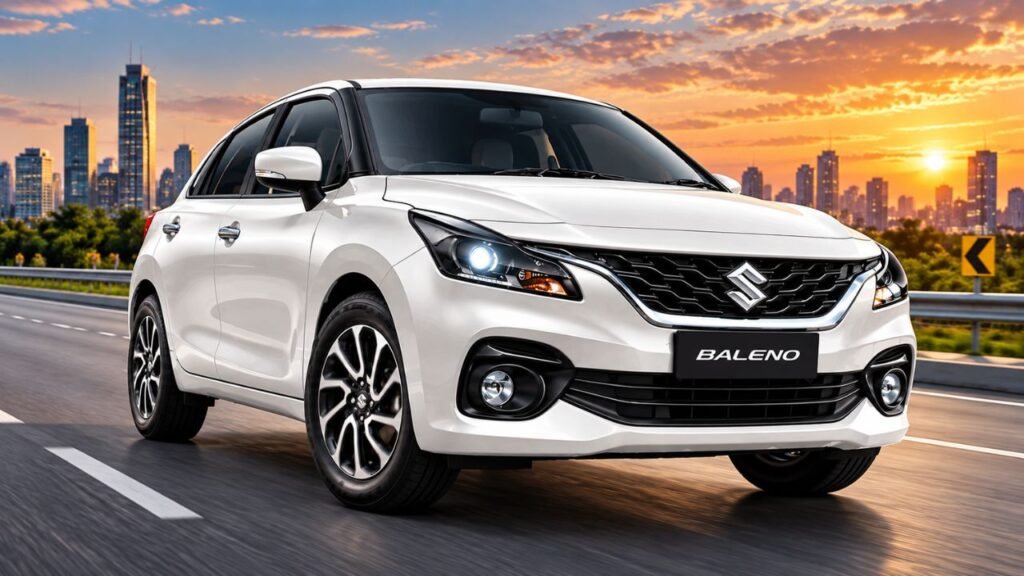
At the front, the facelift gets a redesigned grille, a reworked bumper, and updated LED headlamps with a fresh DRL signature, giving the car a sharper face than the outgoing model, which has been on sale largely unchanged since 2022. Changes to the side profile and rear are expected to be more subtle, though the 16-inch alloy wheels on higher variants get a new design. An updated colour palette, potentially including new dual-tone options, is also expected, though Maruti Suzuki hasn’t detailed the full range ahead of launch.
Maruti Baleno Facelift Interior and Cabin
Inside, the dashboard layout is expected to be a carryover from the outgoing model, which has generally been well regarded for its space and ergonomics in the segment. What’s new is a refreshed upholstery pattern and cabin colour theme, along with the visual change that comes with the larger 10.1-inch touchscreen replacing the outgoing 9-inch unit.
Practicality traits the Baleno is known for – reasonable rear-seat space, a wide boot opening, and well laid-out storage – are expected to carry over unchanged, since these are tied to the platform rather than something a facelift typically touches.
Maruti Baleno Facelift Features Update
- 10.1-inch touchscreen infotainment system, up from the outgoing 9-inch unit, with wireless Apple CarPlay and Android Auto
- Head-up display (HUD) – new to the Baleno
- Ventilated front seats – one of the most talked-about additions
- Automatic climate control, carried over from the outgoing model
- Height-adjustable driver’s seat
- Analogue-digital instrument cluster
- Updated upholstery and cabin trim
- Revised steering wheel design, in line with Maruti Suzuki’s newer models
Maruti Baleno Facelift Safety Features
- Up to 6 airbags on higher variants
- ABS with EBD
- Electronic Stability Programme (ESP)
- ISOFIX child seat anchors
- Traction control
- Rear parking sensors and a 360-degree camera on higher variants
- ADAS suite on the top variant (expected, unconfirmed)
If the ADAS suite does make it to market, it would be a notable step for the Baleno nameplate, since such features have so far mostly been reserved for Maruti Suzuki’s SUVs and sedans rather than hatchbacks.
Read Also: Kia Sorento Launch Price, Date, Images & Specs – India’s New Flagship
Maruti Baleno Facelift vs Rivals
| Factor | Baleno Facelift | Hyundai i20 | Tata Altroz | Toyota Glanza |
| Starting price | ~₹6.00 lakh | ~₹6.00 lakh | ~₹6.00 lakh | ~₹6.73 lakh |
| CNG option | Yes (+ new AMT) | No | Yes | Yes |
| Diesel option | No | No | Yes | No |
| Key USP | CNG-AMT + Maruti’s network | Feature-rich, sporty design | Safety, diesel option | Toyota reliability, shares platform with Baleno |
The Baleno facelift’s case rests on its combination of a larger touchscreen, the CNG-AMT option unique to the segment, and Maruti Suzuki’s wide sales and service network – one of the largest in the country and a significant factor for buyers outside major cities.
Maruti Baleno Facelift: Pros and Cons
Pros
- First Maruti Suzuki model to offer a CNG-automatic combination
- Larger 10.1-inch touchscreen and a new head-up display
- Ventilated front seats – a genuine everyday comfort upgrade
- Updated front-end styling without losing the car’s familiar identity
- ADAS suite expected on the top variant, a first for the nameplate
- Backed by Maruti Suzuki’s extensive Nexa sales and service network
Cons
- No major change to the core platform, cabin architecture or dimensions
- Possible switch to a 3-cylinder engine could affect refinement compared to the outgoing 4-cylinder unit (unconfirmed)
- CNG-AMT is an entirely new configuration – real-world drivability and efficiency are untested
- No diesel option, unlike the Tata Altroz
- Final specs, mileage and full variant-wise features are still unconfirmed ahead of launch
Which Maruti Baleno Facelift Variant Should You Buy?
- Sigma – if you want the updated styling at the lowest possible entry price.
- Delta – the likely value pick, especially if you’re considering the CNG option.
- Zeta – for the best mix of new tech (touchscreen, climate control) without paying flagship money.
- Alpha – for buyers who want the fully loaded Baleno, including ventilated seats and, if offered, ADAS.
Maruti Baleno Facelift Final Verdict
The Baleno facelift isn’t a reinvention – it’s Maruti Suzuki keeping one of its best-selling hatchbacks current against rivals that have added more tech and safety kit over the past couple of years. The car’s core appeal isn’t changing: it should still offer the same practicality, efficiency and easy ownership experience that has made the Baleno a consistent segment leader.
What’s changing is the value proposition – a sharper front end, a bigger touchscreen, comfort additions like ventilated seats and a head-up display, and the segment-first CNG-AMT powertrain all point to Maruti Suzuki addressing specific gaps rather than just refreshing the badge.
Whether the CNG-AMT combination turns out to be the differentiator Maruti Suzuki is hoping for will likely depend on real-world reviews once the car is out. But on paper, the Baleno facelift looks like a well-rounded update to a car that didn’t need reinventing in the first place. Exact prices, specs and features will be confirmed at the official launch on September 5, 2026 – check with your nearest Maruti Suzuki Nexa dealership for the final price list and booking details.
Frequently Asked Questions:
Q1. What is the launch date of the Maruti Baleno facelift?
The Baleno facelift launches in India on September 5, 2026.
Q2. What is the expected price of the Maruti Baleno facelift?
It’s expected to range from around ₹6.00 lakh to ₹9.50 lakh (ex-showroom), broadly in line with the outgoing model.
Q3. Does the Baleno facelift get a CNG-automatic option?
Yes, reports indicate it will be offered with a CNG-AMT combination – a first for any Maruti Suzuki car in India.
Q4. What engine does the Baleno facelift use?
It’s expected to use a 1.2-litre petrol engine, possibly the Z12E three-cylinder unit shared with the Swift and Dzire, along with a CNG variant.
Q5. What new features does the Baleno facelift get?
Expected additions include a 10.1-inch touchscreen, a head-up display, ventilated front seats, updated upholstery, and an ADAS suite on the top variant.
Q6. Is the Baleno facelift an all-new generation model?
No, it’s a mid-cycle facelift of the existing second-generation Baleno, not a new-generation model.
Q7. How does the Baleno facelift compare with the Hyundai i20 and Tata Altroz?
It’s expected to be closely priced with both, with its CNG-AMT option and Maruti’s service network as differentiators, while the Altroz continues to offer a diesel option and strong crash-test ratings.
Q8. Where can I check the on-road price of the Baleno facelift in my city?
On-road prices vary by city due to state-specific RTO and insurance charges – check with your nearest Maruti Suzuki Nexa dealership or the official Maruti Suzuki website once the price list is released.
Source: Maruti Suzuki Baleno





Leave a Reply