

Hyundai Motor India finally put an end to months of guesswork and confirmed the name of its upcoming compact SUV – the Hyundai Bayon. It’s not a rebadged Venue, and it’s not a shrunk-down Creta either. It’s a brand-new nameplate for India, built on a car that already exists in Europe but is being reworked almost from the ground up for Indian roads and Indian buyers. The new Hyundai Bayon has been the subject of rumours for months, and with the name confirmation now official, the Hyundai Bayon India launch story has finally moved from speculation to something Hyundai itself is talking about.
Here’s the short version, if you’re in a hurry: the Bayon nameplate has been around since 2021, selling steadily across Europe and Turkey as a small, hatchback-based crossover below the Kona. The India-spec Bayon is a completely different animal – bigger, boxier, more of an actual SUV – and it’s expected to slot in the gap between the Venue and the Creta, a spot Hyundai has apparently wanted to fill for a while. Everything beyond the name itself is still officially unconfirmed, but we’ve pulled together what’s known, what’s rumoured, and what’s pure speculation, and organised it all below – launch date, expected price, engine options, features, seat-of-the-pants design details from spy shots, rivals, and a full FAQ section. We’ll keep updating this as Hyundai reveals more.
Hyundai Bayon India: Quick Specification
Before we go deep into each section, here’s a one-glance summary of where things stand. Anything marked Confirmed comes directly from Hyundai’s own 14 September 2026 announcement; everything marked Expected is media speculation, not an official figure, so treat it accordingly.
| Parameter | Detail | Status |
| Name | Bayon | Confirmed (14 Sept 2026) |
| Codename | BC4 (India-spec) | Reported, unconfirmed |
| Market position | Between Venue and Creta | Widely reported, unconfirmed |
| Launch date | Between Oct 2026 and May 2027 (no single confirmed date) | Unconfirmed |
| Launch venue | Not announced | – |
| Expected price (base) | ₹8–11 lakh (ex-showroom) | Estimated |
| Expected price (top trim) | ₹14–16 lakh (ex-showroom) | Estimated |
| Body style | Boxier, more upright SUV stance vs current Euro Bayon | Reported from spy shots, unconfirmed |
| Platform | Rumoured next-gen platform | Unconfirmed |
| Engine options | 1.0L/1.2L/1.5L petrol candidates; CNG likely | Speculative, sources disagree |
| Transmission options | 5MT / 6-speed iMT / 7-speed DCT (candidates) | Speculative |
| Sunroof | Expected on top trims | Unconfirmed |
| ADAS | Level 2 ADAS expected | Unconfirmed |
| Airbags | Six expected as standard | Unconfirmed |
| Key rivals | Maruti Fronx, Tata Punch/Nexon, Nissan Magnite, Renault Kiger, Skoda Kylaq | Based on price-band and segment fit |
This is deliberately a mix of “confirmed” and “expected” columns rather than a clean spec sheet – because right now, that mix is the honest picture. A proper spec sheet with real, verified numbers will only exist once Hyundai India issues one.
Hyundai Bayon India Launch Date
Hyundai Motor India has confirmed exactly one thing so far: the name. On September 14, 2026, the company announced that its upcoming compact SUV – internally being talked about as a Venue-Creta bridge model – will carry the Bayon badge globally recognised from Europe. Every fresh update on the Hyundai Bayon India launch since then has come from auto media, not from Hyundai itself. The statement itself was short. Hyundai didn’t attach a launch date, didn’t reveal pricing, and didn’t confirm a single spec. What it did say is that more details would follow “in the coming days,” alongside some fairly standard language about technology, intelligent mobility, and design built around the tastes of Indian buyers.
That vagueness has left a gap, and Indian auto media has rushed in to fill it – with wildly different conclusions.
- One widely cited estimate points to a launch around October 15, 2026 – barely a month away from the name confirmation, which would be an unusually fast turnaround by Hyundai’s own standards.
- A separate, more recently updated estimate pushes the timeline all the way out to May 2027, explicitly labelled as “tentative” by the source itself.
- Reports from mid-2025 suggested a mid-2026 window, which has clearly already come and gone without a launch.
- Other coverage from around the same period simply said “second half of 2026,” based on industry sourcing rather than anything concrete.
- A few outlets have avoided giving a specific month altogether, framing it only as a “2026 launch” in general terms.
So which one do you believe? Honestly, none of them with full confidence. The only thing that’s actually confirmed is the name, confirmed on a single date – September 14, 2026 – with nothing else attached to it. Everything else circulating right now is a rumour chain, a dealer-network leak, or an educated guess based on Hyundai’s usual product-launch rhythm. The most recent estimate (May 2027) carries slightly more weight simply because it was updated after the name confirmation, but Hyundai hasn’t validated it either. Treat every date on this page as provisional until Hyundai India puts out an actual press release with a launch date attached.
Hyundai Bayon Price in India – Expected Numbers
Nobody outside Hyundai’s pricing committee knows the final number yet, but there’s noticeably more agreement here than there is on the launch date – which is unusual, and probably tells you the segment positioning (Venue-to-Creta bridge) is doing most of the work in shaping these guesses rather than any leaked document. If you’re specifically hunting for the Hyundai Bayon price in India, here’s every estimate currently doing the rounds, laid out side by side.
| Source | Estimated Starting Price (Ex-showroom) |
| Estimate A | ₹8.00 – 14.00 lakh |
| Estimate B | ₹10 lakh (base variant) |
| Estimate C | ₹10 lakh (base, 998cc/manual configuration) |
| Estimate D | ₹9 – 11 lakh (base), ₹14–16 lakh (top trims, turbo-petrol automatic) |
| Estimate E | Likely “under ₹10 lakh” |
Line all of that up and you get a fairly tight consensus: a starting price somewhere in the ₹8–11 lakh range, with fully loaded variants – the ones running a turbo-petrol engine paired with an automatic gearbox – potentially stretching up toward ₹14–16 lakh. That would put the Bayon’s price band overlapping meaningfully with the top-spec Venue on one end and the entry-level Creta on the other, which lines up neatly with its rumoured job: give Hyundai India a car for buyers who’ve outgrown the Venue’s price ceiling but aren’t quite ready to stretch to Creta money.
Why This Pricing Actually Matters
This isn’t just a random number Hyundai will land on – it’s really the entire reason this car exists. The Venue tops out at a price where buyers start cross-shopping into the compact-SUV mainstream, and the Creta starts high enough that a chunk of those buyers get priced out entirely. Hyundai appears to be building the Bayon specifically to catch that overflow – buyers who want more space, more tech, and a more grown-up SUV stance than the Venue offers, without needing to find Creta-level money. If Hyundai keeps the Bayon anchored near that ₹8–11 lakh entry point, it slots almost perfectly into that gap.
Where the Bayon’s Price Would Land Against Current Rivals
Since the Bayon isn’t launched yet, this is a placeholder comparison built purely on price-band overlap with cars already on sale – not a “true” rival list, just what currently occupies that same rupee bracket.
| Model | Approx. Starting Price (Ex-showroom) |
| Mahindra Bolero | ₹8.49 lakh |
| Mahindra Bolero Neo | ₹8.99 lakh |
| Tata Punch EV | ₹8.16 lakh |
| Hyundai Exter | ₹5.81 lakh |
| Tata Punch | ₹5.75 lakh |
| Maruti Suzuki Brezza | ₹7.40 lakh |
| Renault Kiger | ₹5.81 lakh |
| Nissan Magnite | ₹5.68 lakh |
| Skoda Kylaq | ₹7.59 lakh |
That’s a fairly wide spread, which tells you something important: at this stage, nobody actually knows precisely where the Bayon will sit within that band, only roughly which band it’ll be in.
Hyundai Bayon India: Market Positioning
This is the one point where almost every source agrees, and it’s worth taking at face value. The India-spec Bayon is expected to sit above the Venue and below the Creta – Hyundai’s attempt at a genuine bridge model rather than a simple trim reshuffle. One report frames it plainly as “a crossover that could slot between the Venue and Creta,” language echoed almost word-for-word by other outlets covering the announcement.
This is a meaningfully different job than the one the Bayon does in Europe, where it sits below the Kona as Hyundai’s smallest SUV in that market. In India, the same badge is being repositioned upward, into a gap in the middle of the range rather than at the bottom of it – which is really the whole reason this is being treated as an almost entirely new vehicle rather than an import of the European car with a few local tweaks.
Hyundai Bayon India: Codename and Design Direction – What the Spy Shots Reveal
Industry reporting – drawing on spy shots of test mules already spotted testing – refers to the upcoming India model by the internal codename BC4, distinguishing it from the current European Bayon’s BC3 codename. That’s not just a numbering detail; it signals Hyundai genuinely considers this a different-generation product rather than a facelift of the existing car.
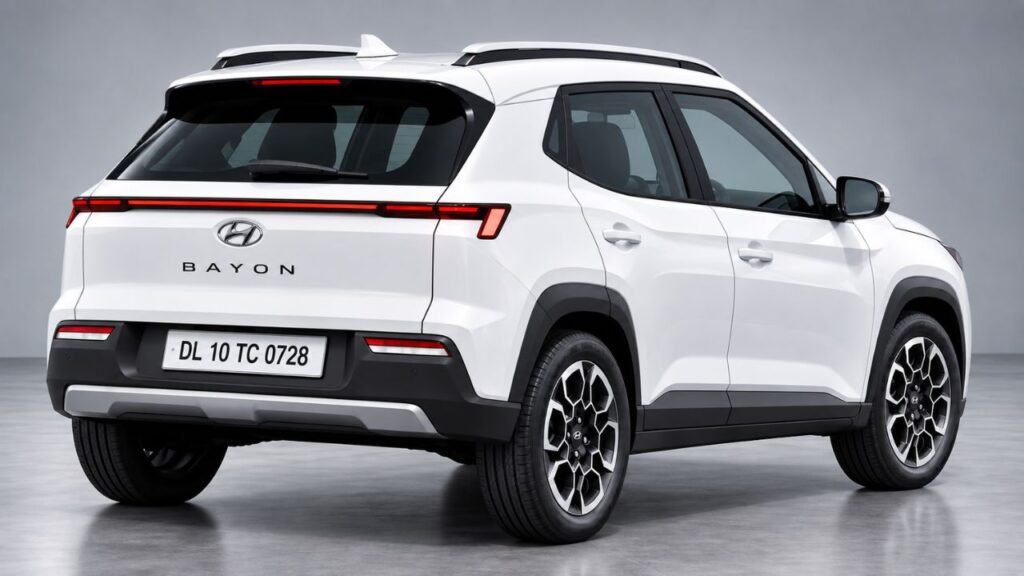
Two influences are obvious once you look at what’s been reported: the boxier, more upright SUV language Hyundai has been leaning into across its recent global concepts, and a deliberate move away from the rounded, hatchback-derived crossover shape of the outgoing European Bayon. In every way that matters, the new Hyundai Bayon is being built as its own product rather than a facelift of the car Europe already knows.
Overall stance. Spy images reportedly show a taller stance and a more assertive road presence than the current Euro-spec car. The next-generation Bayon is expected to move toward a boxier, more conventionally SUV-like silhouette – a bigger footprint overall, with a longer wheelbase and wider track than the outgoing model, aimed squarely at improving cabin space and boot capacity, two areas where compact crossovers in this price band tend to get compared closely against each other.
Proportions. Larger in every dimension that matters for day-to-day usability – expect a longer body, a wider stance, and a wheelbase stretched enough to make a real difference to rear-seat legroom, rather than a cosmetic bump.
It’s worth being upfront here: exact dimensions haven’t been officially confirmed by Hyundai as of this report. Every figure circulating through auto media right now is an estimate built from spy-shot analysis, not a confirmed specification sheet – so treat anything you read about exact millimetres with a healthy pinch of scepticism until Hyundai publishes real numbers.
Read Also: Tata Curvv Series X Launch Price, Variants, Features & Specs
Cockpit and Interior – What’s Expected
Nothing about the India-spec interior has been officially confirmed either, but the expectation, largely extrapolated from what’s already sitting in Hyundai’s current India line-up (Venue, i20 N Line, Creta) combined with what’s confirmed for the existing European Bayon, points toward a cabin that leans tech-forward rather than minimalist:
- Dual 10.25-inch digital displays – instrument cluster plus touchscreen – mirroring the setup already confirmed for the European Bayon
- Wireless Android Auto and Apple CarPlay
- Wireless phone charging
- Hyundai’s Bluelink connected-car suite
- LED lighting throughout, potentially including a signature DRL treatment in the spirit of the Euro Bayon’s arching daytime running light
- Ventilated and/or heated front seats on higher trims
- A panoramic sunroof reserved for top-spec variants
- Multi-colour ambient interior lighting
None of this is confirmed by Hyundai directly. It’s an informed projection built off segment trends and Hyundai’s existing India feature strategy – the kind of kit list you’d expect on a car aiming to look and feel a notch above the Venue.
Hyundai Bayon India: Expected Engine and Performance
This is where different reports genuinely contradict each other, almost certainly because Hyundai hasn’t released a single official line about powertrains yet. Multiple, sometimes overlapping, sometimes conflicting possibilities are doing the rounds:
A newly developed 1.2-litre turbocharged petrol engine. Positioned between the existing 1.0-litre turbo and 1.5-litre turbo units already in Hyundai’s India range, this engine is rumoured to produce somewhere in the region of 160 PS and 253 Nm – a genuinely strong output for this segment – and could be engineered from the outset to meet upcoming CAFE 3 and BS7 emission norms. Some reports go further and describe this unit as “hybrid-ready,” suggesting Hyundai could eventually offer an electrified variant down the line, paired possibly with a dual-clutch automatic or an e-CVT.
The existing 1.0-litre turbo-petrol engine. Potentially offered in two states of tune – around 100 PS and 120 PS – consistent with what’s already sold in the European Bayon today. Some overseas markets get this engine with mild-hybrid assistance, and a handful of Indian reports speculate that assistance could eventually be localised for efficiency gains, though this is firmly in “maybe, someday” territory.
A 1.2-litre naturally aspirated petrol engine. Similar to what currently does duty in the outgoing Hyundai i20 – a simpler, cheaper-to-run option that would undercut the turbo variants.
A 1.5-litre, four-cylinder naturally aspirated petrol engine. The same unit currently found under the bonnet of the Hyundai Creta, producing roughly 115 PS and 143.8 Nm, put forward by some outlets as the most likely India-spec engine – notably paired with a factory-fitted CNG option. If that turns out to be accurate, it would reportedly make the Bayon Hyundai’s first model measuring over four metres in length to get a factory CNG powertrain, which would be a genuinely significant first for the brand in India.
A twin-cylinder factory-fitted CNG setup. Mentioned repeatedly given how popular CNG variants have become among Indian compact-SUV buyers, and Hyundai’s broader push into CNG options across its India range in recent years.
Given how much disagreement there is between sources on this specific point, the honest advice is to treat all of the above as speculative until Hyundai India issues an official spec sheet. What most reports do converge on, though, is that a CNG variant is highly likely in some form, and that whatever engine ultimately powers the Bayon will come from Hyundai’s existing Kappa/Smartstream petrol family – not a diesel, and not a from-scratch new architecture built specifically for this car.
Expected Transmission Options
Reported possibilities include a 5-speed manual, a 6-speed iMT (intelligent manual transmission), and a 7-speed DCT automatic – broadly mirroring the transmission spread Hyundai already offers across the Venue, i20, and Creta in India. Nothing unusual here; it would be consistent with how Hyundai typically structures its India range.
Read Also: Maruti Suzuki WagonR 2026: Ex-Showroom & On-Road Breakdown
Hyundai Bayon India: Expected Features
Building on the same logic as the interior projections above – segment trends plus Hyundai’s existing India playbook – here’s what auto media expects the feature list to include, especially on higher trims:
- Level 2 ADAS (Advanced Driver Assistance Systems), including blind-spot collision avoidance and navigation-based adaptive cruise control
- Six airbags as standard
- ABS with EBD and Electronic Stability Control
- Dual 10.25-inch screens (instrument cluster + touchscreen)
- Wireless smartphone connectivity and charging
- Connected car tech via Bluelink
- Panoramic sunroof on top trims
- Ventilated/heated front seats on select variants
- Full LED lighting signature
Again – worth repeating – none of this is confirmed by Hyundai. It’s a reasonable, evidence-based guess rather than a leaked spec sheet.
The European Bayon: What the Same Badge Already Looks Like Elsewhere
It’s worth understanding the car this nameplate is borrowed from, because it helps explain why the India version is being treated as such a departure rather than a straightforward import.
The Bayon currently sold across Europe and Turkey – internally coded BC3 CUV – has been on sale since it was revealed in March 2021, positioned as Hyundai’s smallest SUV for the European market, slotting in below the Kona. It’s closely related to the third-generation Hyundai i20 hatchback, sharing the same Hyundai-Kia K2 platform, and is a front-engine, front-wheel-drive car that has never once been offered with all-wheel drive – reinforcing that it was always meant to be an urban crossover, not an off-roader. It’s built at Hyundai Assan’s plant in İzmit, Turkey, and outside of Europe and Turkey it has historically only reached a handful of markets across Central Asia, the Middle East, and North Africa. India was never part of that original plan.
Dimensions. The European car measures 4,180mm in length, 1,775mm in width, and 1,490–1,500mm in height depending on trim and wheel size, riding on a 2,580mm wheelbase, with kerb weights ranging roughly 1,045–1,255kg depending on engine and transmission. Boot space sits around 411 litres with the rear seats up, expanding to about 1,205 litres with them folded flat.
Design. Hyundai describes the styling as an interpretation of its “Sensuous Sportiness” design language layered over the brand’s SUV design heritage – a grille that widens toward the bottom for a planted stance, arrow-shaped headlamps, and the signature “Seamless Horizon Lamp,” a full-width LED daytime running light that arches across the entire bonnet, introduced with a January 2024 facelift. The facelift also brought a redesigned front fascia, new bumpers, fresh alloy wheel designs, and a skid plate that now stretches seamlessly across the width of the car.
Engines (Europe). Over its life the European Bayon has run a range of small-capacity petrols:
| Engine | Transmission | Power | Torque |
| 1.0L T-GDi (100PS tune) | 6MT / 7DCT | 100 PS | 172 Nm |
| 1.0L T-GDi (120PS tune) | 6MT / 7DCT | 120 PS | 200 Nm |
| 1.2L MPi | 5MT | 84 PS | 118 Nm |
| 1.4L Kappa II | 6MT / 6AT | 100 PS | 134 Nm |
By late 2025, Hyundai UK simplified this entire range down to a single 1.0-litre, three-cylinder T-GDi turbo petrol producing 90 PS, offered with either a 6-speed manual or a 7-speed DCT – mirroring a similar simplification applied to the related i20. Fuel economy for the manual sits around 50.4 mpg WLTP combined, with CO2 emissions in the 124–126 g/km range.
Safety. Euro NCAP tested the Bayon in 2021, scoring 76% for adult occupant protection, 82% for child occupant protection, 76% for pedestrian protection, and 67% for safety assist.
Sales. The Bayon has grown steadily in its two core markets, roughly doubling European volumes between 2021 (15,404 units) and 2024 (28,241 units), with a similar growth pattern in Turkey over the same period, rising from 5,067 units in 2021 to 17,581 in 2024.
None of this is what Indian buyers will actually get – but it’s a useful baseline for understanding the design DNA and brand story Hyundai is borrowing before reworking the car almost entirely for a different market and a different price point.
Read Also: BYD Cars Price 2026, New Car Models, Images & Reviews
Hyundai Bayon 440 vs Bayon Europe: What’s the Difference? (India-spec vs Euro-spec)
| Aspect | European Bayon (Current, BC3) | India-Spec Bayon (Upcoming, BC4) |
| Status | On sale since 2021, facelifted Jan 2024 | Not yet launched; name confirmed 14 Sept 2026 |
| Platform | Hyundai-Kia K2 (shared with i20) | Rumoured next-gen platform (unconfirmed) |
| Market position | Below the Kona; Hyundai’s smallest Euro SUV | Expected between Venue and Creta |
| Body style | Rounded, hatchback-derived crossover | Rumoured boxier, more upright SUV stance |
| Engines | 1.0L T-GDi turbo, 1.2L MPi, 1.4L Kappa II | Speculated: new 1.2L turbo, existing 1.0L turbo, 1.2L/1.5L NA petrol, possible CNG |
| Transmissions | 5/6MT, 6AT, 7DCT | Speculated: 5MT, 6-speed iMT, 7DCT |
| Starting price | From roughly £23,795 (UK, 2026 model year) | Estimated ₹8–11 lakh (base) |
| Markets | Europe, UK, Turkey, select MEA/CIS markets | India (primary target) |
Bottom line: these aren’t the same car wearing the same badge for convenience – they’re built for entirely different buyers. The European Bayon is a mature, second-generation product doing a very specific job as Hyundai’s smallest European SUV. The India-spec Bayon is a bigger, boxier, more conventionally SUV-shaped car aimed squarely at plugging a gap in Hyundai’s domestic line-up.
Hyundai Bayon India: Expected Rivals
Because of its rumoured positioning between the Venue and Creta, and its compact-SUV/crossover styling, most auto coverage expects the Bayon to go up against:
| Rival | Segment Fit |
| Maruti Suzuki Fronx | Most frequently cited direct rival |
| Maruti Suzuki Victoris | Cross-shop on size and pricing |
| Tata Punch / Punch EV | Compact SUV overlap |
| Tata Nexon | Slightly larger, price-band overlap |
| Nissan Magnite | Entry compact-SUV segment |
| Renault Kiger | Entry compact-SUV segment |
| Skoda Kylaq | Newer entrant, similar price band |
| Mahindra Bolero / Bolero Neo | Overlap mainly on price, not segment |
| Kia Seltos | Mentioned in broader comparisons given price-band stretch on top trims |
Royal Enfield-style honesty here: on paper, several of these rivals already have a head start in brand recognition within this exact price band, particularly the Fronx and Punch. What the Bayon will lean on is the same thing every Hyundai in this range leans on – a strong dealer network, competitive resale value, and Hyundai’s overall reputation for feature-loading its cars a notch above what rivals offer at the same price. That combination has worked for the Venue and the Creta, and it’s presumably the same playbook Hyundai wants the Bayon to run.
Why the Hyundai Bayon India Matters
The Venue has been a solid seller for Hyundai in India, but its price ceiling means a chunk of buyers who want more space, more features, or just a more “grown-up” looking SUV inevitably get pushed to cross-shop rivals – or stretch their budget into Creta territory. The Creta, meanwhile, has become almost a segment unto itself, pulling buyers upward and leaving a visible gap underneath it that Hyundai hasn’t had a dedicated product for.
The Bayon reads like Hyundai’s answer to exactly that gap. Not a replacement for either car – a bridge between them. Buyers who felt the Venue was starting to feel a size too small, but weren’t ready to pay Creta money, are precisely who this car is being built for. It’s also a useful signal about how Hyundai treats its global nameplates going forward: rather than importing the European Bayon wholesale, the company appears comfortable stretching a familiar badge over a substantially different product when a market’s needs call for it – something worth watching if Hyundai repeats the approach with other nameplates down the line.
Frequently Asked Questions (FAQs)
What is the launch date of the Hyundai Bayon in India?
Not officially confirmed. Estimates range from October 15, 2026 to May 2027, with Hyundai itself having confirmed only the name so far, on September 14, 2026.
What will be the price of the Hyundai Bayon in India?
Expected to start somewhere in the ₹8–11 lakh (ex-showroom) range, with fully loaded turbo-petrol automatic variants potentially reaching ₹14–16 lakh. Official pricing will only be confirmed at launch.
What engine will the Hyundai Bayon use in India?
Unconfirmed. Rumours include a new 1.2-litre turbo-petrol (~160 PS), the existing 1.0-litre turbo, a 1.2-litre or 1.5-litre naturally aspirated petrol, and a strong possibility of a factory-fitted CNG option.
Where will the Hyundai Bayon sit in Hyundai’s India line-up?
Between the Venue and the Creta, based on nearly unanimous agreement across auto media coverage.
Is the India-spec Bayon the same car as the European Bayon?
No. The India-spec car (codenamed BC4) is expected to be significantly larger, boxier, and more conventionally SUV-shaped than the current rounded, hatchback-derived European Bayon (BC3).
Will the Hyundai Bayon get a sunroof?
Expected on top trims, though this is speculative pending official confirmation.
Will the Hyundai Bayon come with a CNG option?
Widely expected, and some reports suggest it could make the Bayon Hyundai’s first sub-4-metre-plus model in India to get a factory CNG powertrain – but this remains unconfirmed.
What are the rivals of the Hyundai Bayon in India?
Maruti Suzuki Fronx and Victoris, Tata Punch and Nexon, Nissan Magnite, Renault Kiger, Skoda Kylaq, and – on price-band overlap – the Mahindra Bolero range and even the Kia Seltos in some comparisons.
Has Hyundai confirmed any specifications for the India-spec Bayon?
No. As of this report, Hyundai has confirmed only the name. Powertrains, dimensions, features, and launch date remain officially unconfirmed and are based on media speculation and spy-shot analysis.
Source: Hyundai





Leave a Reply