September 11 is circled on a lot of calendars right now. That’s the day BMW India finally pulled the wraps off the facelifted BMW 7 Series, alongside its all-electric twin, the BMW i7 – arguably the most anticipated update on the brand’s 2026 calendar, and one that a fairly vocal chunk of luxury-sedan shoppers have been waiting on since the current-generation 7 Series landed back in January 2023.
Here’s the short version, if you’re in a hurry: this isn’t an all-new car. It’s a mid-life refresh – a new grille, a heavily reworked cabin borrowed from BMW’s Neue Klasse design language, tweaked lighting, and updated tech across the board, on the same fundamental platform. The petrol, diesel, and fully electric i7 all continue to share one production line, which is still the 7 Series’ single biggest party trick against its German rivals.
BMW 7 Series Facelift Launch Date in India
BMW confirmed the 7 Series and i7 facelift launch for September 11, 2026 in India. It’s not a rumour or a “likely window” anymore – dealerships across the country have had bookings open since August 1, 2026, and pre-launch reservations have been rolling in for over a month. There’s a reason this timing lines up the way it does. The updated 7 Series and i7 were first shown to international media back in April 2026, roughly five months before the India reveal – a fairly standard gap for BMW to localise a facelift for the Indian market, sort out CBU logistics for the higher trims, and let dealer networks build stock.
That last part is worth noting: dealership sightings of the facelifted 740i, 740d, and i7 started showing up across major cities in the weeks running up to launch – a fairly reliable sign that stock was already moving ahead of the official reveal, and that deliveries likely won’t take long once final variant-wise pricing is out. Right up until September 11, it wasn’t fully clear whether the diesel 740d would even make the cut for India this time around, with some pre-launch reports suggesting a petrol-and-electric-only lineup. If you’re set on a diesel flagship, that’s worth confirming with your dealer before you get attached to a variant.
BMW 7 Series Facelift Expected Price
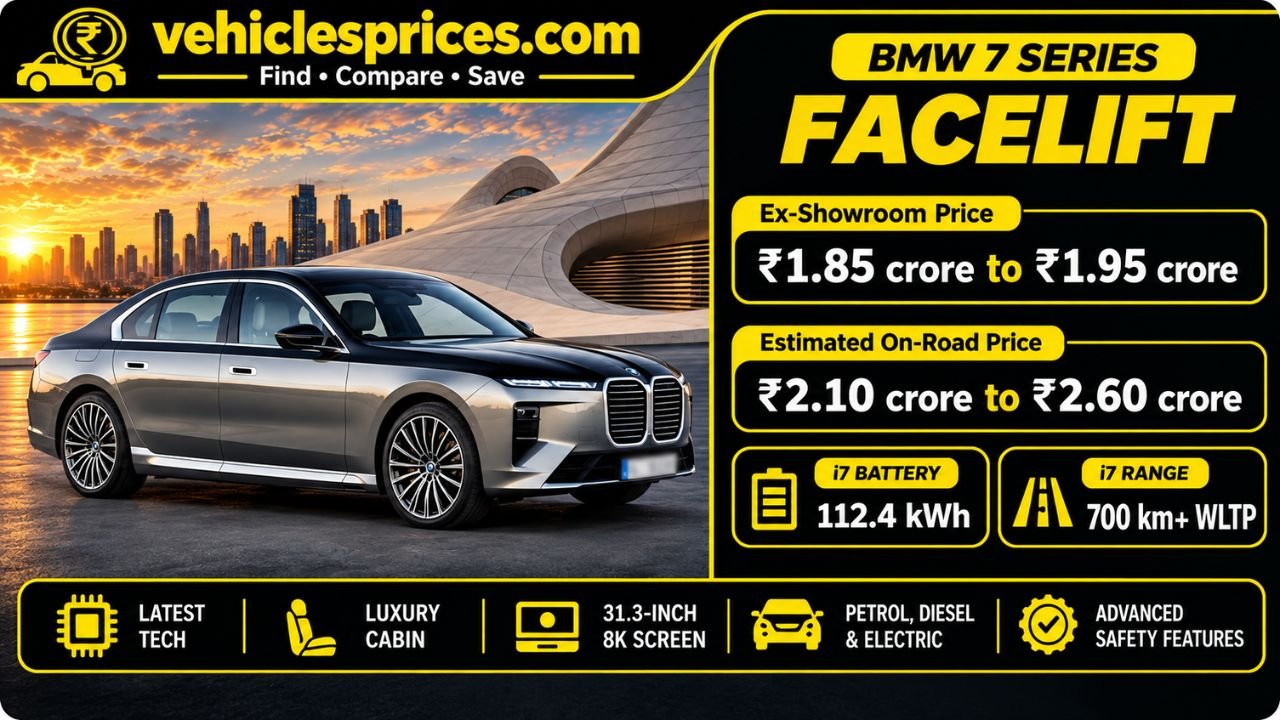
Nobody outside BMW India’s pricing team knows the exact final number down to the rupee, but the consensus among dealer sources and auto publications is fairly tight on where this lands. We can have a look at bmw 7 series price expect the ICE range (740i / 740d) to open around ₹1.85 crore and stretch toward ₹1.95 crore for the fully loaded M Sport trim, with the i7 starting around ₹2.10 crore and topping out near ₹2.60 crore for the range-topping variant – broadly a modest premium over the outgoing model, which is typical for a facelift with this much new tech.
| City | Expected Starting Price – 740i/740d (Ex-showroom) | Expected Starting Price – i7 (Ex-showroom) |
| Mumbai | ₹1.87 crore onwards | ₹2.12 crore onwards |
| Delhi | ₹1.85 crore onwards | ₹2.10 crore onwards |
| Bangalore | ₹1.88 crore onwards | ₹2.14 crore onwards |
| Pune | ₹1.86 crore onwards | ₹2.11 crore onwards |
| Hyderabad | ₹1.86 crore onwards | ₹2.12 crore onwards |
| Chennai | ₹1.87 crore onwards | ₹2.13 crore onwards |
| Kolkata | ₹1.85 crore onwards | ₹2.10 crore onwards |
| Ahmedabad | ₹1.84 crore onwards | ₹2.09 crore onwards |
That’s ex-showroom, not what actually leaves your account when you drive it home. Add RTO registration, road tax, and insurance, and the real number climbs a lot further than it does on a mainstream sedan – luxury cars attract steeply higher road tax slabs in several states, and we’ll break that down next.
Why does this pricing matter so much for a car in this bracket? Because unlike the mainstream segment, buyers here aren’t choosing between “can I afford it” and “can’t I” – they’re choosing between the 7 Series, the S-Class, and the A8L, and a few lakh rupees either way genuinely does move people between showrooms at this level.
BMW 7 Series 2026 On-Road Price Structure
The on-road price isn’t a random number your dealer picks. It’s built from three clear parts, and understanding them helps you spot an inflated quote instantly – which matters more here than almost anywhere else in the market, given the absolute rupee values involved.
- Ex-showroom price: The factory-set base cost before any tax or fee – the ₹1.85–1.95 crore (ICE) or ₹2.10–2.60 crore (i7) range covered above.
- RTO registration and road tax: A percentage of the ex-showroom price, and this is where luxury cars get hit hardest – several states apply a steeper tax slab once a vehicle crosses a certain price threshold, sometimes touching 20%+ of the ex-showroom value.
- Comprehensive insurance: Mandatory for every new car, with the premium scaling directly with the vehicle’s declared value – meaning insurance alone on a 7 Series can run into several lakh rupees a year before add-on covers.
Because road tax rules differ so sharply across states – and because those rules specifically target higher-value cars – the same 7 Series variant can cost tens of lakhs more or less depending purely on where you register it. A car bought in Delhi and one bought in Karnataka, identical on paper, can carry meaningfully different on-road price tags.
BMW 7 Series On-Road Price in Top Cities
Here’s how the 740i base variant (expected ex-showroom ₹1.85 crore) roughly compares on-road across a few major cities, once RTO and insurance are factored in. Treat these as indicative – your dealer’s exact figure will depend on your specific state’s current tax slab and the insurance add-ons you choose.
| City | Ex-Showroom (Expected) | Approx. On-Road Price |
| Delhi | ₹1.85 crore | ₹2.10 crore onwards |
| Mumbai | ₹1.87 crore | ₹2.35 crore onwards |
| Bangalore | ₹1.88 crore | ₹2.30 crore onwards |
| Pune | ₹1.86 crore | ₹2.28 crore onwards |
| Chennai | ₹1.87 crore | ₹2.22 crore onwards |
| Hyderabad | ₹1.86 crore | ₹2.20 crore onwards |
| Kolkata | ₹1.85 crore | ₹2.15 crore onwards |
Notice how much wider that gap is compared to a mainstream car – a ₹10 lakh scooter-segment price swing between cities is trivial, but on a flagship sedan, the difference between registering in Delhi versus Karnataka or Maharashtra can be the price of an entire small hatchback. If you have any flexibility on where you register the car, it’s genuinely worth checking.
BMW 7 Series Facelift Features
What’s confirmed and what’s expected, based on official reveals and reporting so far:
- 17.9-inch curved central iDrive touchscreen
- 14.6-inch dedicated front-passenger display
- BMW Panoramic Vision head-up projection across the lower windscreen
- 31.3-inch 8K rear theatre screen, foldable into the roof lining
- Bowers & Wilkins 4D Diamond surround sound with seat-mounted bass exciters
- Zero-gravity rear-left seat with auto leg-rest deployment
- Flush, motorised door handles with proximity sensors
- Standard xDrive all-wheel drive across the petrol, diesel, and electric range
- Illuminated kidney grille with a redesigned, larger light ring
No compromise on the tech front here – if anything, the facelift leans harder into digital immersion than the outgoing car did, particularly in the back seat.
BMW 7 Series Facelift Engine and Performance
Under the skin, you’ll find three distinct routes into 7 Series ownership, and they’re aimed at genuinely different buyers rather than being trims of the same idea.
740i petrol: A 3.0-litre inline-six turbo-petrol with a 48V mild-hybrid assist, producing around 400 bhp and 580 Nm, paired with an 8-speed Steptronic automatic. The mild-hybrid system unlocks a “Sport Boost” function – hold the left paddle shifter and the car sharpens throttle response, exhaust note, and hybrid assist for roughly 10 seconds, useful for a confident overtake on the highway.
740d diesel: The same basic 3.0-litre inline-six architecture in diesel form, producing around 313 bhp and 670 Nm – with that torque available from as low as 1,500 rpm. On a full tank, this is the variant built for genuinely long-distance driving, with a real-world range that can comfortably clear 900 km on the highway. The catch, as flagged earlier, is that its India-spec availability for this facelift wasn’t fully confirmed as of publication – worth a direct check with your dealer.
i7 electric: The full EV route swaps the inline-six for a 112.4 kWh battery pack driving a dual-motor setup good for around 544 bhp and 745 Nm – a genuine leap from the outgoing i7’s rear-wheel-drive-biased setup to a standard high-output AWD footprint. It’s the quickest and quietest way into a 7 Series, and arguably the version that best represents where BMW wants the flagship to go next.
Compared to the outgoing (pre-facelift) 7 Series, the power and torque figures are broadly similar on the ICE cars – the real story with this update is less about outright numbers and more about the battery capacity jump on the i7, and the depth of tech layered over the same fundamentals.
BMW 7 Series Facelift Mileage and i7 Range
Official ARAI mileage figures for the facelifted 740i and 740d weren’t out at the time of writing – those typically get certified only around or at launch – but going by the outgoing model, expect the petrol to return somewhere in the 10–12 kmpl range in real-world use, with the diesel comfortably ahead at 13–15 kmpl. Neither number is the headline reason anyone buys a car in this segment, but the diesel’s range advantage on long inter-city runs is a genuine, practical draw for buyers who actually drive these cars themselves rather than being chauffeured.
The i7 is the more interesting number here. BMW’s claimed WLTP figure for the updated 112.4 kWh pack is north of 700 km – a meaningful step up from the outgoing i7’s roughly 590–625 km WLTP rating. Real-world Indian conditions – AC running near-constantly, stop-start city traffic, and the odd hill climb – will bring that down, so a realistic expectation is somewhere around 500–580 km on a full charge. DC fast-charging specifics vary slightly by source at the time of writing, but expect a 10–80% top-up in roughly 30–35 minutes on a suitably powerful charger, once BMW confirms the exact ceiling for the India-spec car.
BMW 7 Series Facelift Design and Styling: What’s Changed
The facelift is a case of evolution rather than revolution on the outside, but it’s a genuinely significant shift on the inside – and both are deliberate.
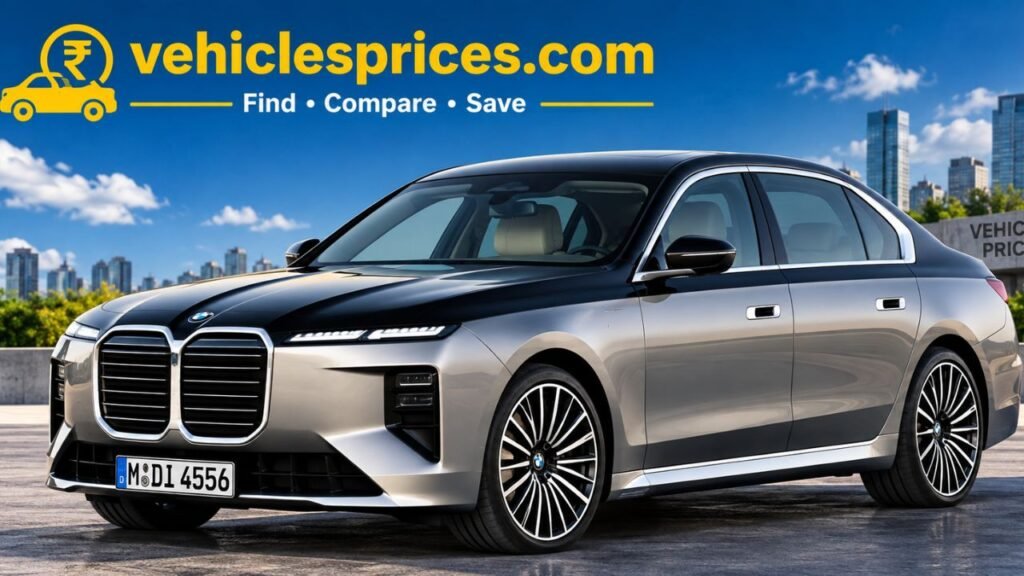
Front end. The kidney grille grows larger again and switches from vertical to horizontal slats, wrapped in a continuous illuminated ring that stays lit even while the car is moving. The headlamp cluster splits into two tiers: a slim upper strip housing the DRLs – reportedly using genuine Swarovski crystal elements in higher trims – sitting above smaller, more angular lower lamp clusters positioned near the air curtains. It’s a bolder, more layered face than the outgoing car’s cleaner single-unit lamps.
Side profile. Flush door handles carry over from the outgoing generation but get refined internals – proximity sensors and motor actuators mean a simple button press triggers a fully automated door-opening sequence, while stepping on the brake pedal pulls the driver’s door shut automatically.
Cockpit. This is genuinely the biggest talking point of the whole update. The dashboard moves to a dramatic, multi-layered curved panel arrangement dominated by the 17.9-inch central iDrive screen, with a full-width Panoramic Vision projection replacing the traditional compact head-up display. The 14.6-inch front passenger screen is new territory for the segment – it lets the passenger stream a film or run apps via Bluetooth headphones without spilling any of it onto the driver’s side of the cabin, addressing a genuinely common complaint about long-haul comfort for the person riding shotgun.
Rear cabin. If the outgoing 7 Series’ rear-seat tech was already class-leading, the facelift pushes further. The 31.3-inch 8K theatre screen folds away into the Alcantara-lined roof when not in use and deploys via a door-card control, with native streaming apps and AirConsole casual gaming built in. Combined with the 36-speaker, 1,900-watt Bowers & Wilkins system – complete with bass-translating exciters built into the seat structure itself – the back seat is genuinely designed to function as a private screening room or a mobile boardroom, not just a place to sit while someone else drives.
BMW 7 Series Cabin Comfort and Practicality
While there’s no official word yet on any change to interior dimensions, it’s worth noting the outgoing 7 Series was already built on a long-wheelbase-only footprint for markets like India – meaning rear legroom was never the issue here. The zero-gravity rear-left seat is the real practicality story: it reclines up to 42.5 degrees, deploys an integrated leg-rest, and automatically shifts the front passenger seat forward to open up genuine limousine-grade stretch space.
That matters more in the Indian context than it might elsewhere, given how many 7 Series and S-Class buyers in this market are chauffeured rather than driving themselves. A rear seat that behaves less like a car seat and more like a business-class flat-bed is arguably a bigger sales driver here than outright horsepower.
Quick Comparison: Facelift vs Outgoing (Pre-Facelift) 7 Series
| Parameter | 7 Series Facelift (2026) | Outgoing 7 Series (2023) |
| Front infotainment | 17.9-inch iDrive + 14.6-inch passenger screen | Curved 14.9-inch iDrive display, no passenger screen |
| Head-up display | Full-width BMW Panoramic Vision | Standard compact HUD |
| Rear theatre screen | 31.3-inch 8K | 31-inch 8K (largely carried over) |
| i7 battery | 112.4 kWh | 101.7 kWh |
| i7 claimed WLTP range | 700 km+ | ~590–625 km |
| Grille design | Larger, horizontal slats, continuous light ring | Vertical slats, illuminated outline |
| Headlamp design | Split two-tier, angular lower units | Split two-tier, rounder lower units |
| Drivetrain | Petrol, (diesel tbc), full EV – all standard AWD | Petrol, diesel, full EV – all standard AWD |
Bottom line: this isn’t a ground-up rethink, and BMW never pretended it would be. It’s a mid-cycle sharpening of an already-dominant tech package, with the i7’s battery upgrade being the single most meaningful hard-spec change in the whole update.
BMW 7 Series Facelift Rivals
| Rival | Approx. Price (Ex-showroom) | Powertrain |
| Mercedes-Benz S-Class | ₹1.70–2.30 crore | 2.0–3.0L petrol/diesel, mild-hybrid |
| Mercedes-Benz EQS (EV rival to i7) | ₹1.55–1.85 crore | Electric, up to 118 kWh |
| Audi A8L | ₹1.55–1.60 crore | 3.0L petrol, mild-hybrid |
| Porsche Taycan (EV rival to i7) | ₹1.75–2.40 crore | Electric, up to 105 kWh |
| BMW 7 Series / i7 (Expected) | ₹1.85–2.60 crore | Petrol, (diesel tbc), full EV |
BMW’s real advantage here isn’t a spec-sheet argument – the S-Class arguably still wins on outright cabin isolation and brand cachet with a certain kind of traditional buyer, and the A8L undercuts both on price while staying every bit as understated. What the 7 Series brings that neither fully matches yet is the sheer breadth of tech on display, particularly in the back seat, and a noticeably more engaging drive than the S-Class’s famously soft, isolating character.
Why the BMW 7 Series Facelift Matters
When the current-generation 7 Series first arrived in India in 2023, it was already a fairly radical departure from the conservative flagship BMW had built for decades – bold styling, a giant rear theatre screen, and a genuinely tech-forward cabin that split opinion as much as it won admirers. Traditionalists who wanted a quieter, more understated flagship gravitated toward the S-Class instead.
This facelift doesn’t walk any of that back – if anything, it leans further in, borrowing cues from BMW’s Neue Klasse concept language and adding an entire second screen for the front passenger. It reads less like BMW trying to win over the S-Class crowd, and more like a confident bet that the tech-forward, digitally immersive flagship is exactly where the segment is heading, even if it means staying the more divisive choice for a few more years.
For buyers, the practical upshot is simple: if you were drawn to the outgoing 7 Series’ tech-first character, this update gives you meaningfully more of it, particularly in the back seat and on the i7’s range. If the split headlamps and oversized grille never sat right with you the first time around, nothing here is likely to change your mind.
Should You Book Now or Wait?
Bookings have technically been open since August 1, so a chunk of early buyers have already committed without knowing the exact final price – which tells you something about how little price sensitivity actually exists at this end of the market. For everyone else deciding whether to book at launch or hold off, here’s how we’d think about it.
Book now if: you’ve already driven the outgoing 7 Series or i7 and know the cabin tech and driving character suit you – the facelift doesn’t change the fundamental character of the car enough to justify waiting a generation. Early bookings also tend to get priority on allocation, which matters more for the i7’s higher trims given BMW typically imports those as CBUs in limited numbers.
Wait a few weeks if: you’re on the fence about the diesel’s availability, or you want confirmed ARAI mileage and WLTP range figures before signing off on a variant. BMW has a track record of quietly adjusting minor spec details in the weeks right after launch as India-spec homologation wraps up, so a buyer with no urgency loses very little by giving it a month.
Consider the outgoing model if: your dealer still has pre-facelift stock and is willing to negotiate – the outgoing 7 Series and i7 aren’t going to feel meaningfully dated for years, and the facelift’s biggest upgrades (the passenger screen, Panoramic Vision, the i7’s bigger battery) matter more to some buyers than others. If your priority is simply “flagship BMW sedan” rather than “latest tech,” there’s a reasonable value argument for the older car at a discount.
Read Also: jawa 42 all star black | Suzuki Bikes Price | Toyota Fortuner On Road Price
Frequently Asked Questions (FAQs)
What is the launch date of the BMW 7 Series facelift?
September 11, 2026, alongside the electric i7 facelift.
What will be the price of the BMW 7 Series facelift in India?
Expected to start around ₹1.85 crore (ex-showroom) for the 740i/740d and around ₹2.10 crore for the i7, though official variant-wise pricing is confirmed only at launch.
What engine does the BMW 7 Series 2026 facelift use?
A 3.0-litre inline-six in both petrol (740i, ~400 bhp) and diesel (740d, ~313 bhp) forms, both with 48V mild-hybrid assist and an 8-speed automatic, plus the fully electric i7 with a 112.4 kWh battery producing around 544 bhp.
Is the BMW 740d diesel available in India this time around?
This wasn’t fully confirmed as of publication – some pre-launch reports suggested the India-spec facelift could go petrol-and-electric only. Check with your dealer for current lineup availability.
What is the expected range of the BMW i7 in India?
BMW claims over 700 km on the WLTP cycle; realistically expect around 500–580 km in real-world Indian driving conditions.
How is the facelift different from the outgoing 7 Series?
A larger horizontal-slat grille, split two-tier headlamps, a new 14.6-inch front passenger screen, BMW Panoramic Vision replacing the standard head-up display, and a bigger 112.4 kWh battery on the i7 versus the outgoing car’s 101.7 kWh pack.
Does the BMW 7 Series facelift come with all-wheel drive as standard?
Yes – xDrive AWD is standard across the petrol, diesel, and electric variants.
What are the main rivals of the BMW 7 Series facelift?
The Mercedes-Benz S-Class and Audi A8L on the ICE side, with the Mercedes-Benz EQS and Porsche Taycan as the closest EV rivals to the i7.
Source: BMW Group





Leave a Reply