Electric scooters are no longer a curiosity in India. They are a real choice for a daily commute, and the TVS iQube Electric is one of the names buyers trust most. The tricky part is that the iQube is not one scooter. It comes with six battery and trim combinations, and the TVS iQube price changes by up to ₹55,000 depending on which one you pick.
TVS launched the iQube in January 2020 and has kept updating it. The one millionth unit rolled out of the Hosur plant in June 2026, prices were revised in July, and a MillionR Special Edition followed in August. This guide covers the TVS iQube price in India, the on-road price in major cities, every variant, the real-world range, charging time, colours and how it stacks up against rivals. All figures were checked in October 2026.
TVS iQube Specifications
| Specification | Details |
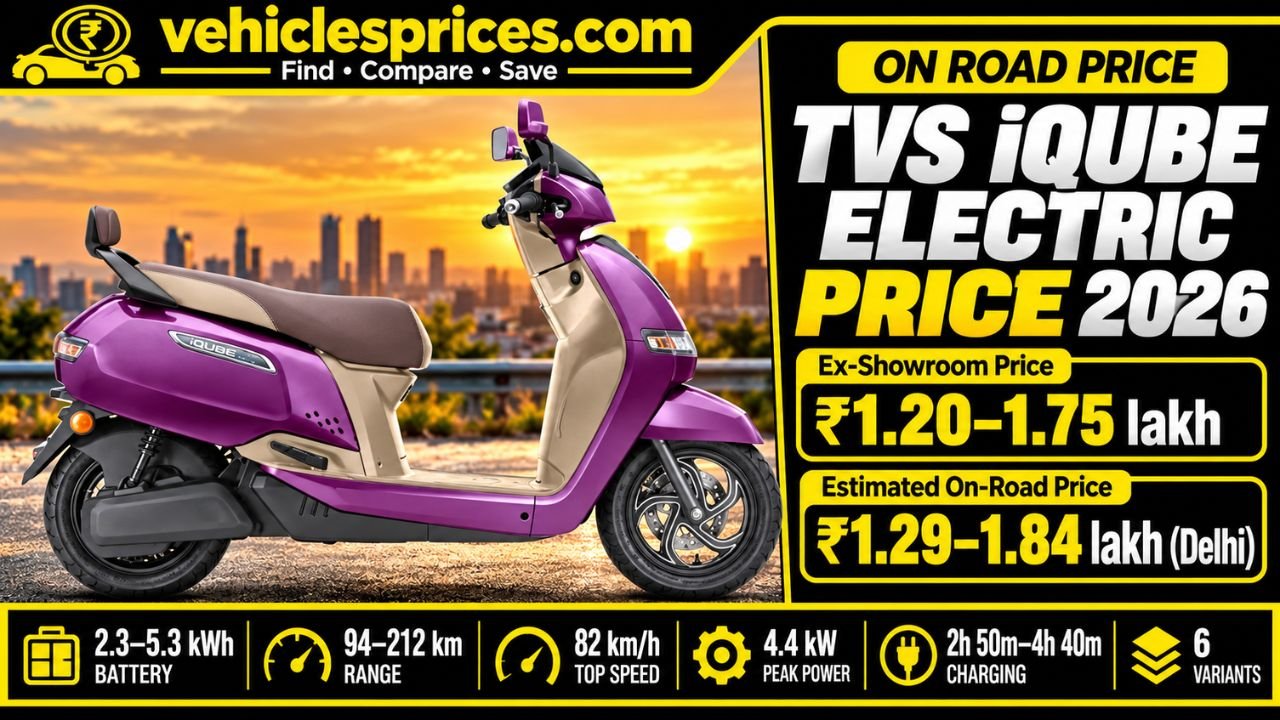
| Ex-showroom price (Delhi) | ₹1.20 lakh to ₹1.75 lakh |
| On-road price (Delhi) | ₹1.29 lakh to about ₹1.84 lakh |
| Variants | 2.3 kWh, 3.1 kWh, 3.5 kWh, MillionR Edition, S 4.7 kWh, ST 5.3 kWh |
| Battery | 2.3 kWh to 5.3 kWh lithium-ion |
| Motor | Hub-mounted BLDC, 3.68 kW to 4.4 kW peak, 140 Nm wheel torque |
| Claimed range (IDC) | 94 km to 212 km |
| Top speed | 68 km/h (2.3 kWh), 82 km/h (other variants) |
| Charging time (0-80%) | 2 hr 50 min to 4 hr 40 min |
| Brakes | Front disc and rear drum (front drum on 2.3 kWh) |
| Underseat storage | 30 to 32 litres (35.5 litres on MillionR) |
TVS iQube Price: What You’re Actually Paying For
The TVS iQube price starts at ₹1,20,374 ex-showroom for the 2.3 kWh and goes up to ₹1,75,384 for the iQube ST. Those figures are Delhi prices. Because electric scooters qualify for different state incentives, the number on your invoice can move.
Add registration, insurance and a few small charges, and you get the TVS iQube on road price. Budgeting only on the ex-showroom number is a common mistake, though for an EV the gap is smaller than it is for a petrol scooter.
Check Also: TVS Ronin On-Road Price, Variants, Mileage, Features, Colours & Reviews
TVS iQube On-Road Price: How It’s Calculated
The TVS iQube on road price has three parts: the ex-showroom price, registration or RTO charges, and first-year insurance. In Delhi, the RTO line is zero for the iQube, so you only add insurance and about ₹700 in other charges. On the ST, for example, an ex-showroom price of ₹1,75,384 plus ₹7,751 for insurance and ₹700 in fees gives ₹1,83,835.
That means the on-road premium in Delhi is only about 5% to 7%. Other states can charge more, so the TVS iQube on road price in your city may differ. Add-ons like extended warranty or a better charger raise the bill further.
TVS iQube Price in India: Variant-Wise List
TVS sets one ex-showroom price list, and state incentives then adjust it. Prices were raised by ₹500 to ₹10,400 on July 30, 2026, which is why older articles show lower numbers.
| Variant | Battery | Claimed range | Ex-showroom (Delhi) |
| iQube 2.3 kWh | 2.3 kWh | 94 km | ₹1,20,374 |
| iQube 3.1 kWh | 3.1 kWh | 123 km | ₹1,36,965 |
| iQube 3.5 kWh | 3.5 kWh | 145 km | ₹1,47,200 |
| iQube MillionR Edition | 3.5 kWh | 145 km | ₹1,50,751 |
| iQube S | 4.7 kWh | 175 km | About ₹1.65 lakh |
| iQube ST | 5.3 kWh | 212 km | ₹1,75,384 |
Every step up in battery adds range, but it also adds weight. The 2.3 kWh weighs about 110 kg, while the S and ST come close to 129 kg.
Here is the TVS iQube Electric price spread at a glance:
- Entry (2.3 kWh): ₹1.20 lakh
- Mid (3.1 kWh and 3.5 kWh): ₹1.37 lakh to ₹1.47 lakh
- Special edition (MillionR): ₹1.51 lakh
- Long range (S 4.7 kWh): about ₹1.65 lakh
- Top (ST 5.3 kWh): ₹1.75 lakh
The gap between the cheapest and costliest TVS iQube Electric is about ₹55,000. In return, the ST gives you more than double the claimed range of the base model.
TVS iQube On-Road Price: City-Wise Comparison
| City | Starting on-road price |
| Delhi | ₹1,28,546 |
| Bangalore | ₹1,26,439 |
| Chennai | ₹1,26,095 |
| Mumbai | ₹1,27,408 |
| Pune | ₹1,27,408 |
| Hyderabad | ₹1,32,989 |
Hyderabad is the most expensive of these cities for the base TVS iQube price, while Chennai is the cheapest. In Delhi, the MillionR Edition costs ₹1,59,505 on-road, the S about ₹1.74 lakh and the ST about ₹1.84 lakh. Top variants cost more in other cities as well, so ask your dealer for a written quote.
TVS iQube 2.3 kWh: The Entry Point
The TVS iQube 2.3 kWh is the cheapest way into the family at ₹1,20,374. It claims 94 km of range and a top speed of 68 km/h, and the motor makes 3.68 kW. It also has drum brakes at both ends and a 5-inch TFT display.
The 2.3 kWh charges from 0 to 80% in 2 hours 50 minutes, the quickest of any variant. It suits short city commutes of 30 to 40 km a day. If you only need a second vehicle for the neighbourhood, the TVS iQube range on this variant is plenty. An owner of the base model reports around 70 km on a charge, which is lower than the claimed figure.
Check Also: Royal Enfield Meteor 350 On-Road Price, Variants, Mileage, Features, Colours & Reviews
TVS iQube 3.1 kWh and 3.5 kWh: The Sweet Spot
The TVS iQube 3.5 kWh costs ₹1,47,200 and claims 145 km. The 3.1 kWh sits between the two at ₹1,36,965 with 123 km. Both use the stronger 4.4 kW motor, reach 82 km/h and get a front disc brake. Charging takes 4 hours 3 minutes on the 3.1 kWh and 4 hours 40 minutes on the 3.5 kWh.
Most buyers should look at the 3.5 kWh. A higher claimed TVS iQube mileage figure matters less than real range, and here the 3.5 kWh delivers. An owner in Uttarakhand reports around 115 km of real range on mixed roads, which makes the TVS iQube range on this variant usable for a full day of office travel plus errands. The 3.1 kWh is worth a look if your daily run is under 70 km. The TVS iQube 3.5 kWh also has the best balance between price, weight and charging time, which is why it is the variant dealers push most. Compared with the TVS iQube 2.3 kWh, it costs about ₹27,000 more but gives you a stronger motor, a front disc brake and an 82 km/h top speed.
TVS iQube MillionR Edition
TVS introduced the TVS iQube MillionR Edition on August 25, 2026, to mark one million iQube customers. It is based on the 3.5 kWh and carries the same 145 km claimed range. It costs ₹1,50,751, about ₹3,500 more than the standard 3.5 kWh.
For that you get Aurora Green dual-tone paint, premium seat upholstery, MillionR badging and new graphics. It also adds a front storage box, which lifts storage from 32 to 35.5 litres, and a USB Type-C charging port. Mechanically nothing changes, so it is a cosmetic and convenience upgrade.
TVS iQube S and TVS iQube ST: The Long-Range Pair
The TVS iQube S sits between the 3.5 kWh and the ST. It carries a 4.7 kWh battery with a claimed 175 km range and an 82 km/h top speed. It adds a 7-inch non-touch TFT display, voice assist and hill hold. Charging takes about 4 hours for 0 to 80%, and the 0 to 40 km/h run is claimed at around 4.3 seconds.
The TVS iQube ST is the flagship, and the TVS iQube S is the better pick if you want range without the touchscreen. It has a 5.3 kWh battery, a claimed 212 km range, a 7-inch touchscreen TFT and tyre pressure monitoring. TVS quotes a 50,000 km battery warranty on the ST page, and the scooter links to the SmartXonnect platform with more than 118 connected features. The ST is slightly slower off the line at about 4.5 seconds for 0 to 40 km/h, because the bigger battery adds weight.
The difference between S and ST is only about ₹10,000 in ex-showroom price, so if you are buying at this level, the ST’s extra range and touchscreen are easy to justify. The TVS iQube ST price of ₹1,75,384 is the highest in the lineup, but it is the only version that suits riders with a long daily run.
Which TVS iQube Variant Should You Buy?
- Best budget pick: iQube 2.3 kWh at ₹1.20 lakh, for short city trips
- Best all-rounder: iQube 3.5 kWh at ₹1.47 lakh
- Best for a lower budget with more range than the base: iQube 3.1 kWh at ₹1.37 lakh
- Best for style and storage: MillionR Edition at ₹1.51 lakh
- Best for long commutes: iQube S at about ₹1.65 lakh
- Best for tech and maximum range: iQube ST at ₹1.75 lakh
If you ride less than 40 km a day, the 2.3 kWh is enough. If you cover 60 to 80 km, the 3.5 kWh or S gives you comfortable headroom. Anything beyond that is ST territory.
TVS iQube Battery, Range and Charging Time
The TVS iQube range on paper is rated on the Indian Driving Cycle. Real-world numbers are lower, and testers put them at roughly 70% to 80% of the claim.
| Variant | Claimed range | Real-world range (approx.) | Charging 0-80% | Top speed |
| 2.3 kWh | 94 km | 70 to 80 km | 2 hr 50 min | 68 km/h |
| 3.1 kWh | 123 km | 90 to 100 km | 4 hr 3 min | 82 km/h |
| 3.5 kWh | 145 km | 105 to 115 km | 4 hr 40 min | 82 km/h |
| S 4.7 kWh | 175 km | 130 to 145 km | 4 hr | 82 km/h |
| ST 5.3 kWh | 212 km | 150 to 165 km | 4 hr 18 min | 82 km/h |
Anyone asking about TVS iQube mileage is really asking about range, and these real-world figures are the ones to plan around. Fast riding in Power mode, a heavy pillion and hilly roads will all cut the TVS iQube range, while gentle riding in Eco mode stretches it. As with any EV, the TVS iQube Electric loses a little range as the battery ages, so leave yourself a buffer. The iQube charges only from an AC socket and does not support DC fast charging. It comes with a portable off-board charger that fits under the seat, though the charger can take up a lot of the boot.
Check Also: Harley Davidson X440 On-Road Price, Variants, Mileage, Features, Colours & Reviews
TVS iQube Running Cost
An electric scooter is cheaper to run than a petrol one. At roughly ₹8.50 per unit of electricity, a full 3.5 kWh charge costs about ₹30. With around 110 km of real range, that works out to roughly 30 to 35 paise per km after charging losses. Service is also light, with the first service due at 4,000 km or 180 days.
TVS iQube Motor and Performance
The motor is a hub-mounted BLDC unit with 4.4 kW of peak power and 3 kW of rated power. The motor makes 33 Nm, while torque at the wheel is 140 Nm. It is rated IP67 for water and dust. TVS claims 0 to 40 km/h in around 4.2 to 4.7 seconds, depending on the variant.
On the road it feels smooth and silent. Acceleration is quick enough to keep up with city traffic, and the throttle is easy to modulate, which makes the TVS iQube Electric friendly for new riders. Regenerative braking recovers a little energy when you slow down. There are two ride modes, Eco and Power, and the motor stays usable in Eco even when the battery drops below 10%. Top speed is 82 km/h on most variants, which is enough for city roads and occasional highway stretches. The 2.3 kWh tops out at 68 km/h.
TVS iQube Features

The base TVS iQube Electric comes with a 5-inch TFT console, LED headlamp, indicators and tail lamp, DRLs, Bluetooth connectivity, turn-by-turn navigation, call and SMS alerts, regenerative braking, reverse assist, a USB port and OTA updates. The app adds geofencing, anti-theft alerts, fall alerts and live location tracking.
The S and ST upgrade the display to 7 inches, and the ST adds touch control. The ST also gets TPMS. Rivals like the Ather Rizta offer more features, so the iQube is the simpler and more conventional choice.
TVS iQube Connected Tech and App
TVS calls its connected platform SmartXonnect. It pairs the scooter with your phone and unlocks more than 118 connected features. You get turn-by-turn navigation, call and SMS alerts, distance to empty, remote charge status, geofencing, anti-theft alerts and live location tracking. On the ST, Alexa support and voice assist are also on offer.
The app is useful in daily life. You can check the charge level from your phone, see where you parked and get an alert if the scooter is moved. Software updates arrive over the air, so the TVS iQube Electric can improve after you buy it.
TVS iQube Design and Dimensions
The iQube has a safe, neutral design that suits all ages. It has boxy mirrors and side panels, and a light bar at the front that holds the headlamp, DRL and indicators.
It measures 1,805 mm in length, 645 mm in width and 1,140 mm in height, with a 1,301 mm wheelbase. Ground clearance is 157 mm and seat height is 770 mm. The scooter rides on 12-inch alloys with 90/90 tubeless tyres, and kerb weight runs from about 110 kg to 129 kg depending on the battery.
TVS iQube Storage and Practicality
Underseat storage is 30 litres on the 2.3 kWh and 32 litres on the higher variants, and the MillionR Edition goes up to 35.5 litres thanks to a front storage box. That is enough for 3 to 4 days of groceries or a laptop bag. The large charger can take up much of the space if you carry it around, so leave it at home or at work.
A carry hook, a USB port and a spacious floorboard add to the practicality. The floorboard is wide enough to carry a backpack even with a tall rider on board. Taller riders may notice their knees brushing the front apron.
Check Also: Royal Enfield Continental GT 650 On-Road Price, Variants, Mileage, Features, Colours & Review
TVS iQube Colours
The TVS iQube colours list has six shades: Titanium Grey, Walnut Brown, Pearl White, Aurora Green, Copper Brown Beige and Starlight Blue Beige. Not every colour is on every variant. The 2.3 kWh comes in Pearl White, Walnut Brown and Titanium Grey, while the 3.1 kWh adds Copper Brown Beige and Starlight Blue Beige. The 3.5 kWh offers all of those. Aurora Green Dual Tone is exclusive to the MillionR Edition.
TVS iQube Rider and Pillion Comfort
The seat is wide and soft, and the ergonomics are relaxed. Pillion riders have a spacious seat and a grab rail, so the scooter works well for couples and families. The forward-set footpegs suit most heights, and rear footpegs fold out for the pillion.
The soft seat is great for short trips but can feel too cushy on rides longer than an hour. If you commute long distances, test ride before you commit.
TVS iQube Ride Quality, Brakes and Safety
The iQube has a telescopic fork and twin hydraulic shock absorbers. Ride quality is its best trait. It absorbs potholes well and feels stable at city speeds with a pillion. The seat is soft and spacious, though on commutes longer than an hour it can feel too soft.
Braking uses a 220 mm front disc and a 130 mm rear drum on most variants, with combined braking. The iQube does not have ABS or traction control. Safety extras include side stand warning, hazard lights, tubeless tyres and the app-based crash and fall alerts.
TVS iQube Warranty and Service
TVS lists scheduled services at 4,000 km or 180 days, 8,000 km or 365 days, 12,000 km or 730 days and 16,000 km or 1,100 days. Servicing an electric scooter is simpler than a petrol one because there is no engine oil, spark plug or clutch to look after. TVS quotes a 50,000 km battery warranty on the ST page, so check the exact warranty terms for your variant at the dealer.
The TVS service network is wide, which is a real advantage over newer brands. Spares and accessories can be slow to arrive at some showrooms, so ask about availability before you buy.
TVS iQube EMI
BikeDekho quotes an EMI starting around ₹3,712 per month over 36 months at 9.7% interest for the entry variant. The ST works out to roughly ₹4,796 a month with a down payment near ₹34,000, according to ZigWheels. Check with your dealer, because finance offers change with the festive season.
TVS iQube vs Ather Rizta vs Bajaj Chetak
The TVS iQube vs Ather Rizta question comes up most often, followed by the TVS iQube vs Bajaj Chetak. These starting prices come from BikeDekho:
| Scooter | Starting price | Claimed range | Top speed |
| TVS iQube 2.3 kWh | ₹1.20 lakh | 94 km | 68 km/h |
| Ather Rizta | ₹1.22 lakh | 123 km | 80 km/h |
| Bajaj Chetak | ₹1.19 lakh | 131 km | 70 km/h |
| Ola S1 X Plus | ₹1.22 lakh | 242 km | 125 km/h |
| Vida V2 | ₹1.51 lakh | 143 km | 85 km/h |
| Honda Activa e | ₹1.20 lakh | 102 km | 80 km/h |
The Rizta offers a better feature list, and the Ola S1 X is more budget-friendly for the range. The Vida V2 looks sharper, and the TVS Orbiter offers a long feature list at a lower price. The Bajaj Chetak has a premium metal body, while the Honda Activa e brings a trusted badge but a shorter range. The iQube wins on brand trust, ride comfort, service reach and a wide choice of batteries.
Think about how you will use the scooter. If you want the most range for your money, rivals like the Ola S1 X look strong on paper. If you want a proven, comfortable all-rounder with a large service network, the TVS iQube Electric is a safer bet. Remember that the entry iQube has the shortest range here, so compare the 3.5 kWh against these rivals for a fair match.
Check Also: Ultraviolette X47 Venom On-Road Price, Variants, Range, Features, Colours & Reviews
TVS iQube Review: What Experts Say
BikeDekho’s expert rates the scooter 4.0 out of 5, and owners give it 4.4 out of 5 across 485 reviews. Reviewers praise the smooth, silent ride, comfortable seat, solid design, app connectivity and the instant torque. Owners often mention the low running cost, the comfortable ride with a pillion and how easy the scooter is for first-time riders, including older family members. The TVS iQube review feedback on range is mostly positive, though owners note that real range depends heavily on riding style.
The negatives are worth knowing. One tester saw rattling panels and rusting screws within six months. The hub motor makes tyre changes harder. Charging takes longer than some rivals, and accessories can be hard to find at the showroom.
Practical Tips Before You Finalise Your Purchase
- Ask the dealer for the TVS iQube on road price in writing, with ex-showroom price, insurance and other charges as separate lines.
- Choose the battery by your daily distance. Add a 30% buffer to your daily run before you decide.
- Check for state incentives and festive finance offers before you pay.
- Confirm you can charge at home or at work, since there is no fast charging.
- Test ride two variants. The 2.3 kWh and 3.5 kWh feel quite different.
What’s Changing in TVS iQube Price and Lineup
Prices can move at any time, and the July 2026 revision is a reminder. Always check the latest list before booking. TVS has not confirmed any new iQube variant, although one portal mentions a possible iQube Sport. Treat that as speculation until TVS announces it.
On the wider range, TVS has shown concepts such as the Vision iQube and an electric maxi-scooter called the M1-S, but neither has a confirmed launch date.
Check Also: Triumph Speed 400 On-Road Price, Variants, Mileage, Features, Colours & Reviews
FAQs
What is the TVS iQube price in India?
It starts at ₹1,20,374 for the 2.3 kWh and goes up to ₹1,75,384 for the ST, ex-showroom Delhi.
What is the TVS iQube on-road price in Delhi?
It runs from ₹1,28,546 for the base variant to about ₹1.84 lakh for the ST.
What is the real-world range of the TVS iQube?
Expect around 70 to 80 km on the 2.3 kWh and 105 to 115 km on the 3.5 kWh. The ST can reach about 150 to 165 km.
How long does the TVS iQube take to charge?
From 0 to 80%, it takes 2 hours 50 minutes on the 2.3 kWh and up to 4 hours 40 minutes on the 3.5 kWh.
What is the top speed of the TVS iQube?
It is 82 km/h on most variants and 68 km/h on the 2.3 kWh.
Does the TVS iQube have a touchscreen?
Only the iQube ST has a 7-inch touchscreen TFT.
Does the TVS iQube need a licence?
Yes, a driving licence is required.
Source: TVS Motors