The November 27 date has been circled on the calendars of many. This day will witness the debut of Royal Enfield Himalayan 750, which is arguably the most anticipated model for the Royal Enfield for 2026 calendar, and has seen numerous developments, starting from spy photos to the prototypes and two separate international displays.
Now, here is what the summary says in the case of hurry: the Royal Enfield Himalayan 750 is not the bigger version of the Himalayan 450; it is actually in a higher segment than it. The company has developed the new 750cc twin-cylinder engine for the specific purpose, instead of just modifying the existing Himalayan 450; which means this is going to be the flagship for the Himalayan family.
Royal Enfield Himalayan 750 Specifications (Quick Overview)
| Specification | Detail |
| Engine | 750cc, air-oil-cooled, parallel-twin |
| Power (expected) | ~55 PS |
| Torque (expected) | ~60 Nm |
| Gearbox | 6-speed, possibly with slipper clutch |
| Frame | New steel tubular frame, bolt-on rear subframe |
| Front suspension | Showa inverted fork, adjustable |
| Rear suspension | Linked monoshock, remote preload adjustment |
| Front brake | Twin discs |
| Rear brake | Single disc |
| ABS | Switchable, dual-channel |
| Front wheel | 19-inch alloy (road-biased) / spoked (off-road-biased) |
| Rear wheel | 17-inch alloy (road-biased) / spoked (off-road-biased) |
| Fuel tank capacity (expected) | ~20 litres |
| Mileage (expected) | ~20-25 kmpl |
| Kerb weight (expected) | ~220-240 kg |
| Seat height (expected) | ~825-850mm |
| Display | Circular TFT with navigation |
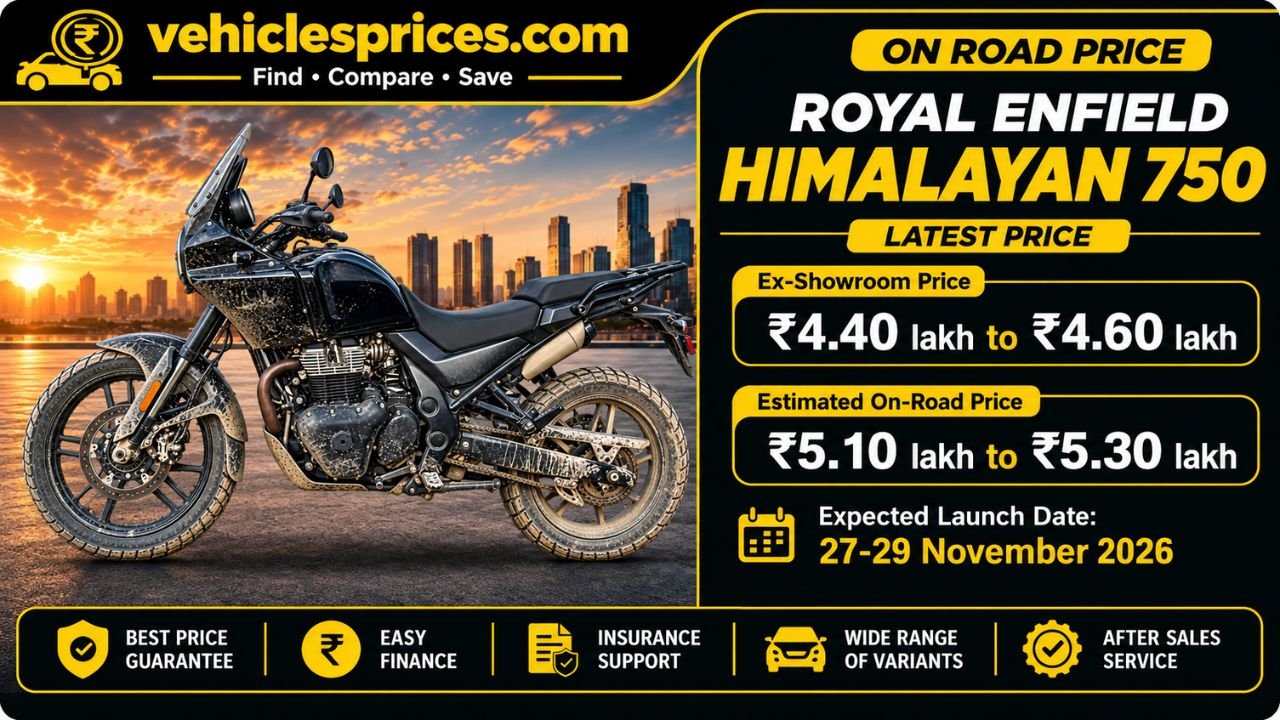
| Expected price | ₹4.40-4.60 lakh (ex-showroom) |
| Expected launch | November 27-29, 2026 (Motoverse, Goa) |
Royal Enfield Himalayan 750 Launch Date in India
Royal Enfield hasn’t issued a formal press release with a fixed date and time yet, but the situation has become much clearer in the past few weeks. The company unveiled the Himalayan 750 at its own Himalayan Basecamp in Ladakh just one day after launching the Himalayan 440, and multiple auto publications suggest the Motorverze 2026 (27-29 November, Vagator, Goa) is set to host the India reveal.
There is a good reason the timing is the way it is: Royal Enfield’s CEO has confirmed the launch of the new 750cc platform will take place around EICMA 2026 in Italy (typically in November) which fits with a pattern of first unveiling bikes internationally and then later in the year showing them off to the home audience at a local event.
A smaller number of reports in the early part of the year suggested an early 2027 India launch would follow, suggesting the domestic debut would come years after the international introduction. This timing estimate appears to have been outdated already considering how far along the production of this bike has become: test mules have been seen in almost production-ready trim with no visible wiring harnesses or data-logging equipment, which typically signals a bike is months from launch, not years.
In the last month or so sightings of the Himalayan 750 have changed from long-lens spy photos to fully revealed showcases — a sure sign the bike has finished development and Royal Enfield is just managing the reveal cadence now.
Royal Enfield Himalayan 750 Expected Price
Nobody outside Royal Enfield knows the final number yet, but the consensus across multiple auto publications is fairly tight on where this is likely to land. Expect the Himalayan 750 to open at around ₹4.40 lakh and go up to roughly ₹4.60 lakh (ex-showroom) for the base variant, with a couple of earlier estimates pegging it slightly lower, closer to ₹4 lakh.
| City | Expected Starting Price (Ex-showroom) |
| Mumbai | ₹4,52,000 onwards |
| Delhi | ₹4,50,000 onwards |
| Bangalore | ₹4,48,000 onwards |
| Pune | ₹4,44,000 onwards |
| Hyderabad | ₹4,48,000 onwards |
| Chennai | ₹4,42,000 onwards |
| Kolkata | ₹4,46,000 onwards |
| Lucknow | ₹4,47,000 onwards |
That’s ex-showroom, not what you’ll actually pay to ride it home. Add in RTO registration, insurance, and state road tax, and the Royal Enfield Himalayan 750 on-road price typically ends up about ₹55,000-₹95,000 higher than the figures above, depending on which state you’re registering in and what insurance cover you pick.
So why does this matter? Because it’s really the whole point of the bike. Royal Enfield already has capable adventure bikes in the 440 and 450 – what it doesn’t have is a genuine twin-cylinder ADV that can go up against international mid-weight tourers without asking buyers to spend premium-European money. Keeping the 750 around ₹4.5 lakh is what makes the comparison possible in the first place.
Royal Enfield Himalayan 750 On-Road Price Structure
The on-road price isn’t a random number your dealer picks. It’s built from three clear parts, and understanding them helps you spot overcharging instantly.
- Ex-showroom price: The factory-set base cost before any tax or fee – the ₹4.40-4.60 lakh range covered above.
- RTO registration and road tax: A percentage of the ex-showroom price, and this percentage changes from state to state – typically 8% to 15%.
- First-year comprehensive insurance: Mandatory for every new two-wheeler, and the premium depends on your city, your age, the bike’s insured value, and any add-on covers you choose. Given the Himalayan 750’s higher price tag, expect a noticeably higher premium than on the 440 or 450.
- Handling and logistics charges: Dealerships typically add a charge to cover transport from the factory or warehouse, plus pre-delivery inspection (PDI).
Because RTO tax rules differ across states, the same Himalayan 750 variant can cost thousands of rupees more or less depending purely on where you register it. So the Royal Enfield Himalayan 750 on-road price you see in one city may not match what a friend pays elsewhere, even for the identical trim.
Read Also: Royal Enfield Himalayan 440 Launch Date, Price & Specifications
Royal Enfield Himalayan 750 On-Road Price in Top Cities
Here’s how the base variant (expected ex-showroom ₹4.50 lakh) roughly compares on-road across a few major cities, once RTO and insurance are factored in:
| City | Ex-Showroom Price (Expected) | Approx. On-Road Price |
| Delhi | ₹4,50,000 | ₹5,10,000 onwards |
| Mumbai | ₹4,50,000 | ₹5,20,000 onwards |
| Bangalore | ₹4,50,000 | ₹5,30,000 onwards |
| Pune | ₹4,50,000 | ₹5,22,000 onwards |
| Chennai | ₹4,50,000 | ₹5,25,000 onwards |
| Hyderabad | ₹4,50,000 | ₹5,18,000 onwards |
| Kolkata | ₹4,50,000 | ₹5,12,000 onwards |
| Lucknow | ₹4,50,000 | ₹5,15,000 onwards |
Every figure above is a working estimate based on how on-road pricing typically stacks up in India – not an official number. Royal Enfield’s website and dealer portals will list exact, state-wise on-road prices only once the bike is actually launched.
Royal Enfield Himalayan 750 Features
What we’re fairly confident about, based on spy shots, the Ladakh showcase, and reporting so far:
- Circular TFT display shared with the Himalayan 450, with Bluetooth, call/SMS alerts, and Google Maps navigation mirrored onto the dash
- Rotary ignition switch on the right switchgear
- A likely ride-mode selector switch, marked with an “M”
- Dedicated cruise control switch – a first for the Himalayan range
- Joystick on the left switchgear for navigating the display
- Dedicated traction control switch, separate from the ABS/hazard controls
- Switchable dual-channel ABS
- Six-speed gearbox, possibly with a slipper clutch
- LED headlamp similar in style to the Himalayan 450
- Tall windscreen for highway wind protection
No confirmed quickshifter yet, and Royal Enfield hasn’t said anything officially about ride-by-wire, but given the ride-mode switch already spotted, some form of electronic throttle control seems very likely. USB charging, an engine kill switch, and full LED lighting throughout are also reasonable assumptions given they’re already standard on the Himalayan 450, though none of these have been explicitly confirmed on the 750 through spy shots so far.
Royal Enfield Himalayan 750 Engine and Performance
Take the tank off, hypothetically, because nobody gets to see inside the engine bay any time soon, and you’ll find an all-new 750cc air/oil-cooled parallel-twin powerplant, not a bored-out version of anything currently in Royal Enfield’s stable, and not the 650cc twin that powers the Interceptor, Continental GT, Shotgun, or Super Meteor, either. It’s all new, mounted to a steel tubular frame with a bolt-on rear subframe and chassis geometry optimized for long-distance touring.
It’s the gearbox and chassis that are the real talking points, though, with the Himalayan 750 getting a six-speeder, and because this isn’t a single-cylinder motor like the current Himalayan models, power delivery is much more linear and the vibes at highway speeds are far less punishing than either the 440 or 450 currently on sale, making long stretches of two-up touring much less fatiguing than with the air-cooled bikes.
Royal Enfield Himalayan 750 Colours
Royal Enfield has not given us an official list of colors for the Himalayan 750 yet, and the few spy shots or showcase units we’ve seen so far have only carried one or two color options: a dull, olive green or sand-like color that fits in with the rugged, expedition-oriented image the company is going for with this Himalayan launch. Considering the 440 and 450 Himalayans launched in multiple colors at launch, each with a different theme (desert, forest, glacier, etc.) to suit their respective adventure levels, it would truly be a surprise if the 750 launched with only one. Expect to see at least three or four color options when the bike is officially unveiled in, likely split between the road-biased and off-road-biased Himalayan variants.
Royal Enfield Himalayan 750 Booking Date
Bookings for a bike this big are rare on launch day itself. Royal Enfield’s pattern with recent flagship launches is indicative of what to expect: the Super Meteor 650 and Himalayan 450 both had bookings open on reveal or within days of it, so expect a similar pattern here, with token bookings opening around the time of the Motoverse 2026 reveal, followed by a phased rollout of deliveries over the following months.
A waiting period of two to four months for the initial batch of deliveries, with allocations going out fastest in metro cities, wouldn’t be unusual for a 750cc platform that’s new to production for Royal Enfield. This is indicative of a general pattern across comparable Royal Enfield launches, not a figure confirmed for the 750 specifically.
Read Also: Upcoming Car Launches in September 2026 – Price, Specs & Dates
Royal Enfield Himalayan 750 Mileage
Official ARAI figures aren’t out yet – those only get certified closer to or at launch – and there’s no smaller-displacement sibling running the exact same engine to extrapolate from this time, unlike the 440’s relationship with the Scram 440. That makes this genuinely one of the harder numbers to pin down right now.
For a rough sense of direction: the Himalayan 450’s single-cylinder engine returns around 29-30 kmpl in typical use, while Royal Enfield’s existing 650cc parallel-twins generally return somewhere in the low-to-mid 20s kmpl in mixed riding. Given the Himalayan 750 is a larger twin built for touring rather than efficiency, expect it to land closer to that 650cc range – roughly 20-25 kmpl – rather than anywhere near the 450’s figures. We’ll swap in confirmed ARAI numbers here the moment Royal Enfield releases them.
Worth flagging separately: fuel tank capacity hasn’t been officially confirmed either, but a few reports tracking the bike’s development have suggested a figure around 20 litres – noticeably larger than the Himalayan 450’s tank, and consistent with a bike built around long, multi-day touring rather than short commutes. A bigger tank paired with an efficiency figure in the low-to-mid 20s kmpl would still translate into a genuinely usable touring range of somewhere around 400-450 km between fill-ups, which is a solid number for a bike this size.
Royal Enfield Himalayan 750 Design and Styling: What the Spy Shots Reveal
The Royal Enfield Himalayan 750 spy shots and showcase photos doing the rounds – including a batch from the UK, an earlier prototype in Brazil, and now full, undisguised images from the Ladakh Basecamp reveal – paint a pretty complete picture at this point. Two influences are obvious: the existing Himalayan 450’s design language, and a genuinely larger, more muscular overall footprint.
Front end. An LED headlamp styled similarly to the Himalayan 450, a tall windscreen for wind protection, and a semi-fairing that gives it a more purposeful, touring-focused look than the smaller Himalayans.
Fuel tank. A muscular tank with large tank shrouds, borrowing a few visual cues from the recently launched Himalayan 440, tying the whole family together even as the displacement jumps considerably.
Rear end. A split-seat setup, chunky grab rails, an upswept exhaust for off-road ground clearance, a saree guard, and a rear luggage rack built for mounting saddlebags and top boxes – all pointing toward genuine long-distance touring intent rather than just adventure-styled looks.
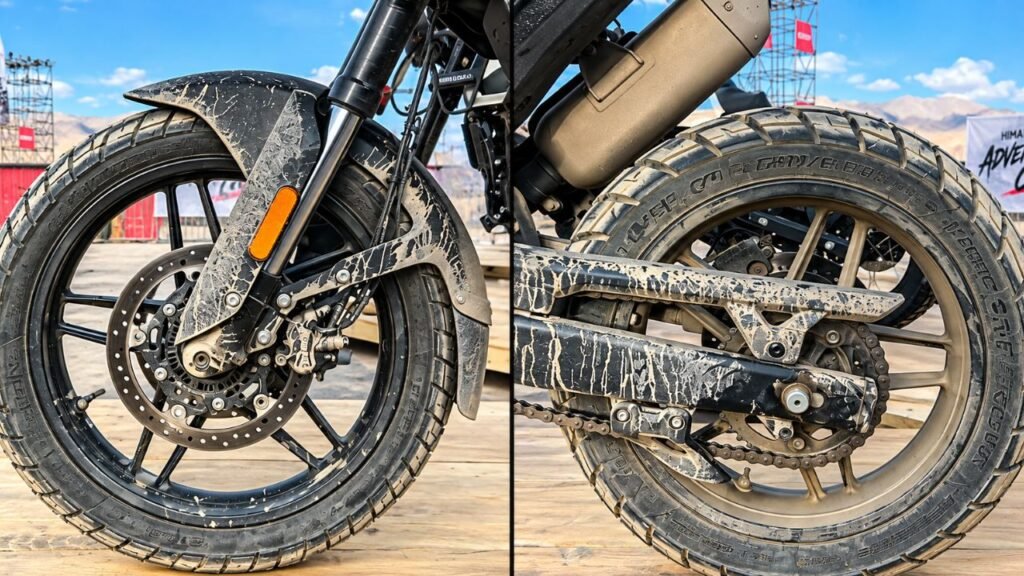
Wheels and tyres. This is where variant choice comes in. The road-biased version, shown most recently in Ladakh, rides on 19-inch front and 17-inch rear cast alloy wheels wrapped in Ceat dual-purpose rubber. A separate off-road-biased variant, shown earlier in Brazil, uses spoked wheels in the same sizes with tubeless tyres – suggesting Royal Enfield is offering both from day one rather than adding a spoke option later.
Cockpit. A circular TFT display shared with the Himalayan 450, a rotary ignition switch, a joy stick to cycle through menus, and switches for cruise control, hazard lights, and traction control — the most comprehensive set of switches on any Himalayan to date.
Royal Enfield Himalayan 750 Weight and Kerb Weight
Royal Enfield has not announced the kerb weight of the bike. For reference, the Himalayan 450 weighs around 196 kg, while their current 650cc twins range from nearly 195 kg to over 240 kg depending on fuel. Considering that the Himalayan 750 gets a bigger engine, a larger frame and touring-friendly features like a luggage rack and bigger fuel tank, it is safe to assume that the kerb weight will be significantly higher than that of the 450. It is expected to be somewhere in the region of 220-240 kg when filled to the brim.
Royal Enfield Himalayan 750 Seat Height and Ergonomics
While there are no official specs yet, it should come as no surprise that the seat height is expected to sit a fair bit above the approachable Himalayan 440’s 800mm figure, given how much bigger and more touring-focused this bike is. The Himalayan 450’s standard seat height of 825mm+ is probably the closer reference point, and the 750 may well land at or slightly above that mark once official numbers are out.
This matters a lot in the Indian market, where average rider height runs lower than in Europe or America, making approachability a genuine factor in the buying decision. A taller seat height isn’t necessarily a dealbreaker – it usually comes with a narrower seat-tank junction that helps shorter riders reach the ground more easily than the raw number suggests – but it’s still worth planning around, especially for anyone under roughly 5’5″.
Quick Ergonomics Comparison
| Model | Seat Height | Approx. Kerb Weight |
| Himalayan 440 | ~800mm | TBA |
| Himalayan 450 | 825mm (standard) | ~196kg |
| Himalayan 750 (Expected) | ~825-850mm | ~220-240kg |
Royal Enfield Himalayan 750 Suspension and Handling
The front fork is a Showa inverted one, adjustable for compression damping and spring preload, while the single monoshock at the rear is linked and also features remote preload adjustment – so that you can tweak the spring preload at the rear without having to get off the bike, a very handy spec to have on an adventure bike that’s likely to be aimed at the higher end of the market.
Two discs at the front and one at the rear provide the braking power, with switchable dual-channel ABS. The ABS is likely to be turned off at the rear to allow for controlled slides at the back on loose ground.
Read Also: Maruti Suzuki Baleno Facelift India Launch, On-Road Price, Variants & Features
Royal Enfield Himalayan 750 vs Himalayan 440: What’s the Difference?
| Parameter | Himalayan 440 | Himalayan 750 (Expected) |
| Engine | 443cc, air-oil-cooled, single-cylinder | 750cc, air-oil-cooled, parallel-twin |
| Power | ~25bhp | ~55 PS |
| Torque | ~34Nm | ~60Nm |
| Gearbox | 6-speed | 6-speed |
| Front Suspension | Telescopic forks | Showa inverted forks (adjustable) |
| Instrument Cluster | Analogue-digital | Full circular TFT display |
| Seat Height | ~800mm | ~825-850mm (expected) |
| Expected Price | ~₹2.40-2.50 lakh | ~₹4.40-4.60 lakh |
| Positioning | Simple, accessible ADV | Premium, flagship touring ADV |
Royal Enfield Himalayan 750 Rivals
| Rival | Approx. Price (Ex-showroom) | Engine |
| Honda NX500 | Depends on import/CBU pricing | 471cc, liquid-cooled parallel-twin |
| BMW F 450 GS | Premium segment pricing | Liquid-cooled parallel-twin |
| Norton Atlas (upcoming) | TBA | TBA |
| Brixton Crossfire 500 Storr (upcoming) | TBA | 500cc, liquid-cooled |
| Himalayan 750 (Expected) | ~₹4.40-4.60 lakh | 750cc, air-oil-cooled parallel-twin |
Royal Enfield’s real advantage here isn’t a spec-sheet fight – most of these rivals run liquid-cooled engines that will likely edge the 750 on outright refinement and peak performance. It’s the brand’s service network, resale value, and the sheer pull of the Himalayan name among Indian adventure riders. That counts for a lot when you’re planning a long tour and want to know parts and mechanics won’t be a problem three states away from home – something genuinely imported rivals can’t always promise in India.
Why the Royal Enfield Himalayan 750 Matters
When the Himalayan 450 replaced the 411, it brought a genuinely impressive set of upgrades – liquid cooling, USD forks, a DOHC head, ride-by-wire, a full TFT dash. It proved Royal Enfield could build a properly modern adventure bike. The Himalayan 750 is the next logical step in that story – not a bigger single, but an entirely new twin-cylinder platform meant to go up against international mid-weight ADVs on genuinely equal footing.
It also completes a clean three-tier Himalayan range: the 440 as the simple, accessible entry point; the 450 as the tech-forward mainstream option; and the 750 as the flagship for riders who want maximum capability and are prepared to pay for it. Very few manufacturers manage this kind of clear segmentation at Royal Enfield’s price points, and it gives buyers a genuine ladder to climb within a single trusted nameplate – all while, if the pricing estimates hold, staying meaningfully cheaper than what a comparable twin-cylinder ADV from an established European or Japanese brand would cost in India.
For existing Royal Enfield owners specifically, the Himalayan 750 also represents something the brand hasn’t really offered before: a genuine “one bike does it all” touring option that doesn’t ask you to step outside the Himalayan badge to get twin-cylinder smoothness, cruise control, and switchable traction control in an adventure-bike body. Until now, that combination simply didn’t exist anywhere in Royal Enfield’s lineup – the 650 twins are cruisers and roadsters, not ADVs, and the Himalayan 450, capable as it is, remains a single-cylinder machine with its own set of trade-offs on long highway stretches.
Frequently Asked Questions (FAQs)
Q1. What is the launch date of the Royal Enfield Himalayan 750?
Expected at Motoverse 2026, November 27-29, in Vagator, Goa, alongside a global debut around EICMA 2026.
Q2. What will be the price of the Royal Enfield Himalayan 750 in India?
Expected to be in the ₹4.40-4.60 lakh (ex-showroom) range, though official pricing is confirmed only at launch.
Q3. What engine does the Royal Enfield Himalayan 750 use?
An all-new 750cc, air-oil-cooled, parallel-twin engine producing around 55 PS and 60Nm, paired with a six-speed gearbox.
Q4. What is the expected mileage of the Royal Enfield Himalayan 750?
Likely in the 20-25 kmpl range, lower than the Himalayan 450’s ~29-30 kmpl, though official ARAI figures aren’t out yet.
Q5. How is the Himalayan 750 different from the Himalayan 440?
The 750 gets a twin-cylinder engine, a TFT display, cruise control, and a much higher price versus the 440’s simpler single-cylinder, analogue-digital setup.
Q6. What is the expected kerb weight of the Himalayan 750?
Not officially disclosed, but likely in the 220-240 kg range given the larger twin-cylinder engine and bigger frame.
Q7. Will there be an off-road-focused variant?
Yes – alongside the road-biased alloy-wheel version, a spoked-wheel, off-road-biased variant has been shown separately in Brazil.
Q8. What are the rivals of the Royal Enfield Himalayan 750?
Honda NX500, BMW F 450 GS, and the upcoming Norton Atlas and Brixton Crossfire 500 Storr.
Q9. Will there be a waiting period after launch?
Likely, given it’s an all-new platform – a two to four month wait for early deliveries wouldn’t be unusual.
Q10. Is the Himalayan 750 a replacement for the Himalayan 440?
No – it sits above the 440 as a new flagship, and the 450 is expected to continue alongside it.
Source: Royal Enfield





Leave a Reply