Bajaj has put an end to the guessing game around its updated quarter-litre naked. The Pulsar N250SS is now officially launched, and it isn’t a cosmetic tweak or a new paint job slapped on the existing N250 – it’s a genuine upgrade to the engine, the gearbox and the electronics, arriving right as the Pulsar brand celebrates 25 years on Indian roads.
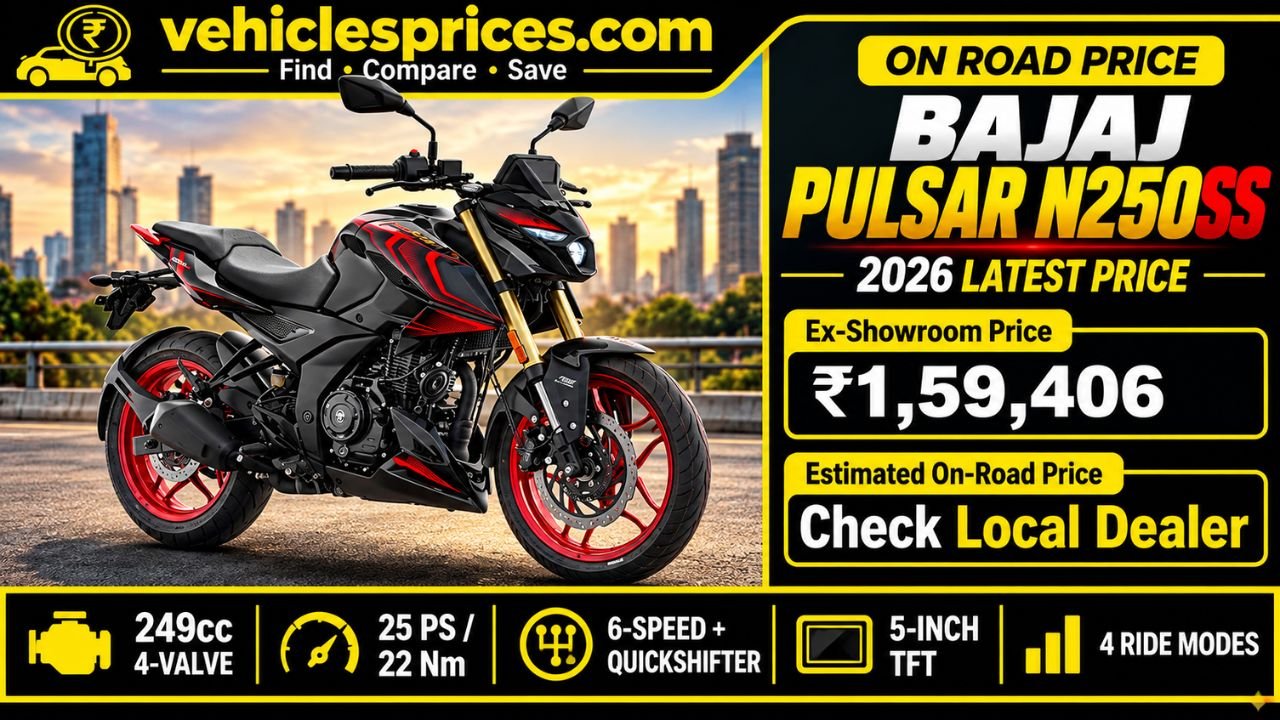
Here’s the short version, if you’re in a hurry: the Bajaj Pulsar N250SS has launched at ₹1,59,406, ex-showroom Delhi, which is about ₹14,000 to ₹17,000 more than the standard N250 depending on which report you read. For that premium, Bajaj has given it a reworked four-valve engine, a six-speed gearbox in place of the old five-speed, a quickshifter, electronic throttle control with four ride modes, and a new 5-inch TFT display with Google Maps mirroring. It’s part of a larger update programme that has already touched the Pulsar N160, the Pulsar 125 and 150, and the NS400Z. We’ve pulled together what’s confirmed, what Bajaj has said, and what’s still being speculated by auto media, and organised it all below – launch details, price, engine and performance, features, mileage, design, rivals, and a full FAQ section. We’ll keep updating this as Bajaj reveals more or as on-road prices get confirmed city by city.
Bajaj Pulsar N250SS: Quick Specification
Before we go deep into each section, here’s a one-glance summary of where things stand. Anything marked Confirmed comes directly from Bajaj’s own launch announcement; anything marked Estimated or Expected is reported by auto media and not an official figure from Bajaj, so treat it accordingly.
| Parameter | Detail | Status |
| Name | Pulsar N250SS | Confirmed |
| Launch date | 21 October 2026 | Confirmed |
| Ex-showroom price (Delhi) | ₹1,59,406 | Confirmed |
| Premium over standard N250 | About ₹14,000-17,000 | Reported, figures vary |
| Engine | 249cc, air-oil-cooled, single-cylinder, 4-valve | Confirmed |
| Power | 25 PS | Confirmed |
| Torque | 22 Nm | Confirmed |
| Gearbox | 6-speed, with quickshifter (Sports Shifter) | Confirmed |
| Throttle | Electronic Throttle Body (ETB) | Confirmed |
| Ride modes | Rain, Road, Sport, Off-Road | Confirmed |
| Instrument cluster | 5-inch TFT with Google Maps mirroring | Confirmed |
| Other features | Adjustable levers, USB Type-C, hazard switch, Panic Brake Alert | Confirmed |
| Mileage | Not officially disclosed yet | Unconfirmed |
| Key rivals | Suzuki Gixxer 250, Hero Xtreme 250R, Yamaha FZ25 | Based on price band and segment fit |
This is deliberately a mix of “confirmed” and “estimated” columns rather than a clean spec sheet, because that’s the honest picture right now. Dealer-level on-road prices by city, and real-world mileage figures, will only firm up once the motorcycle has been riding around for a few weeks.
Bajaj Pulsar N250SS Launch Date and Background
Bajaj Auto officially launched the Pulsar N250SS on 21 October 2026, confirming the price and specifications that had already leaked through dealership sightings in the weeks before. The company had quietly let the updated model reach showrooms ahead of the formal announcement, which is how most of the early spy-shot coverage and expected-price estimates came about in the first place.
The timing isn’t accidental. The N250SS arrives as the Pulsar brand marks 25 years in India, and Bajaj has used the milestone to push through a wave of updates across the range rather than confining the celebration to a single special edition. Since August 2026, the company has rolled out updated N160 variants, new-generation Pulsar 125 and 150 motorcycles, and a TFT-equipped NS400Z. The N250SS now carries that same update programme into the quarter-litre N-series, and recent sightings of updated NS160 and RS200 test motorcycles suggest Bajaj isn’t done yet.
Commenting on the launch, Sarang Kanade, Chief Business Officer of Bajaj Auto’s two-wheeler business, said that pairing an upgraded powertrain with electronic throttle-based ride modes strengthens the motorcycle’s overall proposition, adding that the company wants technology to be a meaningful part of the riding experience rather than a checklist item.
Check Also: Royal Enfield Classic 650 Hypershift Launched at Rs 4.26 Lakh: Price, Design, Engine and Booking Details
Bajaj Pulsar N250SS Price in India
The number everyone’s searching for: the Bajaj Pulsar N250SS price is ₹1,59,406, ex-showroom Delhi. That’s the official, Bajaj-confirmed figure at launch, and it should be read as the starting and currently the only ex-showroom price, since Bajaj has launched the N250SS as a single, fully-loaded variant rather than splitting it into trims.
How does that compare with the standard N250? Reports differ slightly on the exact premium:
| Source | Premium Over Standard N250 |
| Motoring World | About ₹17,000 |
| GaadiFy | ₹14,000 |
| Auto India Daily | ₹14,000 |
Line these up and the honest number sits somewhere between ₹14,000 and ₹17,000 over the regular N250, depending on which variant of the standard bike you’re comparing it against and when each report pulled its pricing. Either way, the bajaj pulsar n250ss isn’t a huge step up in cost for what is a genuinely reworked motorcycle underneath.
Where This Price Sits Against Rivals
Even with the update, Bajaj has kept the N250SS firmly inside its segment rather than pricing it into the next bracket. At ₹1.59 lakh, it undercuts most of its direct rivals by a meaningful margin:
| Motorcycle | Approx. Ex-showroom Price |
| Bajaj Pulsar N250SS | ₹1.59 lakh |
| Suzuki Gixxer 250 | ₹1.85 lakh |
| Hero Xtreme 250R Carbon | ₹1.98 lakh |
That gap of ₹25,000 to ₹40,000 against its closest rivals is worth sitting with for a moment. Bajaj has added a six-speed gearbox, a quickshifter, ride modes and a TFT cluster – features that typically come bundled with a price jump into the next segment – and still kept the bajaj pulsar n250ss launch price well under ₹1.6 lakh. For buyers comparing specs sheets line by line, that’s the N250SS’s single biggest selling point.
On-road prices will naturally run higher once RTO registration, road tax and insurance are added, and those vary by state. As with any fresh launch, expect the first wave of on-road quotes from dealerships to firm up over the next few weeks, so it’s worth checking with your local Bajaj Probiking showroom before you commit to a booking.
Engine, Gearbox and Performance
The headline mechanical change is under the fuel tank. The Pulsar N250SS uses an updated version of the familiar 249cc, air-oil-cooled, single-cylinder engine, but Bajaj has given it a four-valve cylinder head in place of the two-valve unit on the regular N250. That change alone has bumped output from 24.5 PS and 21.5 Nm on the standard bike to 25 PS and 22 Nm on the SS. It’s a modest gain on paper, half a horsepower and half a newton-metre, but the real story isn’t the peak numbers – it’s how the power gets delivered and through what gearbox.
Bajaj has swapped the old five-speed transmission for a six-speed unit, which should spread the power more evenly across the rev range and make high-speed cruising noticeably more relaxed, since the extra ratio typically translates into lower revs at a given road speed. Alongside the new gearbox, the N250SS also gets a Sports Shifter – Bajaj’s name for its quickshifter – which lets you bang through gears without touching the clutch lever or rolling off the throttle. That’s a feature usually reserved for motorcycles a segment or two above this one, and having it on a sub-₹1.6-lakh naked bike is a genuine talking point.
The other big mechanical addition is an Electronic Throttle Body, or ETB, replacing the old cable-operated throttle. This isn’t just about smoother response – it’s what unlocks the bike’s new riding modes: Rain, Road, Sport and Off-Road. Each mode is expected to alter throttle response and power delivery to suit the conditions, giving riders a layer of control that simply didn’t exist on the standard N250. These modes work alongside the bike’s existing ABS modes, stacking two separate layers of electronic adjustment onto what used to be a fairly analogue motorcycle.
Put together, the Bajaj Pulsar N250SS reads less like a mild spec bump and more like Bajaj trying to make a quarter-litre commuter-sports bike feel genuinely modern. Whether the real-world difference in outright performance is dramatic is something only extended test rides will settle, but on specification alone, this is one of the most comprehensively updated bikes in its price bracket right now.
Check Also: 2027 Kawasaki Z1100 Launched at ₹12.79 Lakh: Specs, Features, Mileage, Colours & Reviews
Features and Technology
Beyond the engine and gearbox, Bajaj has loaded the N250SS with a technology package that pushes well past what you’d expect at this price:
- A 5-inch TFT display, replacing the earlier LCD instrument console
- Google Maps mirroring on that TFT screen, letting riders follow turn-by-turn navigation without reaching for their phone
- Four ride modes – Rain, Road, Sport and Off-Road – enabled by the new electronic throttle
- A Sports Shifter (quickshifter) for clutch-less upshifts and downshifts
- Adjustable levers, so riders can set clutch and brake lever reach to their hand size
- A USB Type-C charging port for topping up a phone on longer rides
- A hazard switch and Panic Brake Alert, both increasingly common safety additions across Bajaj’s 2026 line-up
The TFT and navigation mirroring in particular follow a pattern that’s shown up across Bajaj’s other recent Pulsar updates this year – the N160 and the NS400Z have both received similar display upgrades. It suggests Bajaj is standardising this kind of tech across the Pulsar family rather than reserving it for flagship models only, which is good news for anyone shopping lower down the range in the months ahead.
Bajaj Pulsar N250SS Mileage
This is one area where Bajaj hasn’t released an official number yet. As of this report, no ARAI-certified mileage figure has been published for the N250SS, and any number circulating online should be treated as an estimate rather than a confirmed spec.
That said, it’s reasonable to expect the mileage to land somewhere close to the standard Pulsar N250’s figures, given that both bikes share the same base engine architecture, displacement and overall weight. The extra gear in the six-speed transmission could, in theory, help real-world fuel efficiency slightly on highway runs, since the engine would spin at lower RPM at a given cruising speed – but until Bajaj or an independent test publishes actual numbers, this remains speculation rather than fact.
If efficiency is a major deciding factor for you, it’s worth waiting for the first round of owner and reviewer mileage reports, which typically surface within a few weeks of a motorcycle reaching dealerships in volume.
Design and Styling
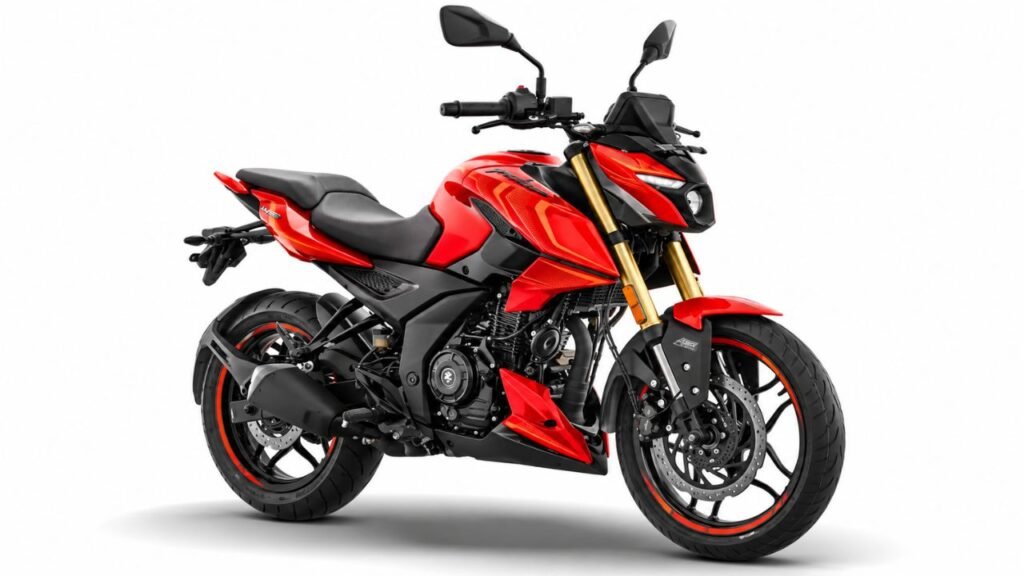
Visually, the Pulsar N250SS carries over the same muscular, naked-streetfighter design language that’s defined the N250 since it launched in 2021 alongside the faired F250. Bajaj hasn’t signalled a major styling overhaul here – this update is squarely about what’s under the skin and on the dashboard, not a fresh set of body panels.
Expect the same twin-pod LED headlamp setup, the sculpted tank shrouds, and the muscular rear section that’s made the N250 recognisable at a glance. The new 5-inch TFT cluster is the most visible change from the rider’s seat, replacing the old LCD unit and giving the cockpit a noticeably more modern feel. Bajaj’s launch imagery shows the N250SS largely following the existing colour and graphics treatment, though dealership stock and official colour-option details will likely be confirmed over the coming weeks.
Where the N250SS Sits in the Pulsar N250 Line-Up
It’s worth being clear about how the N250SS slots in relative to the existing Pulsar N250. This isn’t a replacement for the standard bike – at least not yet – it’s a new, range-topping variant that sits above it. Bajaj’s own positioning frames the N250SS as the version for riders who want the extra gear, the quickshifter and the electronic ride modes, while the standard N250 presumably continues to serve as the more affordable entry point into the same basic motorcycle.
| Aspect | Pulsar N250 (Standard) | Pulsar N250SS |
| Valve configuration | 2-valve | 4-valve |
| Power | 24.5 PS | 25 PS |
| Torque | 21.5 Nm | 22 Nm |
| Gearbox | 5-speed | 6-speed, with quickshifter |
| Throttle | Cable-operated | Electronic Throttle Body (ETB) |
| Ride modes | Not offered | Rain, Road, Sport, Off-Road |
| Instrument cluster | LCD | 5-inch TFT with Google Maps mirroring |
| Approx. ex-showroom price | Lower | ₹1.59 lakh |
This table is built from what’s been reported around the launch rather than a side-by-side Bajaj brochure, so treat the exact figures for the standard N250 as indicative until Bajaj’s own comparison materials are out.
Bajaj Pulsar N250SS: Expected Rivals
Sitting at roughly ₹1.59 lakh, the Pulsar N250SS lands in one of the more competitive pockets of India’s quarter-litre naked motorcycle segment. Based on price-band overlap, auto media has already drawn comparisons with:
| Rival | Approx. Ex-showroom Price | Segment Fit |
| Suzuki Gixxer 250 | ₹1.85 lakh | Closest naked-bike rival by displacement |
| Hero Xtreme 250R Carbon | ₹1.98 lakh | Sportier styling, similar price band |
| Yamaha FZ25 | Comparable segment | Long-running quarter-litre naked |
The honest picture here is that the N250SS undercuts both of its most commonly cited rivals by a noticeable margin while matching or exceeding them on headline tech – the quickshifter and ride modes, in particular, aren’t standard fare at this price point from Suzuki or Hero. That combination of lower price and richer feature list is likely to be Bajaj’s strongest pitch to anyone cross-shopping this segment over the next few months.
Check Also: Hero Xtreme 160R 4V Price, Specs, Features, Variants, Mileage, Colours & Reviews
Chassis, Brakes and Suspension
Bajaj hasn’t flagged any major changes to the underlying chassis or running gear with this update, and that’s largely expected – the N250SS update programme has clearly been built around the engine, gearbox and electronics rather than the hardware that handles the motorcycle’s ride and handling. The N250 has always used a pressed-steel perimeter frame, a telescopic front fork, and a mono-shock rear suspension with multi-step preload adjustment, paired with disc brakes at both ends and dual-channel ABS as standard.
None of the launch material around the N250SS mentions a revised frame, different suspension travel, or a change to the brake package, so it’s reasonable to assume these carry over largely unchanged from the standard N250. If you’ve ridden the existing bike and liked how it handled, the N250SS shouldn’t feel dramatically different in terms of outright chassis behaviour – the difference will be felt mostly in how the engine responds and how cleanly you can shift through the gears, rather than in how the bike turns or stops.
This is worth keeping in mind if outright handling sharpness or a bigger front brake disc is what you’re after. The N250SS is a powertrain-and-tech update layered onto an existing, well-proven chassis, not a ground-up reworking of the motorcycle’s dynamics.
Ownership, Warranty and Service
As with the rest of the Pulsar range, the N250SS is expected to be backed by Bajaj’s standard warranty terms, typically covering the motorcycle for a set period or distance, whichever comes first, with the option to extend coverage through Bajaj’s paid extended-warranty programmes at the time of purchase. Bajaj hasn’t announced any N250SS-specific warranty terms separate from the rest of the N250 range as of this report, so buyers should confirm exact coverage details with their local Probiking dealership at the time of booking.
Spare parts and servicing should flow through Bajaj’s existing Probiking network, which is one of the more extensive service networks among Indian two-wheeler manufacturers. Given that the N250SS shares its core engine architecture, frame and running gear with the existing N250, routine servicing costs and intervals are likely to track closely with the standard model, though the added electronics – the TFT cluster, the electronic throttle body, and the quickshifter – introduce components that didn’t exist on the outgoing bike and could, in theory, affect servicing complexity over the ownership period. This is one area worth asking your dealer about directly, since official long-term service cost data for the N250SS isn’t available yet.
Colours and Availability
Bajaj’s launch materials for the N250SS largely carry over the existing N250’s visual identity, and as of this report, a full, confirmed colour chart specific to the SS variant hasn’t been published in detail. Dealerships that received early stock ahead of the official announcement have shown the bike in colourways consistent with the standard N250’s existing palette, but buyers should check with their nearest showroom for the exact shades on offer in their city, since colour availability on a fresh launch often varies by region before settling down over the following weeks.
Booking should already be open at Bajaj Probiking dealerships given that the bike has had dealer-level stock ahead of the formal launch. As with most fresh launches in India, expect waiting periods to be short initially and to stretch out only if demand outpaces the first few production batches – something that’s hard to predict this early into the launch cycle.
Early Reactions and What to Expect
It’s too early for independent road tests to have published detailed ride impressions, so most of what’s circulating right now is specification-based commentary rather than seat-time feedback. That said, the general tone across auto media coverage has been positive, with most outlets focusing on how much technology Bajaj has managed to pack into a sub-₹1.6-lakh motorcycle. The quickshifter and ride modes, in particular, are being treated as the standout additions, since neither is common at this price point from any manufacturer in India, let alone two together on the same bike.
The more honest caveat worth repeating is that peak power and torque have gone up only marginally – half a horsepower and half a newton-metre isn’t the kind of change you’ll feel on a seat-of-the-pants basis. The real improvement, if the added gear and quickshifter work as intended, should show up in how usable that power feels day to day: smoother shifts, a more relaxed highway cruising RPM, and a throttle response that can be tuned to riding conditions through the new modes. Whether that translates into a meaningfully better riding experience is something only time in the saddle will confirm, and we’d treat any strong claims about transformed performance with a healthy dose of scepticism until proper test rides are out.
Check Also: BMW F 450 RR: Design, Engine, Features, Expected Price and India Launch
Why the Bajaj Pulsar N250SS Matters
The Pulsar N250 has been a steady seller for Bajaj since its 2021 launch, but the quarter-litre naked segment has moved on since then, with rivals adding better electronics and more premium touches at similar price points. The N250SS reads like Bajaj’s answer to that shift – rather than letting the N250 age in place, the company has given it the gearbox, throttle and display upgrade that keeps it competitive on a spec sheet, without pushing the price into a different bracket altogether.
It’s also a signal of how Bajaj is treating the Pulsar nameplate as it crosses the 25-year mark: rather than one anniversary-special motorcycle, the brand has chosen to refresh models across multiple displacement categories – the N160, the 125 and 150, the NS400Z, and now the N250 series – suggesting a broader platform-wide push toward electronic throttle control, TFT displays and quickshifters becoming standard expectations rather than premium extras, even in Bajaj’s more affordable motorcycles.
Should You Buy the Bajaj Pulsar N250SS?
If you’re shopping in the quarter-litre naked segment and were already considering the standard Pulsar N250, the SS variant is worth the extra ₹14,000-17,000 for most buyers, simply because of how much it adds for that money. A six-speed gearbox with a quickshifter and genuine ride modes aren’t features you’d normally expect to find bundled together under ₹1.6 lakh, and Bajaj deserves credit for not pushing the price much beyond what the standard bike already costs.
Where it makes less sense is if you’re coming from the standard N250 already and weighing whether to upgrade purely for the spec sheet. The core riding experience – the frame, suspension and brakes – hasn’t changed, and the power gain is too small to notice without a dyno chart in front of you. For existing N250 owners, the case to switch rests almost entirely on wanting the TFT display, the quickshifter, and the ride modes specifically, rather than any transformation in outright performance.
Against its direct rivals – the Suzuki Gixxer 250 and the Hero Xtreme 250R Carbon – the N250SS is the clear value pick on paper, undercutting both by a meaningful margin while matching or beating them on tech. Riders who prioritise outright badge value, dealer experience, or a particular styling preference may still lean toward those rivals, but on specification and price alone, the N250SS makes a strong case for itself in its segment.
Frequently Asked Questions (FAQs)
What is the launch date of the Bajaj Pulsar N250SS?
The Bajaj Pulsar N250SS was officially launched on 21 October 2026, after appearing at dealerships in the weeks before.
What is the price of the Bajaj Pulsar N250SS in India?
The Bajaj Pulsar N250SS launch price is ₹1,59,406, ex-showroom Delhi.
How much more expensive is the N250SS compared to the standard Pulsar N250?
Reports put the premium between ₹14,000 and ₹17,000 over the standard N250, depending on the source and the exact variant being compared.
What engine does the Bajaj Pulsar N250SS use?
It uses an updated 249cc, air-oil-cooled, single-cylinder engine with a new four-valve head, producing 25 PS and 22 Nm, up from 24.5 PS and 21.5 Nm on the standard N250.
Does the Bajaj Pulsar N250SS get a quickshifter?
Yes. It comes with Bajaj’s Sports Shifter, which allows clutch-less gear changes, paired with a new six-speed gearbox in place of the earlier five-speed unit.
What riding modes does the Pulsar N250SS offer?
Four modes – Rain, Road, Sport and Off-Road – enabled by its new Electronic Throttle Body.
What are the key rivals of the Bajaj Pulsar N250SS?
The Suzuki Gixxer 250, the Hero Xtreme 250R Carbon, and the Yamaha FZ25 are the most commonly cited rivals based on price and segment.
Is the Bajaj Pulsar N250SS a replacement for the standard N250?
As of launch, it’s being sold as an additional, range-topping variant rather than a direct replacement, though Bajaj hasn’t confirmed long-term plans for the standard N250’s lineup position.
Source: Bajaj Auto