Every year, a handful of bikes get a new model-year badge and nothing else. The 2027 Kawasaki Z1100 is one of them. Kawasaki India has launched it at ₹12.79 lakh (ex-showroom), exactly what the 2026 bike cost, and deliveries began on October 19, 2026. The design is the same, the engine is the same, the hardware is the same, and there is still only one colour on offer. If you were waiting for a refresh before you made up your mind, this is not it.
That does not make it a boring story, though. The Z1100 is the bike that finally brought the Z1000 name back to Indian showrooms in spirit, and it did so with an electronics package that was unusual for the money when it arrived in November 2025. A year later, with rivals pricier and the sticker unchanged, it has quietly become a bike worth looking at again. This guide covers what you will actually pay once the bike is registered, what you get for it, how it rides, and who should (and should not) buy one.
2027 Kawasaki Z1100 Specifications
| Specification | Details |
| Ex-showroom price | ₹12,79,000 (single Standard variant) |
| On-road price | Roughly ₹14.0 lakh to ₹15.6 lakh, depending on the city |
| Engine | 1,099 cc, liquid-cooled, inline-four, 16 valves |
| Power | 134.1 bhp (136 PS) at 9,000 rpm |
| Torque | 113 Nm at 7,600 rpm |
| Transmission | 6-speed with bi-directional quickshifter |
| Frame | Aluminium twin-tube |
| Suspension | 41 mm Showa SFF-BP inverted fork, Showa gas-charged horizontal back-link monoshock; adjustable at both ends |
| Brakes | Dual 310 mm front discs, 260 mm rear disc, dual-channel cornering ABS |
| Tyres | Dunlop Sportmax Q5A on 17-inch wheels |
| Kerb weight | 221 kg |
| Seat height | About 815 mm |
| Ground clearance | 125 mm |
| Fuel tank | 17 litres |
| Colour | Metallic Carbon Gray (only colour in India) |
| Electronics | 5-inch TFT, 6-axis IMU, traction control, cruise control, Bluetooth via the Rideology app |
2027 Kawasaki Z1100 Price: What You’re Actually Paying For
The ₹12.79 lakh figure on Kawasaki’s price list is where the conversation starts, not where it ends. Registration charges, road tax and a first-year insurance premium sit on top of it, and on a bike this expensive they add up to a surprisingly large amount. Depending on where you live, the Kawasaki Z1100 price on the road lands somewhere between ₹14 lakh and ₹15.6 lakh. That is an extra ₹1.2 lakh to ₹2.8 lakh that the showroom brochure never mentions, and first-time superbike buyers are often caught off guard by it.
Insurance deserves a special mention. Comprehensive cover is calculated on the insured declared value, so a ₹12.79 lakh motorcycle carries a much heavier premium than the 150 cc commuter most buyers are used to. Add optional cover such as zero depreciation or engine protection and the number rises again, which is why two dealer quotes for the same bike can look quite different.
The sticker itself is the Z1100’s strongest argument. Kawasaki pitches it as the most affordable litre-class streetfighter on sale in India, and that claim holds up well against the closest rival, Honda’s CB1000 Hornet SP. Honda launched that bike at ₹12.36 lakh in 2025, but several current listings show it at about ₹13.29 lakh, so it is worth checking the latest figure before you compare the two.
Kawasaki Z1100 On-Road Price: How It’s Calculated
Think of the on-road price as three layers. The first is the ex-showroom price, which Kawasaki fixes for the whole country. The second is the RTO charge, which includes road tax and registration, and which each state sets for itself. The third is insurance, which depends on the insurer and the bike’s value. Dealer handling charges and any accessories you pick, such as frame sliders or a tank pad, come on top of all three.
Of these, road tax does the heavy lifting. Several states apply higher slabs to expensive vehicles, so a bike that crosses the ₹10 lakh mark can be taxed noticeably more than a mid-range motorcycle. That is the single biggest reason the same Z1100 costs more in one city than another, and it is why you should always ask for an itemised quote instead of a single total.
Kawasaki Z1100 Price in India: National Overview
Because Kawasaki sets the ex-showroom price centrally, there is no regional variation before taxes. And there is only one variant to choose from. The Z1100 SE, which adds Öhlins suspension and Brembo brakes in some overseas markets, is not sold in India, so the Indian lineup is refreshingly simple: one bike, one price, one colour.
The only real decisions left are which dealer to buy from, which accessories to add and which insurer to trust. That simplicity is a quiet advantage. There is no variant ladder to climb, no feature you will regret skipping, and no pressure to upsell yourself into the top trim.
Kawasaki Z1100 On-Road Price: City-Wise Comparison
Different portals quote slightly different totals for the same city, depending on how they treat insurance and handling charges. The figures below are estimates drawn from several sources, so treat them as a guide and ask your dealer for a written quote.
| City | Estimated on-road price |
| Delhi | ₹14.0 lakh to ₹14.3 lakh |
| Kolkata | About ₹14.1 lakh |
| Mumbai, Navi Mumbai and Pune | ₹14.4 lakh to ₹15.5 lakh |
| Chennai and Gurgaon | About ₹15.0 lakh |
| Bangalore | ₹15.1 lakh to ₹15.6 lakh |
| Hyderabad | About ₹15.2 lakh |
The pattern is clear. Delhi and Kolkata are the friendlier cities for registration, while Bangalore, Hyderabad and parts of Maharashtra sit at the expensive end.
Kawasaki Z1100 On-Road Price in Delhi
Delhi is the benchmark most buyers use, and it is one of the cheaper places to register a Z1100. Depending on the portal, the on-road figure comes in between ₹14.0 lakh and ₹14.3 lakh. Tax rates here are moderate and insurance sits close to the national average, so you are unlikely to see any nasty surprises. If you live in the NCR, it is worth comparing a Delhi quote with one from Gurgaon, which comes out noticeably higher at about ₹15 lakh.
Kawasaki Z1100 On-Road Price in Mumbai and Pune
In Mumbai, one portal breaks the on-road price down as ₹12.79 lakh ex-showroom, about ₹89,500 for RTO and roughly ₹61,400 for insurance, which gives a total of about ₹14.43 lakh. Another source shows a higher figure of ₹15.54 lakh, which tells you how much the final number depends on how the dealer bills insurance and handling. Pune and Navi Mumbai fall in the same bracket. Both Mumbai and Navi Mumbai have a single authorised Kawasaki showroom, at Jogeshwari East and Vashi respectively, so it helps to book ahead.
Kawasaki Z1100 On-Road Price in Bangalore
Karnataka charges a much steeper road tax than Delhi, and it shows. A representative Bangalore quote works out to about ₹15.07 lakh, with roughly ₹1.53 lakh going to RTO alone, while another portal puts the figure close to ₹15.6 lakh. The city has one Kawasaki showroom, Rideventur Kawasaki on Langford Road. Compared with Delhi, a Bangalore buyer pays somewhere between ₹80,000 and ₹1.3 lakh more for exactly the same motorcycle, almost entirely because of registration.
Kawasaki Z1100 On-Road Price in Hyderabad and Chennai
Hyderabad comes in at about ₹15.16 lakh, the highest of the cities with confirmed figures, while Chennai sits at around ₹15.03 lakh. Hyderabad has a single Kawasaki dealership, so if you are planning a purchase around a festival or a specific delivery date, it makes sense to book early.
Why the Same Z1100 Costs Differently in Every City
It comes down to who sets the rules. Every state decides its own road tax and registration rates, so identical bikes can carry bills that differ by well over a lakh rupees. Third-party insurance is priced nationally and is the same everywhere, but comprehensive cover and add-ons vary by insurer, which leaves you room to shop around. Dealers add their own handling charges on top, and that is where most of the small differences between two quotes in the same city come from.
Kawasaki Z1100 EMI
Financing a big bike is easier than it used to be, but the numbers still deserve a careful look. On a Bangalore on-road price of about ₹15.07 lakh, a loan of roughly ₹13.56 lakh over 60 months at 8.5% works out to an EMI of around ₹27,800 a month. In Mumbai, a loan of about ₹12.98 lakh on the same terms comes to roughly ₹26,600. A bigger down payment brings these figures down quickly, and since lenders price big-bike loans differently, it is worth collecting at least two offers before you sign.
What’s New in the 2027 Kawasaki Z1100?
Honestly, nothing, and Kawasaki is not pretending otherwise. The company launched it with no changes to the styling, engine, gearbox, frame, suspension, brakes, features or colour. The price is the same as the 2026 bike’s, and the only visible difference is the model year. Kawasaki’s own India website now carries a “New 2027” tag on the Z1100, which is the extent of the update.
For existing owners, that means there is no reason to upgrade. For new buyers, it means you are getting the same proven bike you could have bought a year ago, with a newer registration year and no price hike. If a dealer still has unsold 2026 stock, it is worth asking whether there is a discount, because the two bikes are identical in every way that matters.
Kawasaki Z1100 Variant Guide
India gets one variant: the Standard, which is also the top of the range. There is nothing to compare and nothing to agonise over, which makes the Z1100 one of the simplest big-bike purchases you can make.
| Variant | Engine | Ex-showroom price |
| Z1100 Standard | 1,099 cc inline-four, 6-speed with quickshifter | ₹12,79,000 |
Kawasaki Z1100 Exterior Design
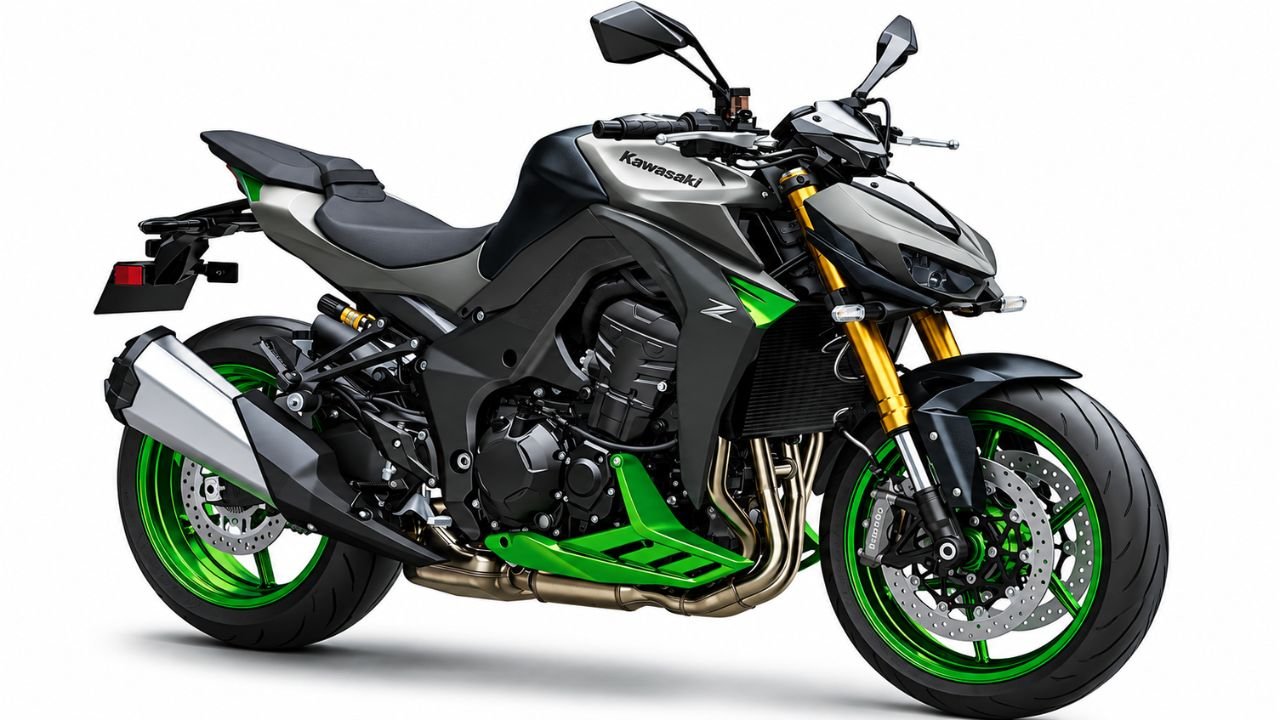
Kawasaki calls its design philosophy Sugomi, a Japanese word that roughly translates to a feeling of intense, almost menacing presence, and the Z1100 wears it well. The front end is dominated by a twin-pod LED headlamp that gives the bike a predatory stare, and the sculpted fuel tank flows into a tight, compact tail that ends in a sharply pointed rear section. Bodywork is kept to a minimum, so the aluminium twin-tube frame and the big inline-four engine do most of the visual talking.
One change from the Z1000 is the exhaust. The old twin-exhaust setup is gone, replaced by a 4-into-1 system on the right side, which keeps the tail cleaner and the whole rear end more compact. The result is a bike that looks smaller and more aggressive than its 1,099 cc displacement suggests. Owners tend to say the same thing: people stop and look wherever they ride it.
Kawasaki Z1100 Colour Options
The Z1100 comes in just one colour in India, a dark Metallic Carbon Gray that some dealers list as Ebony / Metallic Carbon Gray. It is a classy, understated shade that suits the bike’s character, but buyers who want something louder will be disappointed. The 2027 model does not add any new paint scheme.
Kawasaki Z1100 Features and Electronics
Where the Z1100 really earns its keep is in the cockpit and the electronics. A 5-inch full-colour TFT display sits in front of the rider and lets you adjust every rider aid from a single screen. Bluetooth connectivity through Kawasaki’s Rideology app brings turn-by-turn navigation, calls and messages to the display, which makes the cockpit feel genuinely modern for a Kawasaki naked.
Underneath it all is a 6-axis IMU, the sensor that measures the bike’s lean, pitch and yaw. It feeds Kawasaki’s Cornering Management Function, cornering ABS and lean-sensitive traction control, which has three levels plus an off setting. There are two power modes, Full and Low, a bi-directional quickshifter for clutchless shifts in both directions, and cruise control as standard. That last feature is a real bonus on long highway rides, and it is not something every bike at this price offers.
Kawasaki Z1100 Engine and Performance
The heart of the bike is a 1,099 cc liquid-cooled inline-four that makes 134.1 bhp (136 PS) at 9,000 rpm and 113 Nm of torque at 7,600 rpm. It shares its basic architecture with the engine in the Ninja 1100SX, so this is a mature, well-proven unit rather than a fresh and untested one. A 6-speed gearbox with an assist-and-slipper clutch and the quickshifter carries the power to the rear wheel.
Owners describe the acceleration as thrilling and the delivery as smooth and refined, with the bike staying stable and composed at higher speeds. That fits the Z1100’s character: it is a big, torquey, grown-up streetfighter rather than a frantic, high-revving one. The Full and Low power modes let you soften the throttle on wet or unfamiliar roads, which is a sensible touch on a bike with this much grunt.
It is worth being honest about the numbers, though. At 134 bhp, the Z1100 is not the most powerful bike in its class. Honda’s CB1000 Hornet SP makes about 157 PS from a 999 cc engine, so Honda has the advantage on peak output. Kawasaki counters with more torque, 113 Nm against the Honda’s 107 Nm, which matters more in everyday riding than a peak-power figure you can rarely use on Indian roads.
Kawasaki Z1100 Ride Comfort and Handling
The chassis is built around an aluminium twin-tube frame, and the suspension is fully adjustable at both ends. A 41 mm Showa SFF-BP inverted fork looks after the front, with a gas-charged Showa horizontal back-link shock at the rear. The setup gives the Z1100 confident, stable handling at speed while still soaking up bumps well enough for longer rides. Owners praise the way it absorbs rough surfaces without losing composure.
Stopping power comes from Tokico brakes, with dual 310 mm discs at the front and a single 260 mm disc at the back, supported by dual-channel cornering ABS. Dunlop Sportmax Q5A tyres on 17-inch wheels give reassuring grip across varied conditions. Owners specifically call out the brakes as excellent.
On paper, the Z1100 is a heavy bike. It weighs 221 kg, noticeably more than the 188 kg Triumph Street Triple RS, and the seat height is about 815 mm, which is manageable for most riders. Owners, however, report that it feels stable and well balanced rather than cumbersome. Ground clearance of 125 mm is adequate for daily riding, though you will want to take big speed breakers slowly. The riding position is relaxed enough for city use and still feels exciting once you reach the highway.
Kawasaki Z1100 Mileage and Running Costs
Do not expect a frugal bike. Portals list the Z1100 at around 17.85 kmpl, though that is not an ARAI-certified figure, and real-world numbers will drop if you ride it hard. With a 17-litre tank, a practical range of roughly 300 km is realistic, which is enough for most weekend rides but means you should plan fuel stops on longer trips.
The running costs are what you would expect from a flagship naked. Genuine parts and labour cost more than they do for mainstream Indian brands, and Kawasaki’s service network is thin, with a single showroom in several large cities. Tyres, brake pads and the chain-and-sprocket set will be your main recurring expenses, so it is worth budgeting for them from day one. Owners generally describe the build quality as solid and premium, which suggests the bike holds up well beyond the initial excitement.
Kawasaki Z1100 Rivals
The Z1100’s closest competitor is the Honda CB1000 Hornet SP, with the Triumph Street Triple RS and the cheaper Kawasaki Z900 rounding out the field.
| Bike | Engine | Approx. ex-showroom price |
| Kawasaki Z1100 | 1,099 cc inline-four, 134 bhp | ₹12.79 lakh |
| Honda CB1000 Hornet SP | 999 cc inline-four, about 157 PS | ₹12.36 lakh at launch; about ₹13.29 lakh in some listings |
| Triumph Street Triple RS | 765 cc triple | About ₹12.07 lakh |
| Kawasaki Z900 | 948 cc inline-four | About ₹9.4 lakh (earlier comparison figure) |
The Hornet SP is the one to cross-shop. It has more peak power, a fully adjustable Öhlins shock at the rear and Brembo calipers at the front, and it is sold only through Honda’s BigWing Topline showrooms. The Z1100 answers with more torque, cruise control and, depending on the listing you look at, a lower price. The Street Triple RS is a different kind of bike: lighter at 188 kg, with a smaller 15-litre tank and a sharper, more track-focused feel. And the Z900 is the budget route into the Z family, a smaller-engined bike that costs far less but does not offer the same sense of occasion.
Kawasaki Z1100 Review: Who Should Buy It?
The Z1100 is a very easy bike to like and a slightly harder one to criticise. It looks fantastic, the engine is smooth and strong, the brakes and suspension are confidence-inspiring, and the electronics package is a generous one that includes cruise control and an IMU. The single-variant lineup means no confusing choices, and the unchanged price keeps it competitive against rivals that have crept upwards.
The negatives are modest and mostly practical. It is heavy at 221 kg, ground clearance is only 125 mm, mileage hovers around 17.85 kmpl, there is just one colour, and the thin service network may be an issue outside the big cities. The 2027 model adds nothing, so the case for buying rests entirely on the bike you already know.
So who should buy it? If you want a big, comfortable, torquey streetfighter that you can use daily and still enjoy on weekends, and you live somewhere with decent Kawasaki service access, the Z1100 makes a lot of sense. If you want the last word in peak power or a lightweight track toy, look at the Hornet SP or the Street Triple RS instead.
Practical Tips Before You Finalise Your Purchase
Start by asking your dealer for a written quote that lists the ex-showroom price, RTO, insurance and handling charges separately. A verbal total is easy to change at the invoicing stage, and an itemised sheet gives you something to negotiate against. Then ask whether the bike in stock is a 2026 or a 2027 model-year unit, since the two are identical and an older one may come with a discount.
Check the delivery timeline too, because big bikes tend to arrive in small batches and waiting periods can vary by city. Finally, look at where your nearest service centre is and compare insurance quotes from more than one provider, since the premium is a large part of the on-road price.
What’s Changing in Kawasaki Z1100 Price Going Forward
Prices in the premium bike market rarely stand still. The 2027 Z1100 launched at an unchanged price, but manufacturers revise their lists from time to time, and rivals have already moved theirs. State governments also revise road tax and registration slabs, and even a small change can shift the on-road price noticeably. Keep an eye on the latest dealer quote before you book. And since this year’s update was cosmetic in name only, a real mid-cycle upgrade is probably the next thing to watch for.
Key Facts Worth Remembering
The 2027 Kawasaki Z1100 launched in India at ₹12.79 lakh (ex-showroom), unchanged from the 2026 bike, and deliveries started on October 19, 2026. The Z1100 first arrived in India in mid-November 2025 as the spiritual successor to the Z1000. There is one variant and one colour. The 1,099 cc inline-four makes 134.1 bhp and 113 Nm, and an IMU, cornering ABS, traction control, quickshifter and cruise control all come as standard. On-road prices run from roughly ₹14.0 lakh to ₹15.6 lakh depending on the city, and the Honda CB1000 Hornet SP is the closest rival. Accessories, insurance add-ons and dealer charges can push the final price above these estimates.
check Other Bikes: Hero Xtreme 160R 4V | BMW F 450 RR | Harley Davidson X440
FAQs
What is the 2027 Kawasaki Z1100’s ex-showroom price?
₹12.79 lakh, the same as the 2026 model.
What is the Kawasaki Z1100’s on-road price?
Roughly ₹14.0 lakh to ₹15.6 lakh, depending on the city.
What is new in the 2027 Kawasaki Z1100?
Nothing apart from the model year. Design, engine, hardware and colour are unchanged.
How much power does the Kawasaki Z1100 make?
134.1 bhp (136 PS) and 113 Nm from a 1,099 cc inline-four.
Does the Kawasaki Z1100 have cruise control?
Yes. Cruise control, a quickshifter, an IMU and cornering ABS are standard.
What is the Kawasaki Z1100’s mileage?
Portals list about 17.85 kmpl, though real-world figures vary with riding style.
How many variants and colours does the Z1100 have in India?
One Standard variant and one colour, Metallic Carbon Gray.
Which bike rivals the Kawasaki Z1100?
The Honda CB1000 Hornet SP is the closest, followed by the Triumph Street Triple RS.
Source: Kawasaki