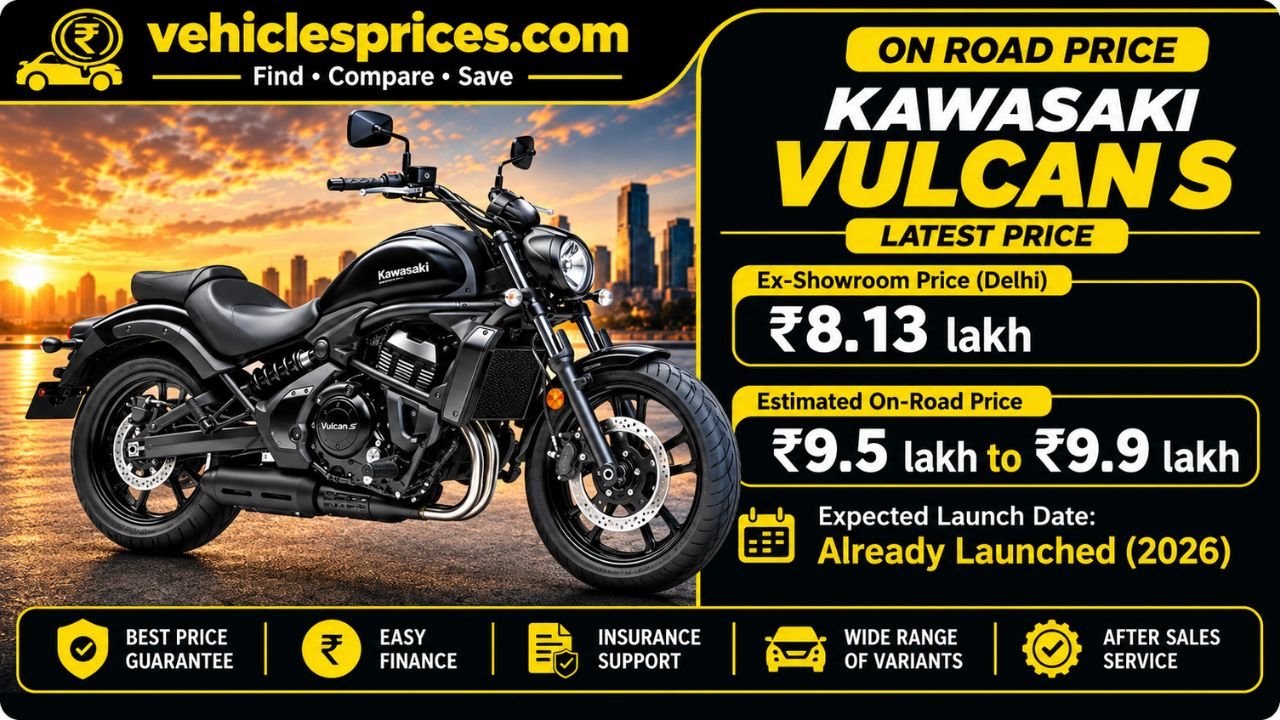
There aren’t many bikes in India that get to have a segment entirely to themselves, but the Kawasaki Vulcan S manages exactly that. It’s the only liquid-cooled 650cc cruiser sold in the country right now, which means it doesn’t really have a straight fight with anything else on paper.
For 2026, Kawasaki hasn’t reinvented the Vulcan S. It’s the same bike mechanically, with one real update – the engine is now E20 fuel-compatible – a new colour option, and a price that’s moved up to reflect both. Below we have compiled a convenient summary of all available information on the automobile: its current price, cost on the road, power, top speed, consumption, equipment, design, seat height, cost of ownership, comparison with the nearest competitor, and much more. We will expand this section as new data becomes available.
Kawasaki Vulcan S Specifications at a Glance
| Specification | Detail |
| Ex-Showroom Price (Delhi) | ₹8.13 lakh |
| Engine | 649cc, liquid-cooled, parallel-twin, DOHC |
| Power | 61 PS @ 7,500rpm |
| Torque | 61Nm @ 6,600rpm |
| Gearbox | 6-speed |
| Top Speed | 186kmph |
| Mileage (ARAI) | 20.58 kmpl |
| Fuel Tank Capacity | 14 litres |
| Seat Height | 705mm |
| Ground Clearance | 130mm |
| Kerb Weight | 235kg |
| Front Suspension | 41mm telescopic fork |
| Rear Suspension | Preload-adjustable monoshock |
| Front Brake | 300mm disc |
| Rear Brake | 250mm disc |
| ABS | Dual-channel, non-switchable |
| Wheels/Tyres | Alloy, tubeless |
| Colour | Metallic Flat Spark Black |
Kawasaki Vulcan S Price in India
The 2026 Kawasaki Vulcan S price in India starts at ₹8.13 lakh (ex-showroom, Delhi). That’s about ₹54,000 more than the outgoing MY24 version, and almost the entire jump comes down to the E20-compliant engine update rather than any new feature or equipment. The bike is sold in a single variant and, for 2026, a single colour – Metallic Flat Spark Black, which has replaced the earlier Pearl Matte Sage Green. No tiered trims, no “which variant should I pick” dilemma. One spec, one colour, one price.
| City | Expected Starting Price (Ex-showroom) |
| Delhi | ₹8,13,000 onwards |
| Mumbai | ₹8,20,000 onwards |
| Bangalore | ₹8,25,000 onwards |
| Pune | ₹8,18,000 onwards |
| Hyderabad | ₹8,17,000 onwards |
| Chennai | ₹8,22,000 onwards |
| Kolkata | ₹8,16,000 onwards |
| Lucknow | ₹8,15,000 onwards |
Only Delhi figure is Kawasaki’s official ex-showroom price, others are indicative as per the typical dealer to dealer variances in other cities as Kawasaki does not announces a different ex-showroom figure for each city. Always confirm the final amount with your local dealer.
These prices are ex-showroom, so you will have to additionally account for RTO, insurance and state road tax. Therefore on an average, the on-road price of the Kawasaki Vulcan S would cost anywhere between ₹95,000-1.4 lakh more than the prices mentioned above depending on the state of registration.
Kawasaki Vulcan S Price History
The Vulcan S has not been static on price over the years, despite it having remained largely similar mechanically since its launch here in India. While it started 2024 at close to ₹7.10-7.19 lakh ex-showroom, a mid-year revision pushed it upwards, and the 2025 model runs to around ₹7.59 lakh. With the 2026 E20-compliant update, it now stands at ₹8.13 lakh.
A jump of close to ₹1 lakh over two years, without substantive mechanical updates, is typical of premium imported and CKD assembled motorcycles in India; where the burden of currency fluctuations, import duty changes as well as certification and compliance costs tend to be borne by the consumer, rather than the manufacturer..
Kawasaki Vulcan S On-Road Price Structure
The on-road price isn’t a random number your dealer picks. It’s built from three clear parts, and understanding them helps you spot overcharging instantly.
- Ex-showroom price: The factory-set base cost before any tax or fee – the ₹8.13 lakh figure covered above.
- RTO registration and road tax: A percentage of the ex-showroom price, and this percentage changes from state to state.
- First-year comprehensive insurance: Mandatory for every new two-wheeler, and the premium depends on your city, the bike’s insured value, and any add-on covers you choose.
Due to the varying RTO taxes in different states, the same Vulcan S can cost thousands of rupees more or less, depending on where you register it. So, the on-road price of Kawasaki Vulcan S that you see in one city may be different from what your friend paid for the same bike in another city.
Kawasaki Vulcan S On-Road Price in Top Cities
Here’s how the bike (ex-showroom ₹8.13 lakh in Delhi) roughly compares on-road across a few major cities, once RTO and insurance are factored in:
| City | Ex-Showroom Price | Approx. On-Road Price |
| Delhi | ₹8,13,000 | ₹9,08,000 onwards |
| Mumbai | ₹8,13,000 | ₹9,25,000 onwards |
| Bangalore | ₹8,13,000 | ₹9,40,000 onwards |
| Pune | ₹8,13,000 | ₹9,28,000 onwards |
| Chennai | ₹8,13,000 | ₹9,35,000 onwards |
| Hyderabad | ₹8,13,000 | ₹9,20,000 onwards |
| Kolkata | ₹8,13,000 | ₹9,15,000 onwards |
| Lucknow | ₹8,13,000 | ₹9,18,000 onwards |
The Vulcan S was never meant to be an impulse purchase – it’s a considered upgrade for someone who already knows they want a liquid-cooled cruiser, so the on-road number is worth budgeting for properly rather than being surprised by it at the dealership.
Kawasaki Vulcan S Features
What the bike offers as standard, based on the current spec sheet:
- Analogue-dominant instrument cluster (no TFT, no connectivity)
- Dual-channel ABS, non-switchable
- Six-speed gearbox
- Alloy wheels, tubeless tyres front and rear
- 41mm telescopic front forks, preload-adjustable rear monoshock
- LED lighting elements
- Floorboard-style footpegs
- Wide, forward-set handlebar
- Slipper clutch for smoother downshifts
- Assist clutch that lightens lever effort in traffic
No TFT screen, no riding modes, no ride-by-wire – and that’s not really a surprise at this price point. Kawasaki has kept the feature list conservative and put the money into the engine instead.
Kawasaki Vulcan S Engine and Performance
Pop the tank off and you’ll find a 649cc, liquid-cooled, parallel-twin engine with a DOHC head – the same fundamental architecture as the Ninja 650 and Z650, tuned here for a cruiser-friendly, midrange-heavy delivery instead of outright top-end pull. Peak power stands at 61 PS (about 60.9 bhp) at 7,500rpm – unchanged from before. Peak torque has dropped slightly to 61Nm at 6,600rpm, down from the earlier 62.4Nm. That’s a small but real side-effect of the E20 recalibration, and it’s not something most riders will notice from the saddle.
One more thing worth clearing up: despite sharing an engine family with the Ninja 650 and Z650, the Vulcan S isn’t tuned to match either for outright pace. Lower riding position, longer wheelbase, more weight overall – all of it costs a bit of straight-line performance, and that’s a deliberate trade-off rather than an oversight. The gearbox is a conventional six-speed unit, and the assist-and-slipper clutch is worth calling out specifically – it lightens up lever effort noticeably in stop-start city traffic, which matters more than it sounds on a bike this size, and reduces rear-wheel hop on aggressive downshifts.
Kawasaki Vulcan S Mileage
The official ARAI-certified mileage for the Vulcan S is 20.58 kmpl. Your actual mileage will depend on your riding pattern, and whether you do more city or highway riding (expect to see lower numbers in the former due to frequent stops and starts). The 14-liter tank should give you a range of anything between 250-280km per fill in mixed riding conditions. It’s enough to allow for some weekend touring without having to worry about looking for fuel stations every hour or so, but it’s not exactly class-leading.
One thing to keep in mind if you’re looking to compare numbers between different sources is that the ARAI cycle is a standardized laboratory test, and doesn’t take into account pillion passenger weight, luggage, or aggressive riding (all of which will add up to lower fuel economy). Most riders who ride in a composed manner and spend a good amount of time on highways report seeing numbers close to, or occasionally even beating the claimed fuel economy figures.
Kawasaki Vulcan S Top Speed
The other number riders ask about constantly: the Kawasaki Vulcan S top speed is 186kmph, a figure that’s consistent across independent test data. For a cruiser – a category that generally prioritises comfort over velocity – that’s a genuinely strong number, and it puts the Vulcan S ahead of most cruisers sold in India on paper. What matters more is how effortlessly the bike sits at 100–120kmph on the highway, and that’s where the parallel-twin engine does its best work – smooth, refined, and never feeling stressed.
0-100kmph comes up in about 4.4-4.5 seconds by most independent estimates, which is quick for a cruiser and a direct result of sharing engine architecture with genuinely sporty machines like the Z650. It’s worth remembering, though, that outright acceleration numbers aren’t really why someone buys a bike like this – the appeal is in how relaxed the engine feels well below those limits, not in chasing them.
Read Also: Suzuki Bikes Price in India 2026 – All Model List & Specification
Kawasaki Vulcan S Design and Styling
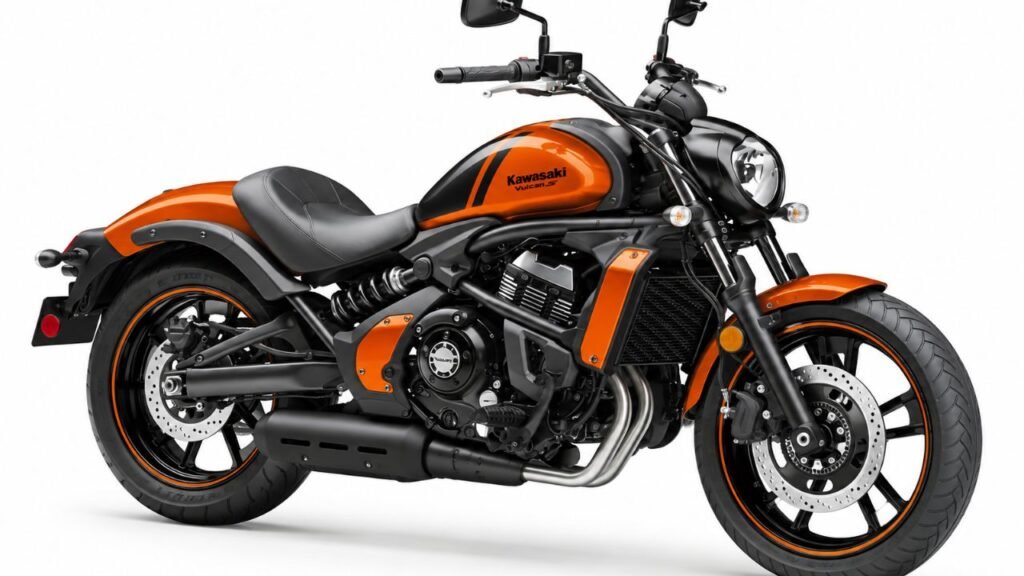
The Vulcan S leans into a modern, minimalist cruiser look rather than the chrome-heavy aesthetic traditionally associated with the segment. That carries forward unchanged for 2026, with the only visual update being the new Metallic Flat Spark Black colour.
Instrument cluster. A fairly conventional analogue setup – genuinely the biggest weak point at this price. At over ₹8 lakh, riders increasingly expect at least some digital functionality, and the Vulcan S doesn’t offer it.
Stance. Long, low-slung, with a wide forward-set handlebar, floorboard pegs, and a low, stepped seat – a classic cruiser riding triangle through and through.
Hardware. Alloy wheels, tubeless tyres, LED lighting – nothing class-leading in 2026, but also not really the point. Buyers here are prioritising the riding experience over the feature sheet.
Tank and bodywork. The sculpted fuel tank and exposed frame sections give the bike a sportier, more muscular silhouette than a typical cruiser, which is part of why Kawasaki has always marketed the Vulcan S as a “power cruiser” rather than a classic one.
Kawasaki Vulcan S Seat Height and Ergonomics
The Kawasaki Vulcan S seat height is just 705mm – remarkably low for a 650cc motorcycle, and a big part of why this bike has built a loyal following in India. Riders on the shorter side can get both feet flat on the ground at a standstill, which does wonders for confidence in stop-start traffic and tight parking lots.
Ground clearance sits at 130mm, adequate for typical Indian road conditions including moderate speed bumps, though this is very much a road-focused machine with no off-road pretensions.
| Parameter | Figure |
| Seat Height | 705mm |
| Ground Clearance | 130mm |
| Kerb Weight | 235kg |
| Fuel Tank Capacity | 14 litres |
Kerb weight comes in at 235kg – on the heavier side for the segment, though most of it sits low in the chassis, which helps rather than hurts low-speed stability once you’re used to managing it.
The riding triangle – handlebar, seat, and footpeg placement – is designed to be genuinely relaxed rather than sporty. Forward-set floorboard pegs and a wide, reasonably upright handlebar keep wrists and shoulders comfortable over longer stretches, though very tall riders sometimes report the forward peg position getting slightly cramped on extended rides, simply because there’s less room to stretch the legs out further compared to a touring-focused layout.
Kawasaki Vulcan S Suspension and Handling
Suspension is a 41mm telescopic fork up front paired with a preload-adjustable monoshock at the rear – fairly conventional hardware for a cruiser at this price, tuned toward comfort over outright sportiness. Braking is a 300mm front disc and 250mm rear disc, with dual-channel ABS as standard and no option to switch it off – unsurprising for a road-only cruiser.
Handling tends to surprise people who’ve never ridden a cruiser before. Despite the 235kg kerb weight and long wheelbase, it doesn’t feel unwieldy in city traffic. Where it does show its cruiser DNA is in tight U-turns, where the longer wheelbase means a wider turning radius than a naked or adventure bike of similar capacity. Ride quality on typical Indian road surfaces is on the firmer side without tipping into harsh – Kawasaki has clearly tuned the suspension to strike a balance between comfort and the kind of composure you want when leaning into a corner, rather than chasing plush, sofa-like comfort at the expense of handling.
Read Also: Alto K10 Price 2026: Ex-Showroom & On-Road Breakdown
Kawasaki Vulcan S EMI Calculator
Financing this bike is common given the ₹8+ lakh price tag. Here’s roughly what the EMI works out to at different tenures, assuming an on-road price of about ₹9.08 lakh (Delhi), a ₹1 lakh down payment, and a typical two-wheeler loan interest rate of 9.5% per annum. Actual rates from lenders currently range roughly 8.5%–12%, so treat these as indicative, not final.
| Tenure | Loan Amount | Interest Rate (approx.) | Estimated EMI |
| 12 months | ₹8,08,000 | 9.5% p.a. | ₹70,880/month |
| 24 months | ₹8,08,000 | 9.5% p.a. | ₹37,125/month |
| 36 months | ₹8,08,000 | 9.5% p.a. | ₹25,900/month |
| 48 months | ₹8,08,000 | 9.5% p.a. | ₹20,320/month |
How these numbers move
- Higher down payment directly lowers your EMI.
- Longer tenure means lower EMI but more total interest paid.
- Interest rate depends on lender and your credit profile.
- Processing fees/insurance can push the effective EMI higher than shown.
Since the Vulcan S sits at a premium price point within its segment, most buyers finance a meaningful chunk of it rather than paying the full on-road amount upfront – so it’s worth comparing at least two or three lenders’ quotes before finalizing a loan.
Kawasaki Vulcan S vs Royal Enfield Super Meteor 650: What’s the Difference?
| Parameter | Kawasaki Vulcan S | Royal Enfield Super Meteor 650 |
| Engine | 649cc, liquid-cooled, parallel-twin | 648cc, air/oil-cooled, parallel-twin |
| Power | 61 PS | 47 PS |
| Torque | 61Nm | 55.7Nm |
| Gearbox | 6-speed | 6-speed |
| Instrument Cluster | Analogue | Semi-digital with Tripper |
| Seat Height | 705mm | ~740mm |
| Ex-Showroom Price | ₹8.13 lakh | ₹3.99 lakh |
| Positioning | Premium, performance-leaning cruiser | Accessible, classic-styled cruiser |
Bottom line: these aren’t really competing for the same buyer. The Vulcan S is for someone who wants genuine engine performance and refinement without giving up cruiser ergonomics; the Super Meteor 650 is for someone who wants classic cruiser styling at roughly half the price.
Kawasaki Vulcan S Rivals
| Rival | Approx. Price (Ex-showroom) | Engine |
| Royal Enfield Super Meteor 650 | ₹3.99 lakh | 648cc, air/oil-cooled |
| Triumph Speed 400 | ₹2.33 lakh+ | 398cc, liquid-cooled |
| Harley-Davidson X440 | ₹2.39 lakh+ | 440cc, air-cooled |
| Kawasaki Vulcan S | ₹8.13 lakh | 649cc, liquid-cooled |
Kawasaki’s real advantage here isn’t spec-sheet pricing – every bike in that table costs meaningfully less. It’s engine performance, refinement, and the appeal of being the only liquid-cooled 650cc cruiser in the country. That matters a lot to a rider who’s already cross-shopped the cheaper options and decided they want more engine for their money, even if it means paying a significant premium to get it.
Kawasaki Vulcan S Ownership Costs
Kawasaki’s service network in India, while smaller than Royal Enfield’s, has expanded meaningfully over the past several years and covers most major cities reasonably well. Spare parts availability for mainstream components is generally good, though highly specific parts can occasionally take longer to source compared to more widely distributed brands. Insurance premiums tend to run higher than for cheaper motorcycles simply because the insured value is higher, so factor that into annual running costs rather than just the one-time on-road price. Maintenance costs on liquid-cooled engines are also generally a bit higher than air-cooled alternatives, given the additional cooling system components that need periodic attention.
Resale value has historically held up reasonably well in India, partly because of relatively low production numbers and partly because it remains, even now, a fairly unique proposition in the used bike market – there simply aren’t many liquid-cooled 650cc cruisers changing hands, which works in an owner’s favour when it’s eventually time to sell.
Kawasaki Vulcan S Pros and Cons
What works:
- Genuinely strong, refined liquid-cooled engine
- Accessible 705mm seat height
- Strong top speed and highway manners for a cruiser
- Confident handling despite the kerb weight
- No direct rival – a unique proposition in India
What doesn’t:
- Analogue-only instrument cluster at a premium price
- Significantly pricier than every realistic alternative
- Forward pegs can feel cramped for very tall riders on long rides
- Fuel tank on the smaller side for serious touring
Why the Kawasaki Vulcan S Still Matters
Royal Enfield’s real advantage in this segment isn’t spec-sheet numbers – the Vulcan S outpowers the Super Meteor 650 comfortably on paper. It’s price, service network, and the accessibility of that 705mm seat height that keep the Vulcan S relevant to a specific kind of buyer rather than the mass market.
The 2026 update is small – E20 compliance, a new colour – but the fundamentals haven’t changed. It’s still the only liquid-cooled 650cc cruiser you can buy in India, and for riders who’ve already decided that’s what they want, there isn’t really an alternative to shop against.
Frequently Asked Questions (FAQs)
What is the Kawasaki Vulcan S price in India?
₹8.13 lakh (ex-showroom, Delhi), working out to roughly ₹9.08 lakh on-road in Delhi.
What is the Kawasaki Vulcan S top speed?
186kmph.
What mileage does the Kawasaki Vulcan S give?
ARAI-certified mileage is 20.58 kmpl.
What mileage does the Kawasaki Vulcan S give?
ARAI-certified mileage is 20.58 kmpl.
What is the Kawasaki Vulcan S seat height?
705mm – one of the most accessible seat heights among 650cc motorcycles sold in India.
What engine does the Kawasaki Vulcan S use?
A 649cc, liquid-cooled, parallel-twin, DOHC engine producing 61 PS and 61Nm, paired with a six-speed gearbox.
Why did the Kawasaki Vulcan S price increase for 2026?
Mainly due to the E20 fuel-compatibility update, which also caused a small drop in peak torque, plus the new colour option.
Does the Kawasaki Vulcan S have a direct rival in India?
Not a true one – it’s the only liquid-cooled 650cc cruiser sold here. The Royal Enfield Super Meteor 650 is the closest comparison, though priced significantly lower.
What is the kerb weight of the Kawasaki Vulcan S?
235kg – on the heavier side for the segment, though most of the weight sits low for stability.
Is the Kawasaki Vulcan S good for tall riders?
Generally yes, though very tall riders sometimes find the forward-set floorboard pegs slightly cramped on longer rides.
Source: Kawasaki India




Leave a Reply