

Buying a sedan in India involves more numbers than most people expect. You see one price on an advertisement, another on the brochure, and a different figure again on the final invoice. The Volkswagen Virtus price follows the same pattern, and knowing why the numbers shift can save you a lot of confusion at the showroom.
The Volkswagen Virtus has held its ground while SUVs took over the market. People still want a proper car with a low stance, a solid body and a turbo engine that is fun to drive. Once the excitement settles, the real question comes up: how much will it cost once everything gets added? Let’s break this down properly, variant by variant and city by city, so you know what to expect before you walk into a dealership.
Volkswagen Virtus Quick Specifications
| Specification | Details & Reference Data |
| Ex-Showroom Price | ₹10.5 Lakh to ₹19.2 Lakh (depending on the variant and the source) |
| On-Road Price (Delhi) | ₹12.33 Lakh (Base Variant) to ₹22.19 Lakh (Anniversary Edition) |
| Variants | Comfortline, Highline, Highline Plus, Topline, GT Line, GT Plus, GT Plus Sport, Anniversary Edition |
| Fuel Type | Petrol only (no diesel, CNG or hybrid) |
| Engines | 1.0L TSI Turbo Petrol (999 cc), 1.5L TSI Evo Turbo Petrol (1,498 cc) |
| Transmission | 6-Speed Manual, 6-Speed Automatic (Torque Converter), 7-Speed DSG |
| Drivetrain | Front-Wheel Drive (FWD) |
| Mileage (ARAI Claimed) | Roughly 18 to 20 kmpl, depending on engine and gearbox |
| Seating Capacity | 5-Seater |
| Boot Space | Over 500 litres |
| Safety Rating | 5-Star Global NCAP (adult and child occupant protection) |
| Key Features | Sunroof (from Highline Plus), ventilated front seats (Topline and above), touchscreen infotainment with wireless smartphone connectivity, digital instrument cluster, cruise control, multiple airbags |
Volkswagen Virtus Price: What You’re Actually Paying For
The Volkswagen Virtus price starts at Rs. 10.71 lakh for the base model and goes up to Rs. 19.2 lakh (ex-showroom) for the top model as of September 2026. Some listings show a slightly lower entry point. One lists the base Comfortline in Delhi at ₹10,49,900. The gap usually comes down to city, update timing and how each portal rounds its figures.
This ex-showroom number is only the base cost of the car. It does not include registration, road tax or insurance, so treat it as a starting reference rather than the final amount you will pay.
The Volkswagen Virtus price in India also depends on your choice of engine and gearbox. A base 1.0 TSI manual sits at the lower end of the spectrum. A 1.5 TSI with the DSG gearbox in the top trim pushes the price close to ₹22 lakh once state charges are added.
One more thing to note is that prices moved after the GST reduction. Volkswagen’s own page lists the GT Plus Sport price as effective from 22nd September 2025, post-GST cut. If you last checked the Volkswagen Virtus price before that date, it is worth checking again.
Volkswagen Virtus Price in India: Variant-Wise Ex-Showroom List
The lineup is easier to understand once you group it by engine and equipment. Here is the Volkswagen Virtus price in India, variant by variant.
| Variant | Engine & Gearbox | Approx. Ex-Showroom Price |
| Comfortline | 1.0 TSI Manual | ₹10.5 – ₹10.71 Lakh |
| Highline Plus | 1.0 TSI Manual | ₹13.91 Lakh |
| GT Line | 1.0 TSI Manual / Automatic | ₹14.34 Lakh onwards |
| Topline | 1.0 TSI Manual | ₹15.16 Lakh |
| Topline | 1.0 TSI Automatic | ₹16.35 Lakh |
| GT Plus Sport | 1.5 TSI DSG | ₹19.19 Lakh |
| Anniversary Edition | 1.5 TSI DSG | ₹19.2 Lakh |
These are indicative figures taken from different listings, and portals update at different times. Use them for planning, and confirm the exact number with your dealer before you book.
Volkswagen Virtus Top Model Price
Buyers who want everything usually ask about the Volkswagen Virtus top model price. The flagship is the GT Plus Sport with the 1.5 TSI engine and the seven-speed DSG. Volkswagen lists it from ₹19.19 lakh, and portals show the top model at around ₹19.2 lakh ex-showroom.
To mark four years of the sedan, Volkswagen also launched the Anniversary Edition. One report says it costs the same as the variant it is based on, so you are paying for the special styling rather than a big premium. That makes the Volkswagen Virtus top model price look fairly reasonable for what you get: a 150 PS turbo engine, a quick dual-clutch gearbox and the full equipment list.
Read Also: Renault Triber Turbo On Road Price, Launched, Engine & Specifications
Volkswagen Virtus GT Plus Sport
The Volkswagen Virtus GT Plus Sport is the version that defines the car. It uses the 1.5-litre TSI Evo engine, which makes 150 PS and about 250 Nm of torque. It also has cylinder deactivation, which shuts down two cylinders at light load to save fuel.
The engine pulls cleanly from low revs and keeps going, so highway overtaking feels effortless. The seven-speed DSG is quick in most conditions, though like any dry dual-clutch it can feel a little hesitant in crawling traffic. Blacked-out elements and sporty badging set the Volkswagen Virtus GT Plus Sport apart from the standard cars.
The steering feels natural as speed builds, and body roll stays well controlled through fast corners. For a sedan at this price, few rivals match how planted it feels on an open road.
Volkswagen has said that the GT, GT Plus and GT Plus Sport variants account for around 60 per cent of overall sales. That is a big share for a segment often assumed to be dominated by base trims. Buyers clearly want the driving experience, and they are willing to pay for it.
Volkswagen Virtus On Road Price: How It’s Calculated
The Volkswagen Virtus on road price includes four major components: ex-showroom price, RTO registration charges, road tax and insurance premium. Each of these varies by state, which is exactly why the same variant costs differently depending on where you register it.
Insurance plays a smaller role. Comprehensive insurance costs more on higher trims because the insured declared value is higher. Add-ons like zero depreciation cover, engine protection and roadside assistance push the cost up further, though these are optional.
Here is a reference from Delhi:
| Variant | Ex-Showroom | Approx. On-Road |
| Base Comfortline | ₹10,49,900 | ₹12,33,089 |
| Mid-range variant | ₹14,65,900 | ₹17,05,734 |
| Anniversary Edition (Top) | ₹19.2 Lakh | ₹22,19,301 |
The Delhi base variant breaks down as an ex-showroom price of ₹10,49,900, RTO charges of ₹1,43,719, and insurance of ₹39,470. This table gives a quick snapshot of the Volkswagen Virtus on road price, but the real picture only becomes clear once you look at individual cities.
Volkswagen Virtus On Road Price Bangalore
The Volkswagen Virtus on road price Bangalore is higher than Delhi for every variant. Karnataka applies one of the steeper road tax structures in the country. For petrol cars in this price bracket it typically sits in the high teens as a percentage, plus applicable cess. That single factor makes Bangalore one of the costlier cities to register the car in.
The table below shows estimates. These are calculated from the Delhi figures and Karnataka’s typical tax slabs, so treat them as planning numbers and not dealer quotes.
| Variant | Estimated On-Road Price (Bangalore) |
| Base Comfortline (1.0 TSI Manual) | ₹12.8 Lakh – ₹13.3 Lakh |
| Mid-range 1.0 TSI (around ₹14.66 Lakh ex-showroom) | ₹17.5 Lakh – ₹18.0 Lakh |
| GT Plus Sport / Anniversary Edition | ₹23.0 Lakh – ₹24.0 Lakh |
If you compare this with Delhi’s pricing, the difference becomes obvious immediately. A buyer looking at the Volkswagen Virtus on road price Bangalore can end up paying roughly a lakh or more above what someone pays for the same top variant in Delhi, purely because of the state tax structure.
Buyers in Bangalore should ask the dealer for an itemised written quote. Tax rates are fixed, so there is little room for negotiation on statutory charges, but insurance and accessory bundles can still be trimmed.
Volkswagen Virtus On Road Price in Delhi
Delhi is the cheapest of the major cities for this sedan. Its road tax slab sits between 10% and 12.5%, considerably lower than what southern states charge.
The Volkswagen Virtus on road price for the base Comfortline comes to about ₹12.33 lakh, and the Anniversary Edition reaches about ₹22.19 lakh. This lower tax structure consistently makes Delhi the most affordable option across the lineup. Buyers near Delhi, or those with the option to register in the National Capital Region, generally save a meaningful amount compared with buyers in Bangalore and other southern cities.
Read Also: Tata Aeris Price On Road, Features, Mileage & Specs
Volkswagen Virtus GT Price and GT On Road Price
The word “GT” confuses many buyers because it covers different cars. Here is how the GT range splits:
- GT Line uses the 1.0 TSI engine with sportier styling. Volkswagen lists it from ₹14.34 lakh ex-showroom.
- GT Plus and GT Plus Sport use the 1.5 TSI engine and are the true performance versions.
The Volkswagen Virtus GT price therefore ranges from about ₹14.34 lakh for the GT Line to around ₹19.19 lakh for the GT Plus Sport. The Volkswagen Virtus GT on road price typically lands around ₹16 to ₹18 lakh for the GT Line, and it climbs to the low ₹22 lakh bracket for the GT Plus Sport in a low-tax city like Delhi. In Bangalore, expect a bit more.
If you enjoy driving, the 1.5 TSI GT variants are the ones worth stretching your budget for. If you mostly want the look at a lower price, the GT Line is the sensible pick. Whichever you choose, always ask for the Volkswagen Virtus GT on road price in writing, because accessories and insurance choices can change the final figure by tens of thousands of rupees.
Volkswagen Virtus Engine and Performance
The Volkswagen Virtus is sold with two petrol engines, and choosing between them is the biggest decision after budget.
1.0 TSI (115 PS)
The 1.0-litre three-cylinder turbo-petrol makes about 115 PS and 178 Nm. It is punchy in the city, refined at cruising speeds and returns respectable fuel economy. You can pair it with a six-speed manual or a six-speed torque-converter automatic. For most owners, this is the right engine. It has enough power for family use and highway trips, and it costs less to buy and run.
1.5 TSI Evo (150 PS)
The larger engine is the reason enthusiasts choose the Volkswagen Virtus. It offers a stronger mid-range and better high-speed composure. It comes with a six-speed manual or the seven-speed DSG. If you regularly cover long distances or simply love driving, this is the one to consider.
Volkswagen Virtus Colours: White and Black
Colour choice matters more on a sedan than most buyers expect. The shape shows best in the right shade.
Volkswagen Virtus white (Candy White) remains the safest choice. It hides dust reasonably well, stays cooler under a hot sun and holds resale value. It is available across the range. The Volkswagen Virtus white price is usually the same as the standard variant price, since solid white generally carries no extra charge. Metallic and pearl shades may carry a small premium on some trims, so ask your dealer to confirm before booking.
Volkswagen Virtus black (Deep Black Pearl) is the most dramatic option, especially on the GT trims where the dark styling elements blend with the body. A Volkswagen Virtus black car looks fantastic when clean, but it shows dust and swirl marks quickly. It suits owners who have covered parking or enjoy washing their car.
Other colours generally include silver, grey, red and blue. Availability changes by variant and year, so check with the showroom.
Volkswagen Virtus Interior
The Volkswagen Virtus interior is a mix of sensible design and good materials, without flashy touches. The dashboard layout is clean and driver-focused, switchgear feels solid, and panel gaps are tight. The dark theme on the GT variants adds a more premium feel.
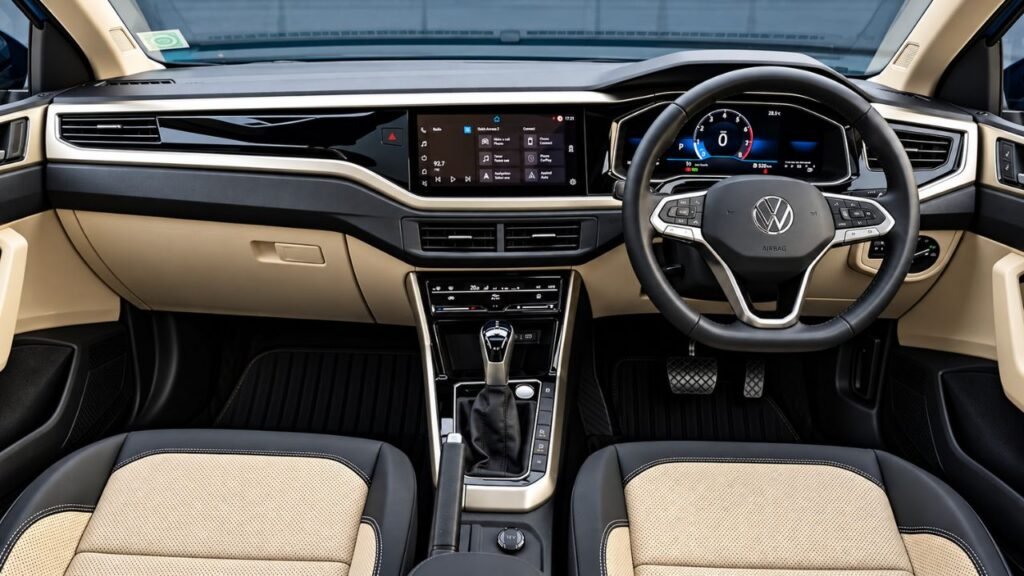
Higher variants come with a large touchscreen, a digital instrument cluster, wireless charging and a decent audio system. Comfort features depend on the trim:
- Sunroof: available from the Highline Plus onwards
- Ventilated front seats: available from the Topline
- Automatic climate control with rear AC vents
- Cruise control and rain-sensing wipers on higher trims
Rear-seat legroom is generous. Two adults can sit comfortably behind a six-footer up front. Three abreast is a squeeze, as in most sedans. The boot is over 500 litres, enough for a family weekend trip with room to spare. The rear seat also folds in a split to extend the load area, which makes the Volkswagen Virtus interior more practical than its sporty image suggests.
Materials are good for the price, with soft-feel surfaces on the upper dashboard and harder plastics lower down. That is the usual trade-off in this class, and it does not spoil the overall impression.
Read Also: Mahindra Scorpio N On Road Price, Mileage & Features
Volkswagen Virtus Mileage
Fuel economy is where many buyers hesitate about turbo-petrol cars, so here is a realistic picture. Listings show the Volkswagen Virtus mileage in the 18 to 20 kmpl range for the 1.0-litre car, and individual variants differ. The Topline automatic is listed at 18.45 kmpl. These are ARAI-certified numbers, and real-world figures tend to be lower.
| Driving Condition | 1.0 TSI | 1.5 TSI |
| City (heavy traffic) | 10–13 kmpl | 9–12 kmpl |
| Mixed | 13–16 kmpl | 12–14 kmpl |
| Highway (steady speeds) | 17–20 kmpl | 15–18 kmpl |
These ranges are approximate and depend on the driver, load and road. To get better Volkswagen Virtus mileage, keep tyre pressures correct, upshift early, avoid long idling and stay on top of the service schedule.
Volkswagen Virtus Top Speed
The Volkswagen Virtus top speed question comes up constantly, especially among buyers looking at the 1.5 TSI. The 1.0 TSI is generally reported to run out of breath somewhere around 180 to 190 km/h. The 1.5 TSI can go beyond that, with figures around 200 km/h or a little above depending on test conditions.
These are indicative numbers, not official claims, and they are only achievable in controlled, legal environments. What matters for daily use is that both engines hold triple-digit speeds with very little effort. The Volkswagen Virtus top speed is far more than most Indian roads will ever allow, so please observe speed limits.
Safety on the Volkswagen Virtus
Safety is a genuine strong point. The Volkswagen Virtus earned a five-star Global NCAP rating for both adult and child occupant protection. That result mattered to buyers and is one reason the car earned trust quickly.
Practical safety features include:
- Multiple airbags across the range, with more on higher variants
- Electronic stability control and traction control
- ABS with EBD
- ISOFIX child-seat mounts
- Tyre pressure monitoring on higher trims
The current car does not offer ADAS, which some newer rivals do. That gap is one of the things the facelift is expected to address.
Volkswagen Virtus Facelift 2026: What We Know
Few topics get as many searches as the Volkswagen Virtus facelift 2026. Volkswagen has not launched it at the time of writing, so most of what circulates is speculation.
Launch dates vary by source. One portal says the Volkswagen Virtus facelift 2026 is expected to launch in India in November 2026. Others point to October 25, 2026. Earlier reports pointed to late 2025 or the first half of 2026, and those windows have already passed. Treat any date as tentative until Volkswagen confirms it.
Reports suggest the update may bring new lighting signatures, a panoramic sunroof, better connectivity and ADAS in the top trims. The engines are expected to carry over unchanged. Estimates for the launch price range from about ₹11.99 lakh to a top end near ₹19.7 lakh, and a small premium over the current Volkswagen Virtus price is likely.
Should you wait? If you want ADAS and the newest features, and you can wait a few weeks or months, waiting makes sense. If you need a car now, or you want discounts on outgoing stock, buying the current model is a perfectly good decision, because the mechanical package is unlikely to change with the Volkswagen Virtus facelift 2026.
Which Volkswagen Virtus Variant Should You Buy?
Picking the right trim saves money and avoids regret. Here is a simple guide.
- Best value: Highline Plus with the 1.0 TSI. It adds the sunroof and useful comfort features at a sensible price.
- Best all-rounder: Topline with the 1.0 TSI automatic. You get ventilated seats and the full feature list with a relaxed drivetrain.
- Best for style: GT Line. It has the sporty look without the jump to the 1.5 TSI.
- Best for enthusiasts: GT Plus Sport. If you drive a lot on highways or simply love an engaging car, this is the one.
- Budget entry: Comfortline. It gives you the core Volkswagen Virtus experience at the lowest price, with fewer features.
Read Also: Mahindra Thar OG Price, Specs, Variants, Colors, & On-Road Cost
Why the Same Sedan Costs Differently in Every City
This question comes up constantly, and the answer is simple. Road tax percentage is the biggest reason for the gap between cities. Every state sets its own rate, so an identical car costs thousands of rupees more or less depending on your registration address.
RTO charges add a smaller layer. Fees for smart cards, hypothecation and number plates vary slightly by transport department, but they contribute far less than road tax.
Insurance also shifts. Third-party rates are set nationally, but comprehensive covers and add-ons vary by insurer, so shopping around can reduce the cost.
Common Mistakes Buyers Make While Checking Virtus Price
Many buyers compare only the ex-showroom price and skip the on-road calculation entirely. That leads to budget shortfalls once RTO fees and road tax get added at the dealership counter.
Insurance is often underestimated, particularly on the 1.5 TSI trims. Since the insured declared value rises with price, the premium rises too. Skipping a comparison across two or three insurers often results in overpaying by several thousand rupees.
Another mistake is ignoring bundled costs like extended warranty packages, accessories and handling fees. Dealerships often present these separately from the standard on-road price, so buyers assume they have budgeted correctly when extra charges appear on the final invoice.
Finally, some buyers confuse the GT Line with the GT Plus, then discover the engine and price gap only after booking. Always confirm the engine under the badge.
Practical Tips Before You Finalize Your Purchase
Ask your dealership for a written on-road price quote instead of relying on a verbal estimate. Verbal figures tend to shift once the invoice is generated, so a documented quote protects you.
Compare insurance quotes from at least two providers rather than accepting the default bundled policy. Standalone insurers frequently offer the same coverage at a lower premium.
Check waiting periods for your preferred variant, and take a test drive of both the 1.0 TSI and 1.5 TSI before deciding. Many buyers find the 1.0 TSI is all they need, which can save a large amount of money.
If the facelift matters to you, ask the dealer directly about expected timelines and current discounts on outgoing stock.
What’s Changing in Volkswagen Virtus Pricing Going Forward
Prices rarely stay fixed for long. Manufacturers usually revise pricing once or twice a year to adjust for input costs, and the Volkswagen Virtus will likely follow the same pattern.
The facelift is the bigger factor. When a refreshed model arrives, the outgoing version often gets discounts, while the new one comes in at a small premium.
State governments also revise road tax slabs periodically. Buyers planning a purchase should watch their state transport department’s announcements, since even a small tax revision can shift the on-road price noticeably.
Key Facts Worth Remembering
- The Volkswagen Virtus price starts at roughly ₹10.5 to ₹10.71 lakh ex-showroom and reaches about ₹19.2 lakh for the top variant.
- In Delhi, the on-road price runs from about ₹12.33 lakh to ₹22.19 lakh.
- Bangalore’s on-road prices are higher than Delhi’s because of Karnataka’s higher road tax.
- The GT Plus Sport is the flagship, with a 150 PS 1.5 TSI engine and a DSG gearbox.
- Claimed mileage is around 18 to 20 kmpl, and real-world figures are lower in the city.
- The facelift is expected in late 2026, but no launch has been confirmed.
- Colour, insurance add-ons and dealership charges can shift the final price beyond these estimates.
Final Thoughts
Checking the Volkswagen Virtus price properly means looking beyond the ex-showroom figure and understanding how your city’s tax structure changes the final number. Delhi buyers currently pay the least, while Bangalore buyers pay noticeably more for the same car. Before you book, get a written quote from your local dealership, compare insurance options instead of accepting the default package, and decide whether you want to wait for the Volkswagen Virtus facelift 2026. This approach gives you a realistic budget and avoids unpleasant surprises when the final invoice arrives.
FAQs
What is the Volkswagen Virtus price at the ex-showroom level?
The ex-showroom price ranges from about ₹10.5 lakh to ₹19.2 lakh, depending on the variant and the city.
What is the Volkswagen Virtus price in India for the top variant?
Top variant, the GT Plus Sport or Anniversary Edition, costs about ₹19.2 lakh ex-showroom.
What is the Volkswagen Virtus on road price in Delhi?
In Delhi, it starts at about ₹12.33 lakh for the base variant and reaches about ₹22.19 lakh for the Anniversary Edition.
What is the Volkswagen Virtus white price?
Solid white is usually offered at the standard variant price. Metallic or pearl shades may carry a small premium on some trims.
Is the Volkswagen Virtus mileage good?
Claimed figures are around 18 to 20 kmpl. Real-world figures are lower in city driving and closer to the claim on the highway.
How often does Volkswagen revise the Virtus price?
Manufacturers typically revise prices once or twice a year based on input costs and compliance requirements.





Leave a Reply